The Andhras are named in the Aitareya Brahmana (c. 800 BCE), by Megasthenes, and in Ashoka's edicts, where they are a people on the border of the empire[1][2]. The Puranas call the Satavahana rulers Andhras, Andhra-bhrityas and Andhra-jatiyas, and most scholars date the dynasty from the late 2nd century BCE to the early 3rd century CE[3][1]. Gautamiputra Satakarni, the king the dynasty is known for, left a coin and the Nashik prashasti that record his titles and power[3][4]. Today the name is carried by the Telugu-speaking people, who call themselves ఆంధ్రులు (Andhrulu), and by the state of Andhra Pradesh[5][1]. The extracts name no deity of their own; the Atlas gives Kanaka Durga of Vijayawada as the KulDevi.
01Faith and deities
The extracts name no deity of the Andhras themselves. The main deity is the KulDevi from the Atlas: Kanaka Durga of Vijayawada, near Amaravati
Kanaka Durga of Vijayawada, near Amaravati
The presiding goddess of the clan's homeland or capital: a link of place, not a recorded clan tie.
| Deity or tradition | Place in the clan's life | Evidence |
|---|---|---|
| Buddhism | Mahayana Buddhism is said to have developed among the Telugus; Amaravati stupa | [5][1] |
| Shiva | Festival deity of today's Telugu speakers (Maha Sivaratri) | [5] |
| Rama | Festival deity of today's Telugu speakers (Sri Rama Navami) | [5] |
| Hanuman | Festival deity of today's Telugu speakers (Hanuman Jayanti) | [5] |
| Krishna | Festival deity of today's Telugu speakers (Krishna Janmashtami) | [5] |
| Durga | Festival deity of today's Telugu speakers (Navaratri, Bathukamma) | [5] |
| Vinayaka | Festival deity of today's Telugu speakers (Vinayaka Chaviti) | [5] |
02Temples
The extracts name no temple built by the Andhras themselves. The Amaravati stupa, built in phases, is the earliest monument named.
Built by the clan
| Temple | Deity | Built by | When | Where |
|---|---|---|---|---|
| Amaravati Stupa | Buddhist stupa | Satavahana patronage (Amaravati, Nagarjunakonda, Sanchi)[3] | Built in phases, 3rd century BCE to c. 250 CE | Palnadu district, Andhra Pradesh[6] |
Given patronage or grants by the clan
| Temple | Deity | What the clan gave | When | Where |
|---|---|---|---|---|
| Nashik caves (Cave 3, Pandavleni) | Buddhist monks (deity not named) | Excavated under Gautamiputra and Nahapana; prashasti in Cave 3 | c. 150 CE (cave) | Nashik[4] |
Later temples in the clan's lands
| Temple | Deity | Built | Where | |
|---|---|---|---|---|
| Thousand Pillar Temple | Hanamkonda[5] | |||
| Ramappa (Rudreswara) Temple | Rudreswara | Palampet, UNESCO site[5] | ||
| Kota Gullu, Ghanpur | Kakatiya | Ghanpur[5] |
03Languages and scripts
| Language or script | Kind | Under the clan | Evidence |
|---|---|---|---|
| Telugu living | South-Central Dravidian language; spoken in Andhra Pradesh and Telangana; classical language from 2008 | The people's own name ఆంధ్రులు (Andhrulu)[5][6] | [6] |
| Telugu script (Vengi script) | Telugu script, called Vengi script for the old form; script name తెలుగు | The earliest Telugu words c. 400 BCE at Bhattiprolu; Kalamalla inscription 575 CE, the first long Telugu inscription[5][6] | [6] |
| Brahmi | Script of the Satavahana coins and inscriptions | Brahmi legend on the coins of Gautamiputra; prashasti of Gotami Balashri[4] | [4] |
| Early Telugu labels | tolacuvandru (తొలచువాండ్రు), a label at Keesaragutta c. 400 CE | Amaravati stupa has the Telugu word nagabu, c. 200 BCE (Mahadevan, as cited)[6] | [6] |
| Prakrit | Language of the Satavahana court (Maharashtri) | Hala's Gaha Sattasai[3] | [3] |
04Books and literature
The extracts name Vedic and Puranic texts that mention the Andhras. No book written by the Andhras is named; the Telugu literature below is that of the later language.
Written in the clan's lands during its era
| Work | Author | Kind | When | Link to the clan |
|---|---|---|---|---|
| Aitareya Brahmana | Brahmana text | Vedic | c. 800 BCE | The Andhras as descendants of Vishvamitra's sons[1] |
| Mahabharata | Vyasa, by tradition | Epic | c. 400 BCE–400 CE (composed) | Andhra infantry and alliances with the Pandavas and Kauravas[7][1] |
| Ramayana, Kishkindha Kanda | Valmiki | Epic | Undated in the extracts | Links the Andhras with the Godavari region[8][1] |
| Puranas (Bhagavata, Vayu, Skanda, Markandeya, Matsya) | Traditional | Puranic | Undated in the extracts | Mention the Andhras and the Satavahanas[1] |
| Gaha Sattasai | Hala | Prakrit verses | Satavahana period | [3] |
Given patronage by the clan
Not recorded.
05Thinkers and scholars
| Name | Field | Era | Contribution |
|---|---|---|---|
| Rapson | Cambridge History of India, vol. 1 (1922) | 1922 | Suggests the Andhras may have stayed non-Aryan in blood and speech[1] |
| Mahadevan | As cited in the Andhras article (title not in the extracts) | 2010 | Dravidian etymology for Andhra; Harappan links; migration from the Indus Valley[1] |
| Romila Thapar | As cited in the Andhras article | 1971 | Portrays the Andhras as mleccha kings[1] |
| Udyotana | Quoted description of the Andhras | 779 CE | Describes the Andhras as beautiful, fond of women and war, and great eaters[1] |
| Brown | Telugu language and literature | 1839 | Essay on the Language and Literature of Telugus[5] |
| Nannayya | Telugu language | 12th century | Andhra Sabda Cintamani[6] |
| Pavuluri Mallana | Telugu writer | c. 11th century | Sara Sangraha Ganitamu[6] |
| Atharvana Acharya | Telugu writer | 13th century | Atharvana Karikavali[5] |
| Appa Kavi | Telugu writer | 17th century | Named among Telugu thinkers[6] |
| Chinnaya Suri | Telugu language | 1807–1861 | Bala Vyakaranam[6] |
| Kandukuri Veeresalingam | Telugu writer | 1848–1919 | Rajasekhara Charitamu[6] |
| Gidugu Venkata Ramamurthy | Telugu language | His birthday, 29 August, is Telugu Language Day[6] | |
| Tanguturi Prakasam Panthulu | Named among Telugu thinkers | [5] | |
| Potti Sreeramulu | Named among Telugu thinkers | [5] |
Rapson, Mahadevan, Thapar and Udyotana write on the ancient Andhras. The other rows are Telugu-speaking writers of the later language, under claimed descent (see Today).
06Art and architecture
Amaravati is the early art site named for the Andhras in the extracts. Telugu is predominant in the evolution of Carnatic music (Telugu language article)[6].
Painting and wall art
Not recorded.
Sculpture and temple art
| Art form | What it is | Era | Evidence |
|---|---|---|---|
| Amaravati School | Amaravati (Andhra or Vengi) School; one of three major early schools with Mathura and Gandhara (Pal 1986, as cited) | c. 2nd century BCE – 3rd century CE | [5] |
| Amaravati figures with serpent heads | Some figures show serpent heads, possibly symbolic (Ganvir 2010, as cited) | Amaravati | [1] |
| Nagarjunakonda and Chandavaram | Art sites named with the Amaravati School | [5] |
Temple and building architecture
| Art form | What it is | Era | Evidence |
|---|---|---|---|
| Amaravati Stupa | Built in phases, Palnadu district | 3rd century BCE to c. 250 CE | [6] |
Weaving and textiles
Not recorded.
Clothing and jewellery
Not recorded.
Coins, pottery and crafts
Not recorded.
07History
Early mentions, c. 800 to 232 BCE
The Aitareya Brahmana (c. 800 BCE) makes the Andhras descendants of Vishvamitra's sons[1]. Megasthenes (c. 310 BCE) describes the Andhras as a distinct race with thirty fortified towns, 100,000 infantry, 2,000 cavalry and 1,000 elephants, and says their power once reached the upper Narmada[2][1][5].
Ashoka's Rock Edict 13 (Kalsi) names the Andhras. His edicts list them with the Pulindas as border peoples, 'unsubdued', and the Andhras are mentioned at his death in 232 BCE[1]. The Telugu people article dates Andhra as a Vedic janapada c. 1100–600 BCE and gives Asmaka among the sixteen Mahajanapadas (7th century BCE)[5].
The Satavahanas, late 2nd century BCE to early 3rd century CE
The Puranas call the Satavahana kings Andhras, Andhra-bhrityas and Andhra-jatiyas[1][3]. Most scholars date the dynasty from the late 2nd century BCE to c. 224 CE; some Puranic readings start it in the 3rd century BCE[3][1].
The Matsya Purana gives 30 Andhra kings ruling for 460 years; some manuscripts give 19 kings and 448.5 years (Dhavalikar)[1]. The capitals were Pratishthana (Paithan) and Amaravati (Dharanikota), with Junnar and Pauni[3]. The homeland is debated, between the eastern and western Deccan, Telangana, Bellary and Karnataka[3].
The Andhras' Satavahana kings traded with Rome (Wolpert 1989, as cited)[1].
Gautamiputra Satakarni
Gautamiputra Satakarni's reign is dated in several ways: 86–110 CE in one reckoning, c. 103–127 CE (Higham 2009), 106–130 CE (R. K. Singh 2013) and ca. 60–85 CE (Bhandare 1999)[4]. The Junagadh inscription of Rudradaman I says he defeated the Satavahana lord twice[4].
His Nashik prashasti, the record of his mother Gautami Balashri in Cave 3 in the 19th year of Pulumavi, calls him 'king of kings' and says he defeated the Shakas, Pahlavas and Yavanas and uprooted the Kshaharata family of Nahapana[4]. The prashasti also claims that he destroyed the pride of the Kshatriyas, stopped the mixing of the four varnas, and gave tax exemption to Buddhist monks[4].
After the Satavahanas
The Andhra Ikshvakus ruled in the Krishna valley in the late 2nd century CE, and Amaravati was prosperous in the 2nd century CE[5]. Vengi was a major Buddhist centre[1]. The later Telugu houses and the modern state follow.
Vishnukundinas and Pallavas, 4th to 9th century CE
The Vishnukundinas ruled in the 5th and 6th centuries CE. In 529 CE, Madhava Varma and four allied clans gained independence by defeating the Salankayanas in coastal Andhra; they were allied by marriage with the Vakatakas and Rashtrakutas[9]. The Telugu language article dates the Tummalagudem (Vishnukundina) inscription to the 5th century[6].
The Pallavas ruled from Kanchipuram from the 4th to the 9th century, including southern Telugu and northern Tamil lands. Mahendravarman I (571/590–630) and Narasimhavarman I (630–668) are named as rulers[9][5]. Xuanzang visited Kanchipuram, and Mahabalipuram survives[9].
Eastern Chalukyas of Vengi, from 624
Pulakesin II of Badami (609–642) conquered Vengi after the Vishnukundina remnants; in 624 he installed his brother Kubja Vishnuvardhana (624–641) there, who later became independent[10].
Their domain ran from Srikakulam to Nellore and lasted nearly four centuries[9]. Their capitals were Pishtapura (Pitapuram), Vengi (Pedavegi, near Eluru) and Rajamahendravaram[10]. Under Rajaraja Narendra (1018/1022–1061) the poet Nannaya partly translated the Mahabharata in the 11th century[9][10].
Kakatiyas of Warangal, to 1323
The Kakatiyas were vassals of the Western Chalukyas of Kalyani near Warangal. Prola II (1110–1158) became independent and made Hanumakonda his capital; Prataparudra I (1158–1195) built Warangal as a second capital[9].
Ganapati Deva (from 1199) was the first since the Satavahanas to unite the Telugu lands, and he defeated the Velanati Chodas in 1210[9]. The Kakatiyas claimed descent from Karikala Chola[9]. Rudrama Devi (died 1289 or 1295) was succeeded by her grandson Prataparudra. Tikkana's Mahabharata belongs to this period; the Telugu language article dates his chapters 4–18 to 1205–1288[9][6].
Attacks began in 1310. The Delhi Sultanate took Warangal in 1323 (Ulugh Khan; Ghiyath al-Din Tughluq)[9][5].
Vijayanagara, 1336 to 1646
Harihara I and Bukka Raya I (Sangama) founded the empire on 18 April 1336[11]. The history article calls Harihara and Bukka former Kakatiya treasury officers or Hoysala commanders; it says they were taken to Delhi in 1323, made governors of Kampili, and reverted to Hinduism under Vidyaranya. Harihara I reigned 1336–1356[9]. Its origin is disputed: Kannada Hoysala commanders or Telugu people linked to the Kakatiyas[11].
The capitals were Vijayanagara (1336–1565), Penukonda (1565–1592), Chandragiri (1592–1604) and Vellore (1604–1646). The Battle of Talikota on 23 January 1565 was followed by the execution of Rama Raya; the last ruler was Sriranga III (1642–1646)[11].
Krishnadevaraya (1509–1529) took Kalinga from the Gajapatis, and the article gives Raichur (1520) as an event of his reign. Telugu became prominent under the later emperors, especially Krishnadevaraya[11].
Qutb Shahis of Golconda, 1518 to 1687
Quli Qutb Mulk, a Shia Turkmen from Hamadan who had served the Bahmanis with the title Qutb-ul-Mulk, founded the Qutb Shahi dynasty of Golconda (1518–1687)[12][9]. He reigned from 7 December 1518 to 2 September 1543, and in 1513 had fought Krishnadevaraya at Pangal[12].
He occupied Vengi between the Krishna and Godavari; a treaty with Vishwanath Dev Gajapati fixed the Godavari as the border[9]. He was assassinated in 1543 by his son Jamsheed Quli, and Ibrahim Quli fled to Vijayanagara[12]. Ibrahim Quli invaded Kalinga in 1571, and Aurangzeb annexed Golconda in 1687[9].
The history article describes the dynasty as tolerant of Telugu culture; the Quli Qutb Shah article does not mention Telugu patronage[9][12].
Northern Circars, 1753 to 1778
In 1753 Salabat Jang ceded Chicacole, Ellore and Rajahmundry to Bussy. The British defeated the French at Chandurthi in 1758. In 1765 Robert Clive obtained the four circars from Shah Alam II, and a treaty with Nizam Ali in 1778 added another[9].
British rule, 1611 to 1922
The British set up a trading post at Machilipatnam in 1611[9]. In 1792 Vijaya Rama Gajapati Raju of Vizianagaram was defeated by the British[9]. In 1801 the Carnatic was annexed into the Madras Presidency[9]. The Dowleswaram anicut, built by Arthur Cotton, dates from 1850[9]. The No Tax campaign at Chirala–Perala (1919) and the Rampa revolt (1922) followed[9].
Hyderabad State, 1948
The Nizam, Mir Osman Ali Khan, ruled Hyderabad State. The Indian Army annexed it in 1948 (Operation Polo), and nine Telugu-speaking districts were within it from 1948 to 1956[9].
Andhra State, 1952 to 1953
Potti Sreeramulu began a fast on 19 October 1952 at Bulusu Sambamurti's house in Madras and died around midnight on 15/16 December 1952. Seven people died in clashes at Anakapalle and Vijayawada. Nehru announced the state on 19 December 1952[13].
Andhra State was created on 1 October 1953 from eleven districts of Madras, with Kurnool as its seat, and was the first linguistic state of independent India[13][9]. Tanguturi Prakasam Pantulu was its first chief minister[9].
Andhra Pradesh, from 1956
On 3 December 1955 the Hyderabad MLAs stood at 103 for merger, 16 neutral and 29 against, with no formal vote. The States Reorganisation Commission reported on 30 September 1955, and after the Gentlemen's Agreement Andhra State merged with the Telugu-speaking districts of Hyderabad State on 1 November 1956 as Andhra Pradesh, with Hyderabad as its capital[13][9]. Neelam Sanjiva Reddy was its first chief minister[9].
Telangana, 2013 to 2014
The CWC resolution of 30 July 2013 is recorded, and a Group of Ministers under Sushil Kumar Shinde is recorded for August 2013. The Andhra Pradesh assembly rejected the 2013 version on 30 January 2014[9][14].
The Bill was introduced in the Lok Sabha on 13 February 2014 and approved by it on 18 February 2014; the Rajya Sabha took it up on 20 February 2014. Assent is given as 1 March 2014[14]. Telangana was formed from ten districts, with Hyderabad as a common capital for up to ten years[9][14]. The appointed day was 2 June 2014, when Telangana came into existence[14][9].
Andhra Pradesh after 2014
The Act's appointed day was followed by the naming of Amaravati as capital on 1 April 2015. A three-capital bill of January 2020 (Visakhapatnam, Amaravati and Kurnool) was later held by the Andhra Pradesh High Court to be beyond legislative competence[14].
08Journey and migrations
The Andhras' origin is debated. Mahadevan (2010, as cited) proposes migration from the Indus Valley into the Deccan after the Indus Valley declined, and a Dravidian etymology for the name[1].
| When | From | To | Why | Evidence |
|---|---|---|---|---|
| After the Indus Valley declined (proposed) | Indus Valley | The Deccan | Migration proposed by Mahadevan (2010, as cited) | [1] |
| Satavahana period | Homeland debated | Pratishthana and Amaravati | Capitals of the dynasty | [3] |
09Seats and lands
| Place | Role | Where today |
|---|---|---|
| Andhradesa | The eastern Deccan (Andhradesa) | Andhra Pradesh, Telangana, Maharashtra |
| Krishna and Godavari deltas | Core homeland of the Andhras; Kolleru Lake lies between them | Andhra Pradesh (Telugu people article) |
| Dhanyakataka (Amaravati) | Capital and homeland site in the Atlas; the Amaravati stupa is built here | Palnadu district, Andhra Pradesh[6] |
| Pratishthana | Satavahana capital | Paithan |
| Nagadesa | Around Amaravati, ruled by Nagas | Amaravati area[1] |
| Andhrapura | Political centre of the Andhras | Not stated |
| Vengi | Major Buddhist centre | Not stated |
| Nashik caves | Excavated under Gautamiputra and Nahapana; prashasti in Cave 3 | Nashik[4] |
| Hanumakonda | Capital of Prola II (1110–1158), Kakatiya | Not stated |
| Warangal | Second capital built by Prataparudra I; besieged by the Delhi Sultanate in 1323 | Not stated |
| Pishtapura | Eastern Chalukya capital | Pitapuram |
| Rajamahendravaram | Eastern Chalukya capital | Not stated |
| Vijayanagara | Capital of the empire, 1336–1565; then Penukonda, Chandragiri and Vellore | Not stated |
| Golconda | The Qutb Shahi dynasty of Golconda (1518–1687) | Not stated |
| Vizianagaram | Vijaya Rama Gajapati Raju of Vizianagaram, defeated by the British in 1792 | Not stated |
| Kurnool | Seat of Andhra State from 1 October 1953 | Rayalaseema, Andhra Pradesh[13] |
| Hyderabad | Capital of Andhra Pradesh from 1956; common capital for up to ten years after 2014 | Not stated |
10Notable figures
| Name | Role | Era | Known from |
|---|---|---|---|
| Vishvamitra legend | Sage whose cursed sons became the Andhras, Pundras, Sabaras, Pulindas and Mutibas | Aitareya Brahmana, c. 800 BCE | [1] |
| Satyaki legend | Had an Andhra infantry force (Karna Parva) | Mahabharata | [1] |
| Shudraka (Suraka) legend | First king of the Andhra-bhrityas | Puranic (undated) | Skanda Purana, Kumarika Khanda[1] |
| Vijaya Satakarni | Named for a pillar inscription | 1st century CE | [6] |
| Gautamiputra Satakarni (𑀕𑁄𑀢𑀫𑀺𑀧𑀼𑀢 𑀲𑀸𑀢𑀓𑀡𑀺) | Satavahana king; defeated the Shakas, Pahlavas and Yavanas; uprooted Nahapana's family | c. 86–110 CE (dates disputed) | [4] |
| Vasishthiputra Pulumavi | Successor of Gautamiputra; coins with double-masted ships | After Gautamiputra | [4][3] |
| Gotami Balashri | Mother of Gautamiputra; her prashasti is in Cave 3 | 19th year of Pulumavi | [4] |
| Hala | Credited with the Gaha Sattasai | Satavahana period | [3] |
| Madhava Varma | Vishnukundina; with four allied clans defeated the Salankayanas in coastal Andhra | 529 CE | [9] |
| Mahendravarman I | Pallava ruler of Kanchipuram | 571/590–630 | [9] |
| Narasimhavarman I | Pallava ruler of Kanchipuram | 630–668 | [9] |
| Pulakesin II | Of Badami; conquered Vengi and installed his brother there | 609–642 | [10] |
| Kubja Vishnuvardhana | Brother of Pulakesin II; governor of Vengi, later independent | 624–641 | [10] |
| Rajaraja Narendra | Eastern Chalukya ruler; under him Nannaya partly translated the Mahabharata | c. 1018/1022–1061 | [10][9] |
| Prola II | Kakatiya; became independent and made Hanumakonda his capital | 1110–1158 | [9] |
| Prataparudra I | Kakatiya; built Warangal as a second capital | 1158–1195 | [9] |
| Ganapati Deva | Kakatiya; first since the Satavahanas to unite the Telugu lands | from 1199 | [9] |
| Rudrama Devi | Kakatiya; succeeded by her grandson Prataparudra | died 1289 or 1295 | [9] |
| Harihara I | Founder of Vijayanagara with Bukka Raya I | 1336–1356 | [11][9] |
| Krishnadevaraya | Vijayanagara emperor; took Kalinga from the Gajapatis | 1509–1529 | [11] |
| Quli Qutb Mulk | Founder of the Qutb Shahi dynasty of Golconda | 1518–1543 | [12][9] |
| Ibrahim Quli | Qutb Shahi ruler; invaded Kalinga | 1571 | [9] |
| Robert Clive | Obtained the four circars from Shah Alam II | 1765 | [9] |
| Vijaya Rama Gajapati Raju | Of Vizianagaram; defeated by the British | 1792 | [9] |
| Potti Sreeramulu | Fast for Andhra State; died after the fast | 19 Oct – 15/16 Dec 1952 | [13] |
| Tanguturi Prakasam | First chief minister of Andhra State | 1 Oct 1953 – 15 Nov 1954 | [13] |
| Neelam Sanjiva Reddy | First chief minister of Andhra Pradesh | from 1956 | [9] |
11Allies, rivals and marriages
| People | Relationship | When |
|---|---|---|
| Mauryans | Megasthenes: the Andhras are second only to the Mauryans in military strength | c. 310 BCE (Megasthenes) |
| Pandavas | Allies of the Andhras in the Mahabharata (5.140, 5.161–162) | Mahabharata |
| Kauravas | Allies of the Andhras in the Mahabharata (5.140, 5.161–162) | Mahabharata |
| Pulindas | Named with the Andhras as border peoples in Ashoka's edicts | 3rd century BCE (Ashoka) |
| Dasyus and Mlecchas | Called Dasyus or Mlecchas in the Brahmanas and the Bhagavata | Brahmanas; Bhagavata Purana |
| Satavahanas | Called Andhras, Andhra-bhrityas and Andhra-jatiyas in the Puranas | Satavahana period |
| Salankayanas | Defeated in coastal Andhra by Madhava Varma and four allied Vishnukundina clans | 529 CE |
| Vakatakas and Rashtrakutas | Allied by marriage with the Vishnukundinas | 5th–6th century CE |
| Western Chalukyas of Kalyani | The Kakatiyas were their vassals near Warangal | Before Prola II (1110–1158) |
| Rashtrakutas | Incursions into the Eastern Chalukya domain; Vijayaditya III checked them | 641–705 |
| Cholas | Kulottunga Chola I was the son of Eastern Chalukya Rajaraja Narendra | Rajaraja Narendra (c. 1018/1022–1061) |
| Velanati Cholas | Defeated by Ganapati Deva of the Kakatiyas | 1210 |
| Delhi Sultanate | Took Warangal from the Kakatiyas; Harihara and Bukka were taken to Delhi | 1323 |
| Bahmanis | Quli Qutb Mulk served them; tribute wars with Vijayanagara | Vijayanagara period |
| Gajapatis of Odisha | Rivals of Vijayanagara; Krishnadevaraya took Kalinga from them | 1509–1529 |
| Qutb Shahis | Quli Qutb Shah fought Krishnadevaraya at Pangal | 1513 |
| Vishwanath Dev Gajapati | A treaty with the Qutb Shahis fixed the Godavari as the border | Qutb Shahi period (undated) |
| Aurangzeb | Annexed Golconda | 1687 |
| French (Bussy) | Chicacole, Ellore and Rajahmundry ceded to Bussy; British defeated the French at Chandurthi | 1753; 1758 |
| Nizam Ali | A treaty with him in 1778 added another circar | 1778 |
12Society and livelihood
The Andhras' society is in the extracts through Megasthenes, the Mahabharata and the Satavahana inscriptions: an army, walled towns and an agrarian economy with trade.
Government and social order
| Institution or group | What it was | Evidence |
|---|---|---|
| Army | Megasthenes: 100,000 infantry, 2,000 cavalry and 1,000 elephants; the Mahabharata describes the Andhra infantry as long-haired, ornamented and carrying swords, nooses and bows[2][1] | [2] |
| Walled towns | Megasthenes: thirty fortified towns[1] | [2] |
| Satavahana administration | Ahara divisions under amatya or amaca; nagara, nigama and gama[4] | [4] |
| Buddhist monks | Given tax exemption and a village grant in the Nashik prashasti[4] | [4] |
Livelihood over time
| Era | Livelihood | Evidence |
|---|---|---|
| Satavahana era | Agrarian economy; trade with Rome[1] | [1] |
| Today (Telugu-speaking regions) | Rice is the staple, with ragi in Rayalaseema and Palnadu; Andhra Pradesh is the leading producer of red chilli and rice[5] | [5] |
13Sub-clans and related clans
The Andhras' own sub-clans and branches are not named in the extracts. The list below gives the sub-groups, ruling houses and related peoples the extracts name, with their master-sheet IDs where they have one.
| Clan | Relation | Where | Size | In the Atlas | Evidence |
|---|---|---|---|---|---|
| Andhra-bhrtya | Sub-clan | Satavahana court (servants of the Andhra kings) | same name as ANC-163: check | [1] | |
| Andhra-jati | Branch | same name as ANC-168: check | [1] | ||
| Andhrarakas | Branch | The south (Markandeya Purana) | same name as ANC-165: check | [1] | |
| Nagas | Related people | Nagadesa, around Amaravati | ANC-088 | [1] | |
| Satavahana | Dynasty from this clan | Pratishthana (Paithan); Amaravati (Dharanikota) | same name as ANC-183: check | [3] | |
| Andhra Ikshvaku | Dynasty from this clan | Krishna valley | same name as ANC-164: check | [5] | |
| Vishnukundina | Dynasty from this clan | Tummalagudem | same name as ANC-233: check | [6] | |
| Pallava | Dynasty from this clan | Kanchipuram | same name as ANC-242: check | [5] | |
| Salankayana | Dynasty from this clan | new clan candidate | [5] | ||
| Cholas | Dynasty from this clan | ANC-029 | [5] | ||
| Eastern Chalukya | Dynasty from this clan | new clan candidate | [5] | ||
| Kakatiya | Dynasty from this clan | Warangal; 1163–1323 | same name as ANC-170: check | [5] | |
| Musunuri Nayaka | Dynasty from this clan | same name as SUB-305: check | [5] | ||
| Qutb Shahi | Dynasty from this clan | Golconda | new clan candidate | [5] | |
| Kandyan Nayaks | Dynasty from this clan | Sri Lanka (last Sri Lankan dynasty, of Telugu descent) | same name as SUB-152: check | [5] | |
| Mauryas | Related people | ANC-157 | [1] | ||
| Gurjaras | Related people | ANC-038 | [1] | ||
| Gonds | Related people | ST-088 | [1] | ||
| Pundras | Related people | Named alongside the Andhras | ANC-106 | [1] | |
| Pulindas | Related people | Named alongside the Andhras | ANC-105 | [1] | |
| Kalingas | Related people | Named alongside the Andhras | ANC-045 | [1] | |
| Kuntalas | Related people | Named alongside the Andhras | ANC-066 | [1] | |
| Bhojas | Related people | Named alongside the Andhras | ANC-024 | [1] | |
| Kambojas | Related people | Named alongside the Andhras | ANC-046 | [1] | |
| Khasas | Related people | Named alongside the Andhras | ANC-053 | [1] | |
| Salvas (Salwas) | Related people | Named alongside the Andhras | ANC-112 | [1] | |
| Matsyas | Related people | Named alongside the Andhras | ANC-080 | [1] | |
| Kurus | Related people | Named alongside the Andhras | ANC-069 | [1] | |
| Yavanas (Yonas) | Related people | Named alongside the Andhras | ANC-154 | [1] | |
| Asmakas (Assakas) | Related people | Named alongside the Andhras | ANC-013 | [1] | |
| Sabaras | Related people | Named alongside the Andhras | same name as ANC-283: check | [1] | |
| Mutibas | Related people | Named alongside the Andhras | same name as ANC-087: check | [1] | |
| Kutas | Related people | Named alongside the Andhras | new clan candidate | [1] | |
| Maheyas | Related people | Named alongside the Andhras | new clan candidate | [1] | |
| Kakshas | Related people | Named alongside the Andhras | new clan candidate | [1] | |
| Samudranishkutas | Related people | Named alongside the Andhras | new clan candidate | [1] | |
| Dravidas | Related people | Named alongside the Andhras | new clan candidate | [1] | |
| Kanchis | Related people | Named alongside the Andhras | new clan candidate | [1] | |
| Maulikas | Related people | Named alongside the Andhras | new clan candidate | [1] | |
| Bhogavardhanas | Related people | Named alongside the Andhras | new clan candidate | [1] | |
| Naisikas | Related people | Named alongside the Andhras | new clan candidate | [1] | |
| Nabhakas | Related people | Named alongside the Andhras | same name as ANC-213: check | [1] | |
| Nabhapamkits | Related people | Named alongside the Andhras | same name as ANC-214: check | [1] | |
| Pitinikas | Related people | Named alongside the Andhras | new clan candidate | [1] | |
| Sakas | Related people | Named alongside the Andhras | same name as ANC-282: check | [1] | |
| Gakas | Related people | Named alongside the Andhras | new clan candidate | [1] | |
| Yadav | Related people | Telugu-speaking regions | new clan candidate | [5] | |
| Reddy | Related people | Telugu-speaking regions | new clan candidate | [5] | |
| Vishwakarma (Vishwabrahmana) | Related people | Telugu-speaking regions | new clan candidate | [5] | |
| Kapu / Balija | Related people | Telugu-speaking regions | new clan candidate | [5] | |
| Kamma | Related people | Telugu-speaking regions | new clan candidate | [5] | |
| Raju | Related people | Telugu-speaking regions | new clan candidate | [5] | |
| Komati | Related people | Telugu-speaking regions | same name as NE-030: check | [5] | |
| Boya | Related people | Telugu-speaking regions | same name as SUB-147: check | [5] | |
| Devanga | Related people | Telugu-speaking regions | same name as SUB-149: check | [5] | |
| Padmasali | Related people | Telugu-speaking regions | same name as SUB-180: check | [5] | |
| Bhatraju | Related people | Telugu-speaking regions | new clan candidate | [5] | |
| Velama | Related people | Telugu-speaking regions | new clan candidate | [5] | |
| Goud | Related people | Telugu-speaking regions | new clan candidate | [5] | |
| Mala | Related people | Telugu-speaking regions | same name as SUB-160: check | [5] | |
| Madiga | Related people | Telugu-speaking regions | same name as SUB-155: check | [5] | |
| Jangam | Related people | Telugu-speaking regions | new clan candidate | [5] | |
| Kuruba | Related people | Telugu-speaking regions | same name as SUB-154: check | [5] | |
| Relli | Related people | Telugu-speaking regions | same name as SUB-186: check | [5] | |
| Vaddera | Related people | Telugu-speaking regions | new clan candidate | [5] | |
| Telugu Brahmin | Related people | Andhra Pradesh and Telangana | same name as SUB-197: check | [15] | |
| Vaidiki | Branch | Telugu Brahmins | new clan candidate | [15] | |
| Velanati | Branch | Vaidiki Brahmins | new clan candidate | [15] | |
| Veginati | Branch | Vaidiki Brahmins | new clan candidate | [15] | |
| Telaganya | Branch | Vaidiki Brahmins | new clan candidate | [15] | |
| Mulukanadu | Branch | Vaidiki Brahmins | new clan candidate | [15] | |
| Niyogi | Branch | Telugu Brahmins | new clan candidate | [15] | |
| Aruvela | Branch | Niyogi Brahmins | new clan candidate | [15] | |
| Pakanati | Branch | Niyogi Brahmins | new clan candidate | [15] | |
| Prathamasaki | Branch | Niyogi Brahmins | new clan candidate | [15] | |
| Golkonda Vyapari | Branch | Telugu Brahmins | new clan candidate | [15] | |
| Deshastha | Branch | Telugu Brahmins | new clan candidate | [15] | |
| Dravida (Tamil migrants) | Related people | Telugu Brahmins; Tamil migrants of the Chalukya era | new clan candidate | [15] |
Clans marked "new clan candidate" are not in the Atlas yet.
14Surnames
No surname of the ancient Andhras is named. Raju is given as a caste name in the Telugu people article; no count is sourced.
| Surname | Clan or sub-clan | Where | People with this surname | Also used by other communities |
|---|---|---|---|---|
| Raju | Raju (caste name in the Telugu people article) | Telugu-speaking regions | not yet counted | Not checked |
Counts are of everyone with the surname, from the cited source and year, not only members of this clan. A surname shared with other communities says nothing about any one person's origin.
15Songs and music
No song of the ancient Andhras is in the extracts. The Telugu performing arts named in the Telugu people article are listed below under claimed descent.
None recorded yet.
Instruments and styles
| Instrument or style | What it is | Evidence |
|---|---|---|
| Kuchipudi | Named in the Telugu people article; from Krishna district | [5] |
| Andhra Natyam | Named in the Telugu people article | [5] |
| Vilasini Natyam | Named in the Telugu people article | [5] |
| Nava Janardhanam | Named in the Telugu people article | [5] |
| Perini Sivatandavam | Named in the Telugu people article | [5] |
| Oggu Katha | Named in the Telugu people article | [5] |
| Burra Katha | Named in the Telugu people article | [5] |
| Tholu Bommalata | Shadow puppetry; the article dates it to the 3rd century BCE and links it to Indonesian wayang | [5] |
16Poems, lullabies and children's rhymes
Telugu verse from the 11th century onward, and a performance tradition of over five centuries.
Andhra Mahabharatam
Nannaya (11th century);[6]
Ranganatha Ramayanam
Gona Budda Reddy[6]
Sumati Satakam
Attributed to Baddena Bhupaludu; English by C. P. Brown in the 1840s[6]
Avadhanam
A performance tradition described in the Telugu language article[6]
Kanyasulkam
Named in the Telugu language article; rights not checked[6]
17Stories, legends and proverbs
Stories and legends
| Story | What happens | Told by | Evidence |
|---|---|---|---|
| Vishvamitra's curse on his sons | Vishvamitra's sons are cursed, and their descendants become the Andhras, Pundras, Sabaras, Pulindas and Mutibas | Aitareya Brahmana | [1] |
| Shudraka or Suraka | The Skanda Purana gives the origin of Shudraka, the first king of the Andhra-bhrityas | Skanda Purana (Kumarika Khanda) | [1] |
Proverbs and sayings
Not recorded.
18Festivals and fairs
| Festival or fair | When | Where | What happens |
|---|---|---|---|
| Bhogi, Makara Sankranti, Kanuma | January | Telugu regions | Named in the Telugu people article[5] |
| Vaikunta Ekadasi | Not dated | Telugu regions | Named in the Telugu people article[5] |
| Maha Sivaratri | Not dated | Telugu regions | Named in the Telugu people article[5] |
| Ugadi | March or April (Telugu New Year) | Telugu regions | Named in the Telugu people article[5] |
| Sri Rama Navami, Hanuman Jayanti | Not dated | Telugu regions | Named in the Telugu people article[5] |
| Bonalu | Ashada masam | Telugu regions | Named in the Telugu people article[5] |
| Varalakshmi Vratam, Krishna Janmashtami, Vinayaka Chaviti | August | Telugu regions | Named in the Telugu people article[5] |
| Bathukamma | Nine days of Navaratri | Telugu regions | Named in the Telugu people article[5] |
| Dasara, Atla Tadde, Deepavali, Nagula Chavithi | Dasara and Deepavali: not dated; Atla Tadde: 3rd day of the bright half of Ashviyuja | Telugu regions | Named in the Telugu people article[5] |
| Telugu Language Day | 29 August | Telugu regions | Birthday of Gidugu Venkata Ramamurthy[6] |
19Food, dress and games
Food
| Item | What it is | Evidence |
|---|---|---|
| Cuisine | Tangy, hot and spicy | [5] |
| Rice and ragi | Rice is the staple; ragi (రాగి) is eaten in Rayalaseema and Palnadu | [5] |
| Red chilli | Andhra Pradesh is the leading producer of red chilli and rice | [5] |
Dress
| Item | What it is | Evidence |
|---|---|---|
| Uttareeyam / Pai Pancha | Men's wear | [5] |
| Pancha | Men's wear | [5] |
| Jubba | Men's wear | [5] |
| Lungi | Men's wear | [5] |
| Langa voni | Women's wear | [5] |
| Cheera | Women's wear | [5] |
Games and martial arts
Not recorded.
Tags: living still practised · revived brought back after a break · lost known only from records · research reported but not yet confirmed from a source. Songs and poems under copyright are listed by title only; restricted or sacred material is noted without its content.
20Status today
The Andhras are a historical people. Their name is carried by the Telugu-speaking people, who call themselves ఆంధ్రులు, and by Andhra Pradesh[5][1]. That line of descent is claimed, not proven, by the extracts.
Who carries the name today
Recognised heritage
| What | Recognition | Evidence |
|---|---|---|
| Andhra Pradesh | The state takes its name from the Andhra tribe and region | [1] |
| Telugu | Classical language, recognised in 2008 | [6] |
Not yet reviewed by the community.
21For children
The sons of the sage
Long ago, a wise sage named Vishvamitra had many sons. The Aitareya Brahmana tells that some of his sons were cursed. Their children became new peoples. One of these peoples was the Andhras, who lived in the eastern Deccan. The others were the Pundras, the Sabaras, the Pulindas and the Mutibas. The Greek writer Megasthenes wrote that the Andhras had thirty walled towns. Their rulers were called the Satavahanas. Today the name Andhra lives on in the state of Andhra Pradesh, and the Telugu-speaking people call themselves Andhrulu.
22Across the project
| Project | What carries this clan | Status |
|---|---|---|
| Atlas of the Janas | Homeland at Dhanyakataka (Amaravati) in the Atlas; no footprint file yet | To check |
| KulDevi and GrahDevi | Kanaka Durga of Vijayawada, near Amaravati; planets take Navadurga forms | From the Atlas |
| Planet naming | Not yet checked against the Tier registers | To check |
| Renaming and waters | Krishna and Godavari deltas named as the core homeland; no name drawn from them yet | — |
23Open questions
- Is there a sourced sub-clan, gotra or family name for the ancient Andhras (intiperu or other)? None is in the extracts.
- Which Satavahana reign dates are accepted? Four are given in the Gautamiputra article.
- Does the Andhra Mahabharatam need a rights check before any excerpt is shown?
- What do the Telugu proverb collection (archive.org) and the CIIL Sanchika folklore items say? Not yet read.
- Adi Andhra (en.wikipedia.com) and Ragam (surname) are not yet read.
- Is there a documented Andhra totem, seal, war cry or guardian tree? None in the extracts.
- Which of the Telugu caste groups listed as related are accepted as Andhra-descended in the community's own account?
- Conflict: the Act's Gazette date is 1 March 2014 in the History of Andhra Pradesh article and 2 March 2014 in the Andhra Pradesh Reorganisation Act article, which gives assent as 1 March. Which date is the Gazette publication?
- Conflict: the Eastern Chalukya article gives their rule over Vengi as ending c. 1001 in the text but c. 1189 in its infobox. Which end date is right?
- Kakatiya start date: the Telugu people article gives 1163, but the History of Andhra Pradesh article gives only Prola II (1110–1158) and Prataparudra I (1158–1195) and no start date. The Kakatiya dynasty extract also gives 1163 (Anumakonda inscription), but no key for it is on this page; the 1163 start is not used until it is sourced.
- The extracts stop at 2023. What is the status of the Amaravati capital and the three-capital question since then?
- Not yet read for the extend topic: the Vishnukundina dynasty, Krishnadevaraya and Siege of Warangal (1323) articles, and the Britannica Northern Sarkars entry.
24Astitva
अस्तित्व · being, existence: everything by which the clan is known
Documented: the coins and the Nashik prashasti of the Satavahana house, which the Puranas call Andhra[3][4]. No seal, totem or war cry is tied to the Andhras alone in the extracts.
Every clan has every accessory, royal objects included. Each one says how it is known: Documented This clan's own object is recorded. · Regional tradition Recorded for the region or for peoples like this one, not for this clan. · Design Made for this project, with no historical claim. · Under research To be found for this clan from sources. Legends and titles are written in the clan's own script.
1. Seals and coins
| Accessory | For this clan | Basis |
|---|---|---|
| B1 Rajamudra · house seal Round seal with the clan emblem and a short legend in the clan's script | Not yet designed for this clan | Design |
| B2 Anguliya-mudra · signet ring Personal seal ring of the head of the house | Not yet designed for this clan | Design |
| B3 Chhapa · house stamp Ink or block stamp for letters, goods and cloth | Not yet designed for this clan | Design |
| B4 Tamrapatra · charter plate Copper-plate grant on a ring, closed with the house seal | Not yet designed for this clan | Design |
| B5 Shreni-mudra · guild or trade seal Seal for the clan's trade, craft or caravan | Not yet designed for this clan | Design |
| C1 Clan coin Emblem or deity on one side, a legend in the clan's script | Silver coin of Gautamiputra Satakarni, re-struck on Nahapana's silver: an arched chaitya ('three-arched hill') and the Ujjain symbol 𑀕𑁄𑀢𑀫𑀺𑀧𑀼𑀢 𑀲𑀸𑀢𑀓𑀡𑀺 Gotamiputa Satakani · “King Lord Satakarni, son of Gotami” | Documented |
| C2 Coin die The die that strikes the coin | Not yet designed for this clan | Design |
2. Living symbols
| Accessory | For this clan | Basis |
|---|---|---|
| I1 Totem trio The tree, bird and animal the clan protects | Not yet found for this clan | Under research |
| I2 Kaval-maram · guardian tree The tree that stands at the clan's seat | Not yet found for this clan | Under research |
3. Stone and gate
| Accessory | For this clan | Basis |
|---|---|---|
| G1 Torana · gateway The built gate of the seat; the cloth Toran hangs in it | Not yet designed for this clan | Regional tradition |
| G2 Viragallu · hero stone Carved panel stone for a member who died defending the clan | Not yet designed for this clan | Regional tradition |
| G3 Kula-shila · clan stones Standing and table stones that remember the ancestors | Not yet designed for this clan | Design |
| G4 Jayastambha · victory pillar A pillar raised for a victory | Not yet designed for this clan | Design |
| G5 Sima-shila · boundary stone Marks the clan's land, with a line in the native script | Not yet designed for this clan | Design |
4. Sounds
| Accessory | For this clan | Basis |
|---|---|---|
| D1 Pancha-mahashabda · five great sounds The right to five instruments | Not yet designed for this clan | Design |
| D2 Shankha · clan conch The clan's own named war conch | Not yet designed for this clan | Design |
| D3 Murasu · house drums Three drums: war, charity and justice | Not yet designed for this clan | Design |
5. Kit: colours, metals and emblems
The Satavahana coins and the Nashik prashasti are the documented symbols of the house the Puranas call Andhra[3][4]. The emblem in the Atlas is a project design.
| Part of the kit | This clan |
|---|---|
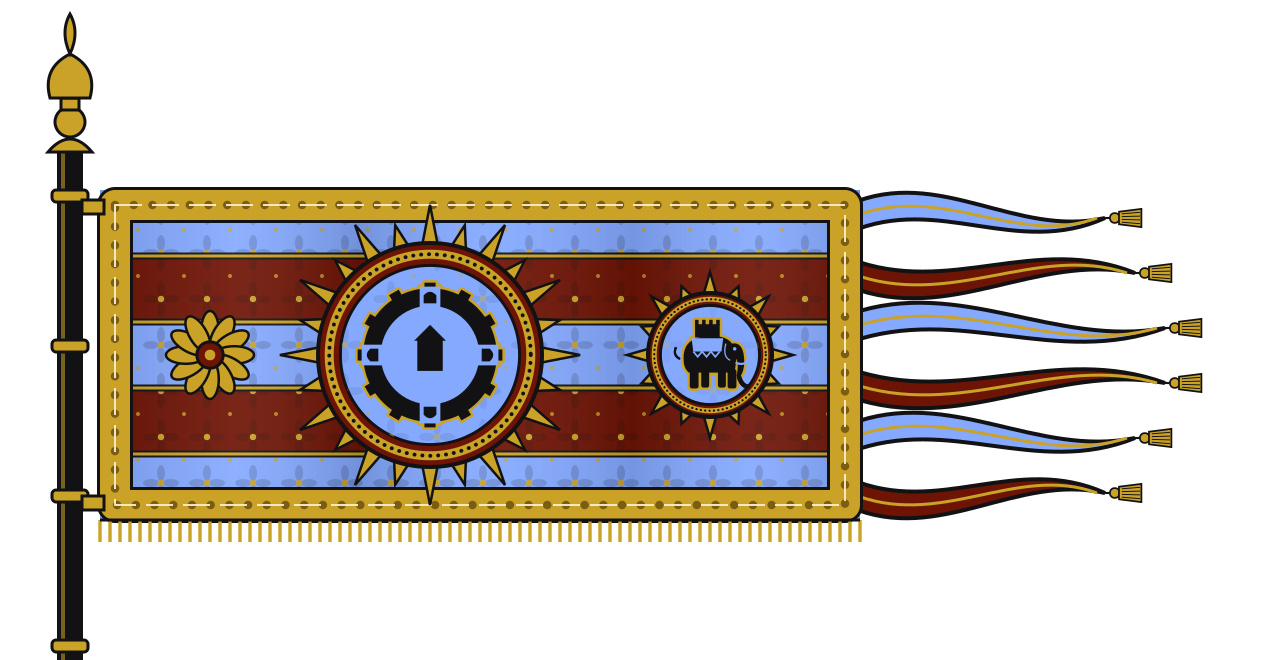
| Field | Intense Electric Blue #84A9FF |
| Accent | Maroon #6E1405 |
| Emblem colour | Charcoal Black #121214 |
| Zari metal | Gold |
| Main emblem | A ring of city walls with gates |
| Second image | A war elephant in profile |
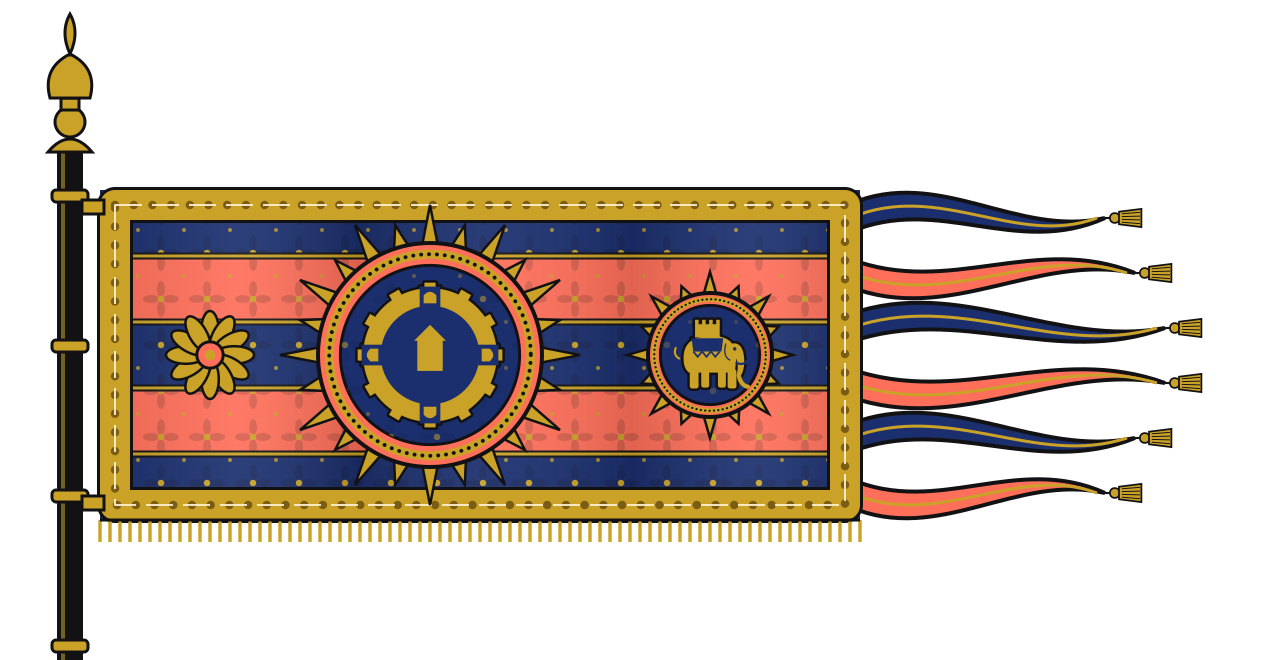
| Night and day | Every visual accessory has two versions: by night the emblem on the dark field, by day the clan's field colour on cloth woven from its metal. |
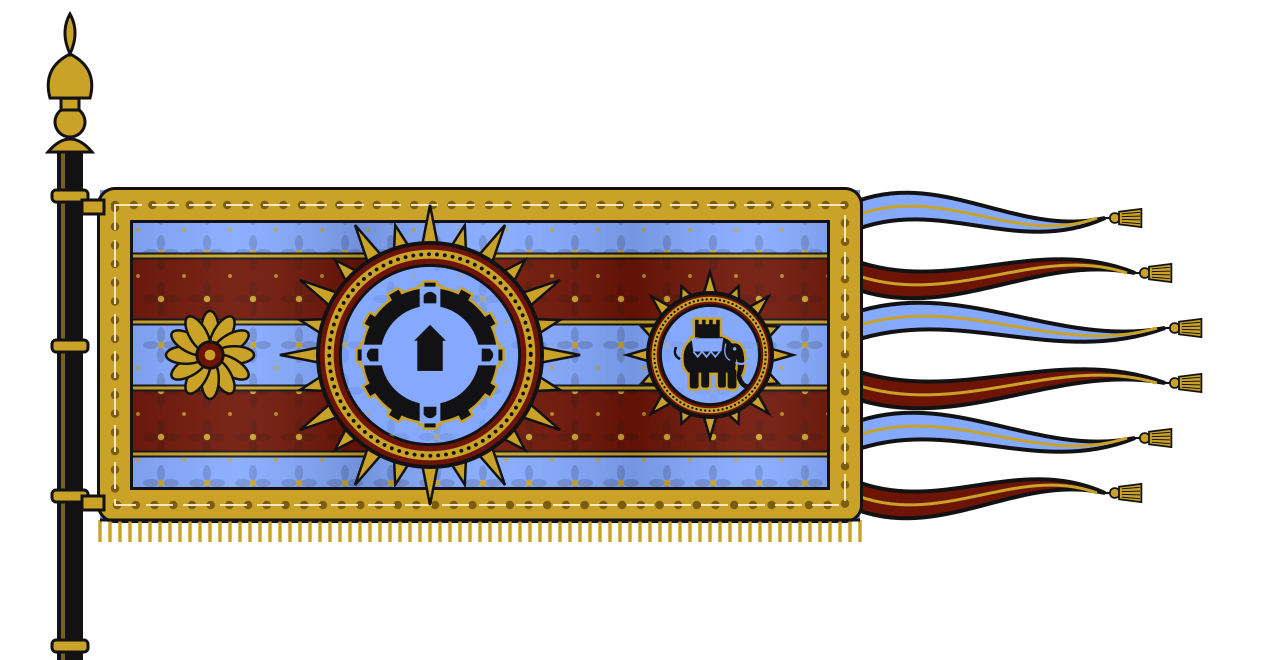
6. Flags
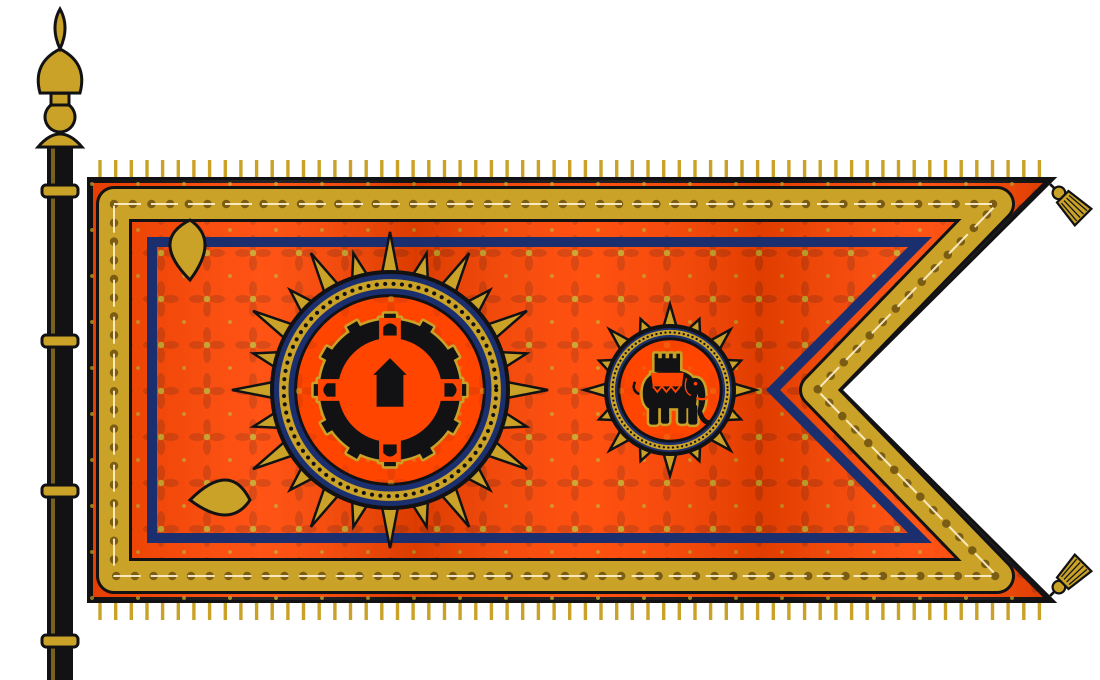
Every clan has every flag type; the type says the occasion and the colours say the clan. The outlined card is the flag the Atlas assigns.
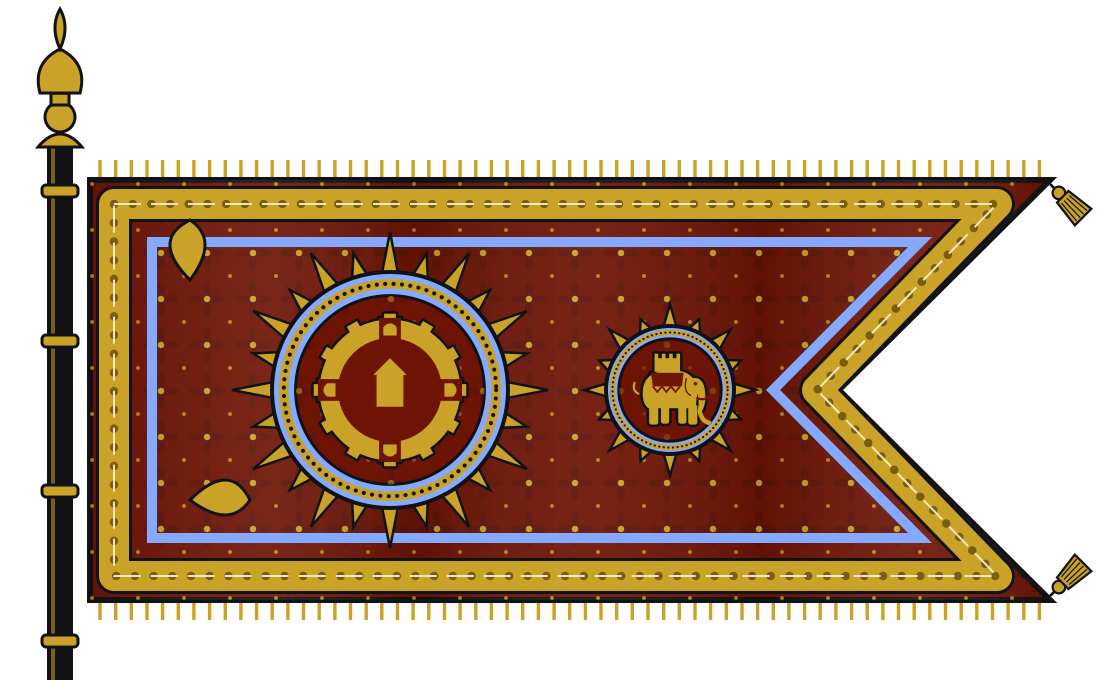
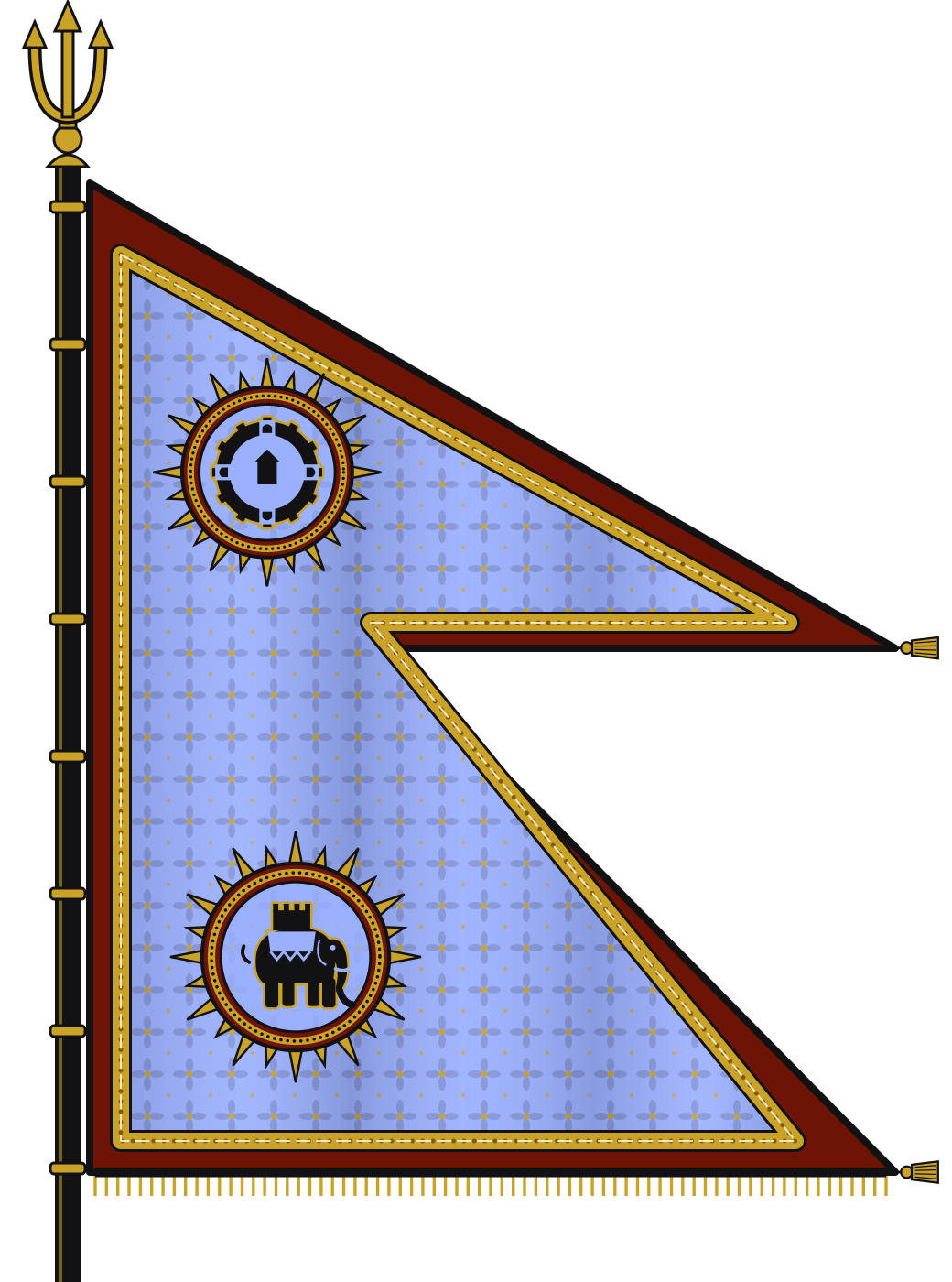
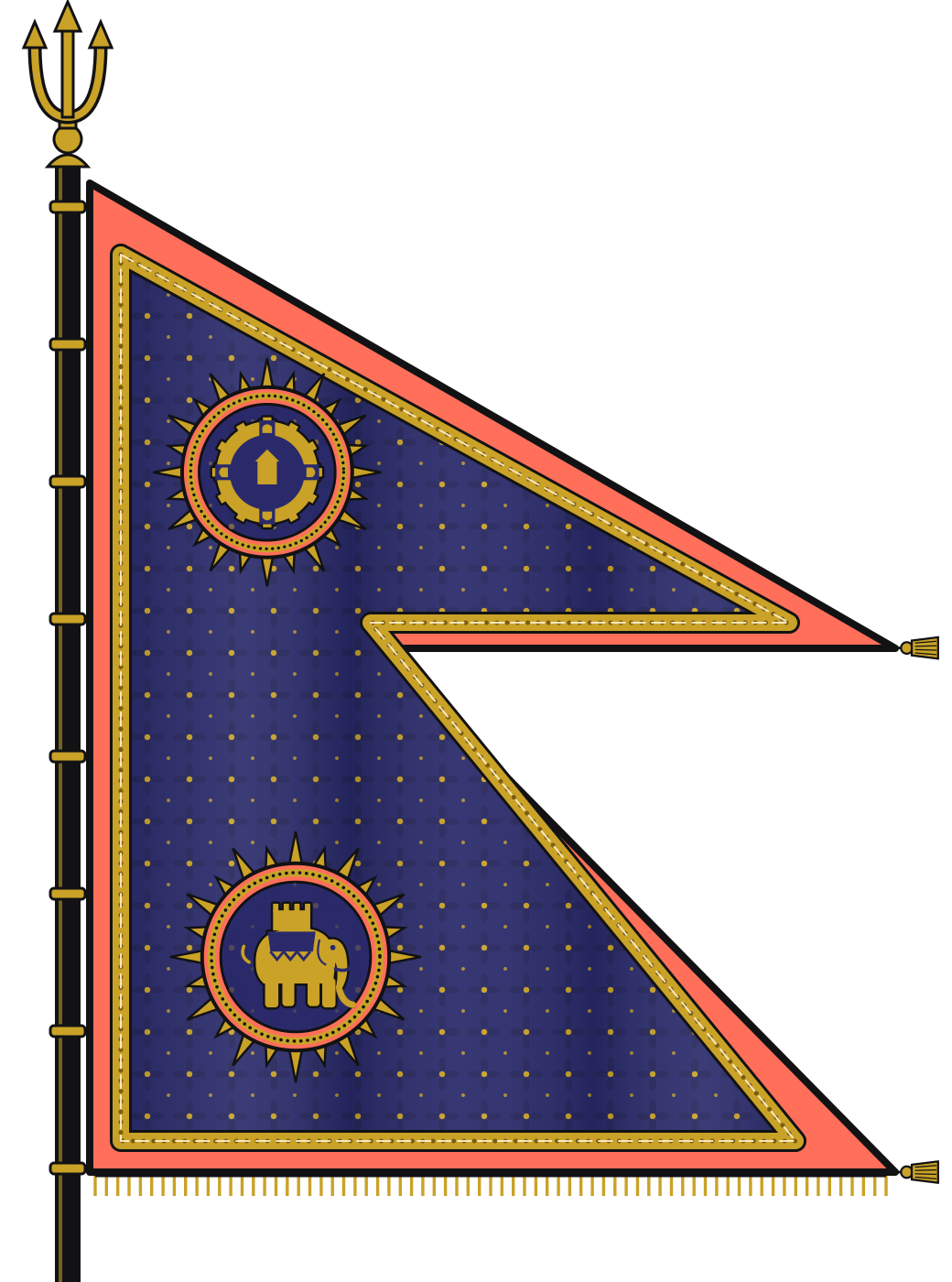



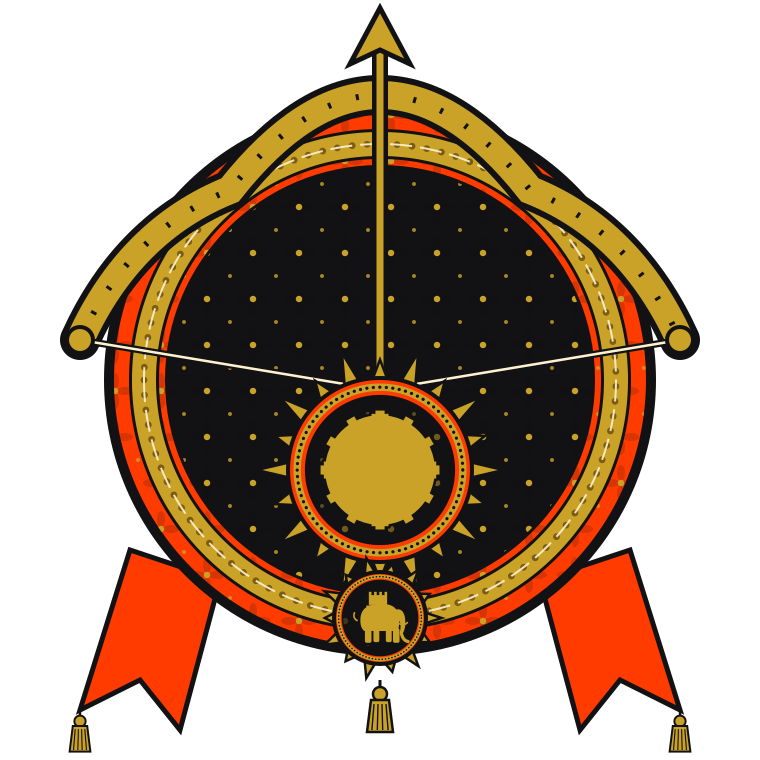
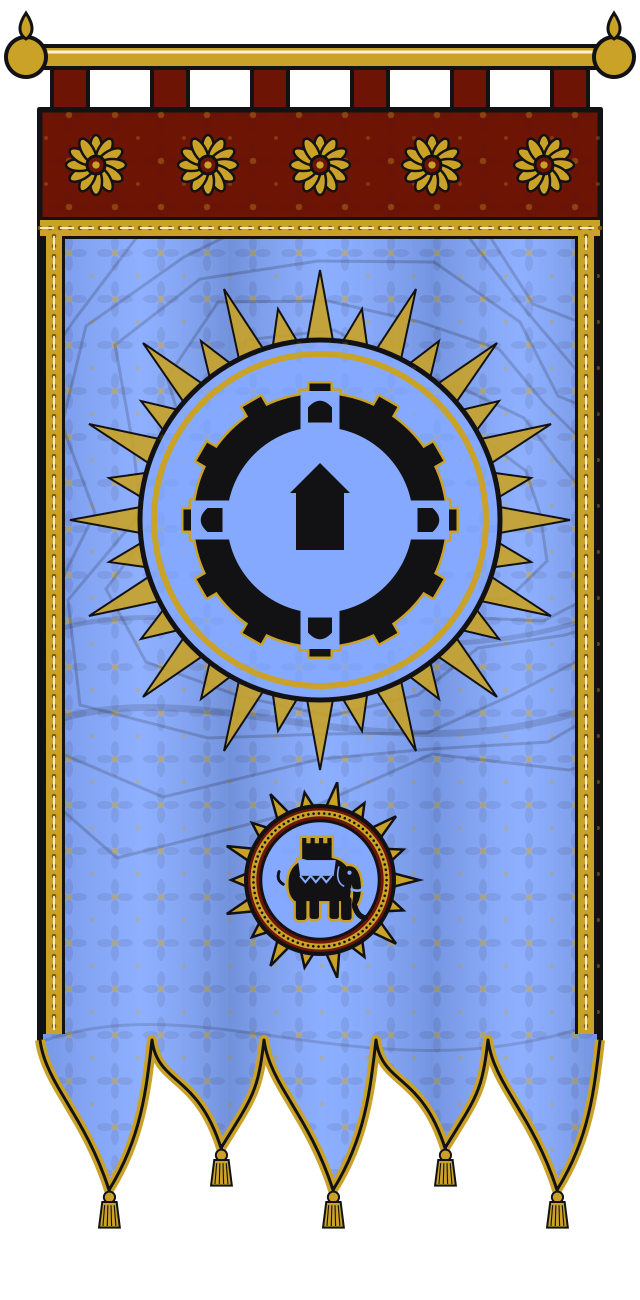
Historic banner
None known
New flag types
| Accessory | For this clan | Basis |
|---|---|---|
| A9 Pota-dhvaja · ship and trade flag For ships, caravans and markets | Double-masted ship on the coins of Pulumavi (Satavahana coin types) Satavahana coin types[3] | Documented |
| A10 Utsava-patāka · festival flag Light, bright flag for fairs and festivals | Not yet designed for this clan | Design |
| A11 Shoka-dhvaja · mourning flag White cloth with the emblem outline in the clan's metal | Not yet designed for this clan | Design |
7. Regalia
| Accessory | For this clan | Basis |
|---|---|---|
| E1 Chhatra · house parasol The ceremonial umbrella | Not yet designed for this clan | Design |
| E2 Chamara · fly-whisks The pair of whisks beside the head of the house | Not yet designed for this clan | Design |
| E3 Danda · staff of office Staff or scepter | Not yet designed for this clan | Design |
| E4 Simhasana · seat The seat of the house, covered in clan cloth | Not yet designed for this clan | Design |
| E5 Khetaka · shield A round shield; the Changi and Dhanush are its flag forms | Not yet designed for this clan | Regional tradition |
| E6 Kula-ayudha · clan weapon The weapon the clan honours | Swords, nooses and bows of the Andhra infantry, as the Mahabharata describes them Andhra infantry in the Mahabharata[1] | Documented |
8. Worn
| Accessory | For this clan | Basis |
|---|---|---|
| F1 Kula-vastra · clan cloth The clan's woven pattern in its kit colours | Not yet designed for this clan | Design |
| F2 Kirti-vastra · honour cloth A cloth earned for a deed, not inherited | Not yet designed for this clan | Design |
| F3 Kula-mala · garland flower The flower or leaf the clan wears as a garland | Not yet found for this clan | Under research |
| F4 Chinha · house pin A metal badge with the pin emblem | Not yet designed for this clan | Design |
9. Records
| Accessory | For this clan | Basis |
|---|---|---|
| H1 Clan words A traditional line in the native script | ఆంధ్రులు · “Andhrulu, the Andhras” The Telugu people's own name for themselves, in Telugu script[5] | Documented |
| H2 Biruda · titles The house's title or titles | Titles in the Nashik prashasti: 'king of kings', 'lord of the mountains' and 'ekabrahmana' Titles of Gautamiputra in the prashasti[4] | Documented |
| H3 Prashasti · praise genealogy The lineage as written at the head of a grant | Nashik prashasti of Gotami Balashri, Cave 3, 19th year of Pulumavi: a grant of Pisajipadaka village to Bhadrayaniya monks Praises Gautamiputra as 'king of kings' and lists the peoples he defeated[4] | Documented |
| H4 Vahi · clan register The book of the clan's births, marriages and deaths | Not yet found for this clan | Under research |
| H5 Rana-ghosha · war cry The clan's cry in battle or celebration | Not yet found for this clan | Under research |
10. VishwaVit · knower of the world
Game values are design choices for this project, not historical claims.
References
- Wikipedia, "Andhras", read 10 Oct 2026, https://en.wikipedia.org/wiki/Andhras
- Megasthenes, Indica (preserved in Arrian, Indica 8) — Pandaia and its queen.
- Satavahana dynasty (Wikipedia, read 2026-10-09, Codex run 8): coin types, including the Ujjain symbol.
- Wikipedia, "Gautamiputra Satakarni", read 10 Oct 2026, https://en.wikipedia.org/wiki/Gautamiputra_Satakarni
- Wikipedia, "Telugu people", read 10 Oct 2026, https://en.wikipedia.org/wiki/Telugu_people
- Wikipedia, "Telugu language", read 10 Oct 2026, https://en.wikipedia.org/wiki/Telugu_language
- Mahabharata (Vyasa, by tradition; composed mostly c. 400 BCE–400 CE) — the Kuru dynasty, the war at Kurukshetra, the banners of the Kuru princes and the line “yato dharmas tato jayah”.
- Valmiki, Ramayana — the Solar line, Ayodhya, the Kovidara banner and the Aditya Hridayam hymn (Yuddha Kanda).
- Wikipedia, "History of Andhra Pradesh", read 21 Oct 2026, https://en.wikipedia.org/wiki/History_of_Andhra_Pradesh
- Wikipedia, "Eastern Chalukyas", read 21 Oct 2026, https://en.wikipedia.org/wiki/Eastern_Chalukyas
- Wikipedia, "Vijayanagara Empire", read 21 Oct 2026, https://en.wikipedia.org/wiki/Vijayanagara_Empire
- Wikipedia, "Quli Qutb Shah", read 21 Oct 2026, https://en.wikipedia.org/wiki/Quli_Qutb_Shah
- Wikipedia, "Andhra State", read 21 Oct 2026, https://en.wikipedia.org/wiki/Andhra_State
- Wikipedia, "Andhra Pradesh Reorganisation Act, 2014", read 21 Oct 2026, https://en.wikipedia.org/wiki/Andhra_Pradesh_Reorganisation_Act,_2014
- Wikipedia (full mirror at wikipedia.com), "Telugu Brahmin", read 10 Oct 2026, https://www.wikipedia.com/wiki/Telugu_Brahmin