The Andh are a farming people of central India who speak Andh, an Indo-Aryan language of the Marathi-Konkani branch, and are listed as a Scheduled Tribe in Maharashtra, Telangana and Andhra Pradesh (state-wise list dated 9 July 2024)[1][2][3]. Popular pages say they descend from the Satavahana dynasty, but Auchitya finds no corroborating evidence for it, and Wikipedia does not reconcile the claim with the evidence[1][4]. Their worship is linked to Shiva, and their observances include Pola, when bulls are worshipped, and Mahadevachi Kathi Puja, a twelve-day worship of twelve Shiva shrines[1]. The community is divided into the endogamous Vertali and Khaltali groups, and into exogamous family lines named for animals and plants[4][5]. The project's KulDevi for the Andh is Jangubai of Kerameri.
01Faith and deities
The Andh's own chief deity is not sourced. The project KulDevi from the Atlas is Jangubai of Kerameri, Adilabad. The Jangubai legend in the cache is centred on the Gonds and does not mention the Andh[6].
Jangubai of Kerameri, Adilabad[6]
The presiding goddess of the clan's homeland or capital: a link of place, not a recorded clan tie.
| Deity or tradition | Place in the clan's life | Evidence |
|---|---|---|
| Shiva | Worship is linked to Shiva; the page cites Singh and Bhanu (Anthropological Survey of India, 2004) | [1] |
| Pola | Festival of bull worship | [1] |
| Mahadevachi Kathi Puja | A twelve-day worship of twelve Shiva shrines; at the end jowar, called amhil, is offered to Shiva for prosperity | [1] |
| Jangubai (KulDevi) | Homeland shrine at Kerameri, Adilabad; no Andh link is sourced | [6] |
| Deity statue at Jodeghat Tribal Museum | An Andh deity statue, not named, in a museum in Telangana | [1] |
02Temples
No temple built or patronised by the Andh is sourced. Wikipedia links the Aundha Nagnath Temple, one of the twelve Jyotirlingas in Aundha, Hingoli district, to the Andh area, without saying that the Andh built or patronised it[1]. The Jangubai shrine at Kerameri is a Gond-centred cave shrine per[6].
Built by the clan
Not recorded.
Given patronage or grants by the clan
Not recorded.
03Languages and scripts
| Language or script | Kind | Under the clan | Evidence |
|---|---|---|---|
| Andh (Andhi) living | Indo-Aryan, Marathi-Konkani branch | Spoken by the Andh; about 100,000 native speakers (2007); regions Maharashtra, Telangana and Madhya Pradesh | [2] |
| Marathi living | Indo-Aryan | The Andh's primary language, per Auchitya; many Andh speak it at home[2] | [4] |
| Telugu living | Regional language | Spoken in Andhra Pradesh and Telangana; Wikipedia gives about 100,000 speakers there, not clearly all Andh | [1] |
| Dravidian language (earlier) legend | Earlier language | The Andh are said to have spoken a Dravidian language before shifting; the language is not named | [1] |
| Other languages of the region | Regional languages | Bhili, Hindi, Khandesi, Kannada, Kolami, Gondi, Tamil, Urdu and Gujarati are listed beside the Andh | [4] |
04Books and literature
No Andh book, grammar or literature is sourced. Under research: the Russell and Hira Lal volumes (Gutenberg) are the lead, not yet read for the Andh.
Written during the clan's history
Not recorded.
Given patronage by the clan
Not recorded.
05Thinkers and scholars
| Name | Field | Era | Contribution |
|---|---|---|---|
| V. P. Wilson | Not stated | Not stated | Quoted by the IPL Myths blog (its reference reads 'Wilson, V.P. 190'): the word Andh is 'only a corruption of the Sanskrit Andhra'[5] |
Singh and Bhanu (Anthropological Survey of India, 2004) are cited by Wikipedia for the Shiva worship; they are not otherwise discussed.
06Art and architecture
No Andh painting, sculpture, architecture, textile or craft is sourced in the extracts.
Painting and wall art
Not recorded.
Sculpture and temple art
Not recorded.
Temple and building architecture
Not recorded.
Weaving and textiles
Not recorded.
Clothing and jewellery
Not recorded.
Coins, pottery and crafts
Not recorded.
07History
A claimed Satavahana origin
Popular pages say the Andh descend from the Satavahana (Andhra) dynasty, which Wikipedia dates from the 3rd century BCE to the 2nd century CE, citing GKToday[1]. The IPL Myths blog retells this without a citation: the dynasty's first Deccan empire was at Kotilingala, in Jagtial district[5].
Wikipedia says the name Andh may derive from Sanskrit Andhra[1]. The IPL Myths blog quotes V. P. Wilson that the word Andh is 'only a corruption of the Sanskrit Andhra'[5]. Auchitya says many believe the Andhra link but finds no corroborating evidence[4]. Indianetzone describes the Andh as non-Aryan, from the Tamil country, a view that conflicts with the Satavahana claim[7].
After the Satavahanas
Auchitya, without a citation, says the Andh were ill-treated by Brahmins in the Satavahana era and that the British took their land and forest afterwards[4]. Wikipedia says that after the last Satavahana ruler the East India Company took lands and forests, which contributed to the community's isolation[1]. The IPL Myths blog also says the dynasty collapsed after an attack by the Nizam of Hyderabad, a claim it gives without a citation[5].
Wikipedia says that after the Satavahana decline many Andh became settled farmers, citing a Photofrem source[1].
Under the Deccan kingdoms
The Atlas records that the Andh lived under the Deccan kingdoms, the Yadavas of Devagiri and later the Nizam's Hyderabad. No dates are given for these periods in the extracts.
The 1950 list
A 2025 news report on a petition before the Supreme Court says the 1950 Scheduled Tribe Order for Hyderabad State named the Andh, with the Bhil, Hill Reddi and Pardhan. The report sets out the petitioners' claims; the court has not ruled[8].
08Journey and migrations
No migration is described in the extracts. The community is historically concentrated in central India, including Marathwada and parts of Telangana[1].
Not recorded.
09Seats and lands
| Place | Role | Where today |
|---|---|---|
| Marathwada | Homeland, per the Atlas | Maharashtra |
| Vidarbha | Homeland, per the Atlas | Maharashtra |
| Adilabad hills | Hills of Adilabad district; homeland per the Atlas | Telangana[1] |
| Parbhani, Nanded, Yavatmal, Akola | Districts where the Andh live | Maharashtra[1] |
10Notable figures
Not recorded.
11Allies, rivals and marriages
| People | Relationship | When |
|---|---|---|
| Satavahana dynasty | Claimed ancestors, not confirmed by evidence | 3rd c. BCE to 2nd c. CE (claimed) |
| Yadavas of Devagiri | Deccan kingdom the Andh lived under | Not stated |
| Nizam of Hyderabad | Later ruler of the area | Not stated |
| Andhras (ANC-008) | A different people in this project; the name may come from Sanskrit Andhra[1] | — |
| Kunbi | Marriage and ceremonies said to resemble the Kunbi's[4][5] | Not stated |
| Bhil, Hill Reddi, Pardhan | Listed with the Andh in the 1950 Scheduled Tribe Order for Hyderabad State, per the 2025 petition report[8] | 1950 |
12Society and livelihood
The Andh are self-described Tribals, relatively well educated and agrarian[1]. Their social life runs on exogamous clans, a caste committee and marriage by negotiation.
Government and social order
| Institution or group | What it was | Evidence |
|---|---|---|
| Vertali and Khaltali | Two endogamous groups; the Vertali are described as the elite and the Khaltali as commoners; intermarriage is forbidden | [4][5] |
| Exogamous family lines | Named for animals and plants, such as cat, tiger, bird, tree and ant-hill | [5][7] |
| Caste committee | Settles disputes; the Panchayat is also named | [4][7] |
| Sadhu Andh | Named in the title of Auchitya's page only; not described | [4] |
| Marriage | Like the Kunbi: marriage by negotiation, elopement not uncommon, polygamy allowed; engagements October to December, weddings January to April | [5][4][7] |
| Widows and divorce | Widow remarriage is widespread but not to the late husband's brother or within his family line; divorce is permitted | [5][4] |
| Patriarchal line | Patriarchal and patrilineal, per Auchitya | [4] |
Livelihood over time
| Era | Livelihood | Evidence |
|---|---|---|
| After the Satavahana decline (claimed) | Many became settled farmers | [1] |
| Today | Mainly agriculturists and labourers, factory work, a few forest products and hunting; fishing is prevalent | [4][7] |
13Sub-clans and related clans
The Andh are divided into two endogamous groups, Vertali (also Vartali), described as the elite, and Khaltali, described as commoners; intermarriage is forbidden[4][5]. Their exogamous family lines are named for animals and plants: Majiria (cat), Baghmare (tiger killer), Titawe (bird), Dukare (tiger), Ringni (tree) and Dumare (ant-hill)[5][7].
| Clan | Relation | Where | Size | In the Atlas | Evidence |
|---|---|---|---|---|---|
| Vertali | Sub-clan | Not stated | new clan candidate | [4][5] | |
| Khaltali | Sub-clan | Not stated | new clan candidate | [4][5] | |
| Intiperlu | Related people | Not stated | new clan candidate | [5][7] | |
| Majiria | Related people | Not stated | new clan candidate | [4][5] | |
| Baghmare | Related people | Not stated | new clan candidate | [4][5] | |
| Titawe | Related people | Not stated | new clan candidate | [4][5] | |
| Dukare | Related people | Not stated | new clan candidate | [4][5] | |
| Ringni | Related people | Not stated | new clan candidate | [4][5] | |
| Dumare | Related people | Not stated | new clan candidate | [4][5] | |
| Kunbi | Related people | Not stated | ST-165 | [4] | |
| Satavahana dynasty | Dynasty from this clan | Deccan (claimed origin) | ANC-183 | [1][5] |
Clans marked "new clan candidate" are not in the Atlas yet.
14Surnames
Seven family or clan names are given as surnames: Intiperlu, Majiria, Baghmare, Titawe, Dukare, Ringni and Dumare[4][5]. No counts by surname are sourced.
| Surname | Clan or sub-clan | Where | People with this surname | Also used by other communities |
|---|---|---|---|---|
| Intiperlu | Intiperlu | Not stated | not yet counted | Not checked |
| Majiria | Majiria | Not stated | not yet counted | Not checked |
| Baghmare | Baghmare | Not stated | not yet counted | Not checked |
| Titawe | Titawe | Not stated | not yet counted | Not checked |
| Dukare | Dukare | Not stated | not yet counted | Not checked |
| Ringni | Ringni | Not stated | not yet counted | Not checked |
| Dumare | Dumare | Not stated | not yet counted | Not checked |
Counts are of everyone with the surname, from the cited source and year, not only members of this clan. A surname shared with other communities says nothing about any one person's origin.
15Songs and music
No Andh song is sourced in the extracts. A Marathi-language search found nothing on the Andh.
None recorded yet.
16Poems, lullabies and children's rhymes
None recorded yet.
17Stories, legends and proverbs
Stories and legends
| Story | What happens | Told by | Evidence |
|---|---|---|---|
| Satavahana descent legend | The Andh are said to descend from the Satavahanas; the first Deccan empire was at Kotilingala, Jagtial district (retold without a citation) | Popular pages, retold in the IPL Myths blog | [5] |
Proverbs and sayings
Not recorded.
18Festivals and fairs
| Festival or fair | When | Where | What happens |
|---|---|---|---|
| Pola | Not stated | Not stated | Bull worship[1] |
| Mahadevachi Kathi Puja | Twelve days | Not stated | Worship of twelve Shiva shrines; jowar is offered to Shiva at the end for prosperity[1] |
| Dussehra | Not stated | Not stated | Listed among the Andh festivals[1] |
| Diwali | Not stated | Not stated | Listed among the Andh festivals[1] |
| Sankranti | Not stated | Not stated | Listed among the Andh festivals[1] |
19Food, dress and games
Food
Not recorded.
Dress
Not recorded.
Games and martial arts
Not recorded.
Tags: living still practised · revived brought back after a break · lost known only from records · research reported but not yet confirmed from a source. Songs and poems under copyright are listed by title only; restricted or sacred material is noted without its content.
20Status today
The Andh are a Scheduled Tribe in Maharashtra, Telangana and Andhra Pradesh (state-wise list dated 9 July 2024). The 2011 census figure is given as 474,110 (Wikipedia's text; the IPL Myths blog places it in Maharashtra), but the sources do not agree on the total[1][5][3].
Who carries the name today
| Community | Link | Basis | Evidence |
|---|---|---|---|
| Satavahana descent (ANC-183) | Community tradition | [1] | |
| Southern (Tamil country) origin | Disputed | [7]; contrary to the Satavahana claim |
Recognised heritage
| What | Recognition | Evidence |
|---|---|---|
| Scheduled Tribe | Constitution (ST) Order 1950, as amended; state-wise list dated 09-07-2024[3] | [3] |
| Jodeghat Tribal Museum, Telangana | Shows a deity statue of the Andh tribe, not named | [1] |
Not yet reviewed by the Andh community. The facts come from encyclopedias, blogs, a news report and the Atlas.
21For children
The plateau farmers
The Andh are farmers in central India, in Marathwada and the Adilabad hills. Many of them speak Marathi at home. At Pola, they honour the bull. They keep Mahadevachi Kathi Puja, a twelve-day worship at twelve shrines of Shiva. At the end of it they offer jowar to Shiva for prosperity. The Andh are on the country's list of Scheduled Tribes.
22Across the project
| Project | What carries this clan | Status |
|---|---|---|
| Atlas of the Janas | Homeland: Marathwada, Vidarbha and the Adilabad hills; not yet pinned | To check |
| KulDevi and GrahDevi | KulDevi Jangubai, homeland shrine at Kerameri, Adilabad; family Saptamatrika with Narasimhi; GrahDevi forms Brahmani, Maheshvari, Kaumari, Vaishnavi, Varahi, Indrani, Chamunda, Narasimhi | From the Atlas |
| Planet naming | Under research | — |
| Renaming and waters | The name may come from Sanskrit Andhra[1]; no place or water name drawn from the Andh is sourced | — |
23Open questions
- Is there a clan deity or chief deity of the Andh, apart from Shiva and the master-sheet KulDevi Jangubai?
- Is the Satavahana descent claim supported by any inscription or scholarly study? Auchitya finds no corroborating evidence.
- Which population figure is right? Sources give 474,110, 478,000, 488,000, 493,450 and 74,000 (ASI); the Maharashtra figure is not settled.
- Do the Andh of Andhra Pradesh and Telangana speak Telugu, or is the 100,000 figure about another group?
- Who is the unnamed deity in the Jodeghat Tribal Museum statue?
- Who was V. P. Wilson, and where is the page the IPL Myths blog cites (190)?
- Are the sub-clan names (Vertali, Khaltali and the exogamous lines) recorded in an official or scholarly source?
- Which Andh words, songs or rhymes exist in Marathi or Andh? No native-script form of the name is in the extracts; the page has no native name until one is sourced.
- Community review: has the Andh community seen this page?
- Contradiction: the Satavahana/Andhra origin[1][5] is set against a southern Tamil-country origin[7]. The page does not choose between them.
- Contradiction: IPL Myths says the Satavahana dynasty collapsed after an attack by the Nizam of Hyderabad, a claim the cache marks as questionable[5]; Wikipedia says the East India Company took lands and forests after the last Satavahana ruler[1].
- Contradiction: burial, with the head facing south[5][7], against burial in a coffin[4]. Which is current practice?
- Contradiction: the info box once named Jangubai as main deity, but the Faith section says the Andh's own chief deity is not sourced[6]. The info box now shows the KulDevi only.
24Astitva
अस्तित्व · being, existence: everything by which the clan is known
No seal, coin, title or symbol of the Andh is documented in the extracts[1]. The accessories below are design or research until sources say more.
Every clan has every accessory, royal objects included. Each one says how it is known: Documented This clan's own object is recorded. · Regional tradition Recorded for the region or for peoples like this one, not for this clan. · Design Made for this project, with no historical claim. · Under research To be found for this clan from sources. Legends and titles are written in the clan's own script.
1. Seals and coins
| Accessory | For this clan | Basis |
|---|---|---|
| B1 Rajamudra · house seal Round seal with the clan emblem and a short legend in the clan's script | Not yet designed for this clan | Design |
| B2 Anguliya-mudra · signet ring Personal seal ring of the head of the house | Not yet designed for this clan | Design |
| B3 Chhapa · house stamp Ink or block stamp for letters, goods and cloth | Not yet designed for this clan | Design |
| B4 Tamrapatra · charter plate Copper-plate grant on a ring, closed with the house seal | Not yet designed for this clan | Design |
| B5 Shreni-mudra · guild or trade seal Seal for the clan's trade, craft or caravan | Not yet designed for this clan | Design |
| C1 Clan coin Emblem or deity on one side, a legend in the clan's script | Not yet designed for this clan | Design |
| C2 Coin die The die that strikes the coin | Not yet designed for this clan | Design |
2. Living symbols
| Accessory | For this clan | Basis |
|---|---|---|
| I1 Totem trio The tree, bird and animal the clan protects | Clan names drawn from cat, tiger, bird, tree and ant-hill (the sources do not call them totems) | Under research |
| I2 Kaval-maram · guardian tree The tree that stands at the clan's seat | Not yet found for this clan | Under research |
3. Stone and gate
| Accessory | For this clan | Basis |
|---|---|---|
| G1 Torana · gateway The built gate of the seat; the cloth Toran hangs in it | Not yet designed for this clan | Regional tradition |
| G2 Viragallu · hero stone Carved panel stone for a member who died defending the clan | Not yet designed for this clan | Regional tradition |
| G3 Kula-shila · clan stones Standing and table stones that remember the ancestors | Not yet designed for this clan | Design |
| G4 Jayastambha · victory pillar A pillar raised for a victory | Not yet designed for this clan | Design |
| G5 Sima-shila · boundary stone Marks the clan's land, with a line in the native script | Not yet designed for this clan | Design |
4. Sounds
| Accessory | For this clan | Basis |
|---|---|---|
| D1 Pancha-mahashabda · five great sounds The right to five instruments | Not yet designed for this clan | Design |
| D2 Shankha · clan conch The clan's own named war conch | Not yet designed for this clan | Design |
| D3 Murasu · house drums Three drums: war, charity and justice | Not yet designed for this clan | Design |
5. Kit: colours, metals and emblems
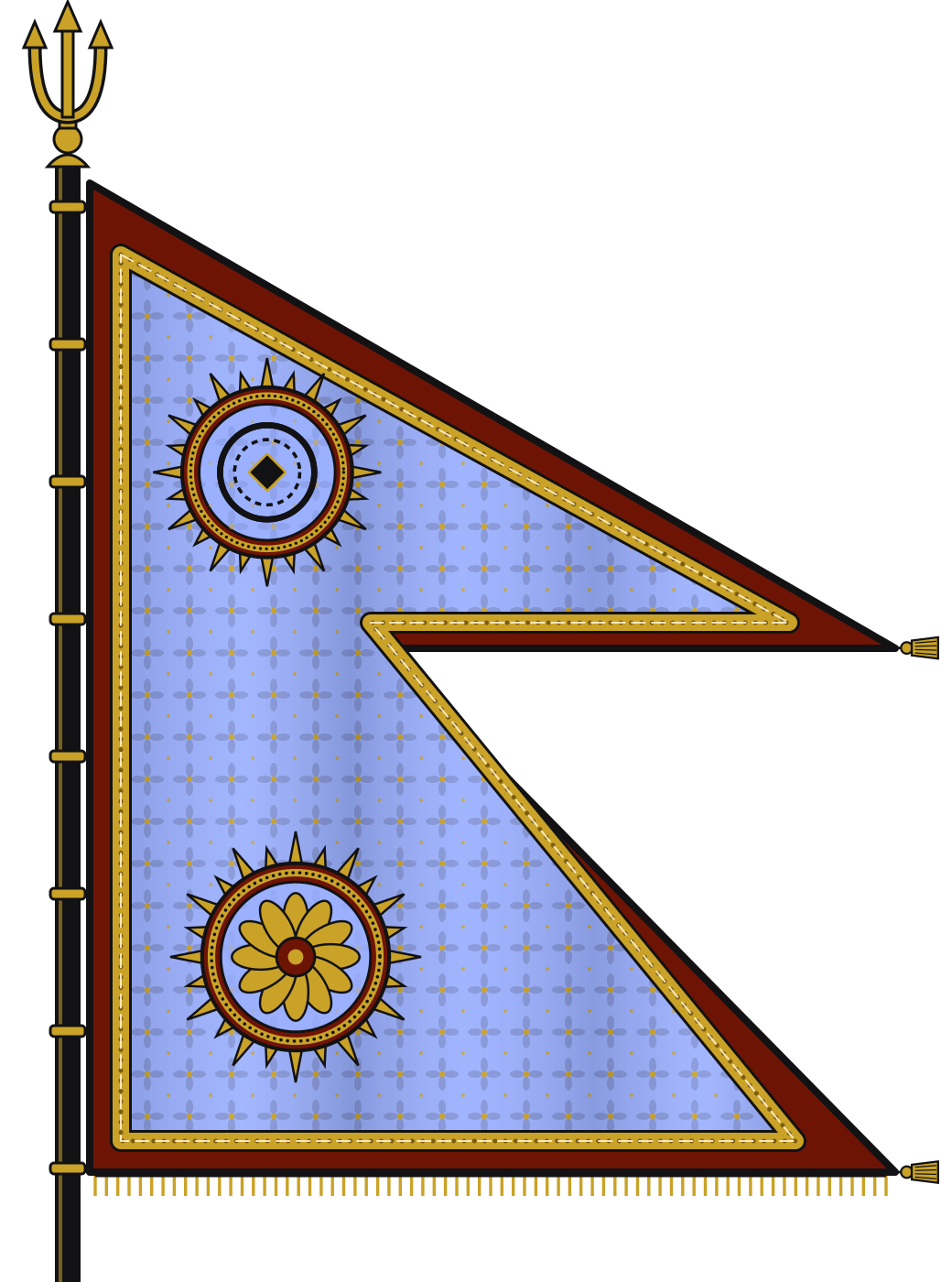
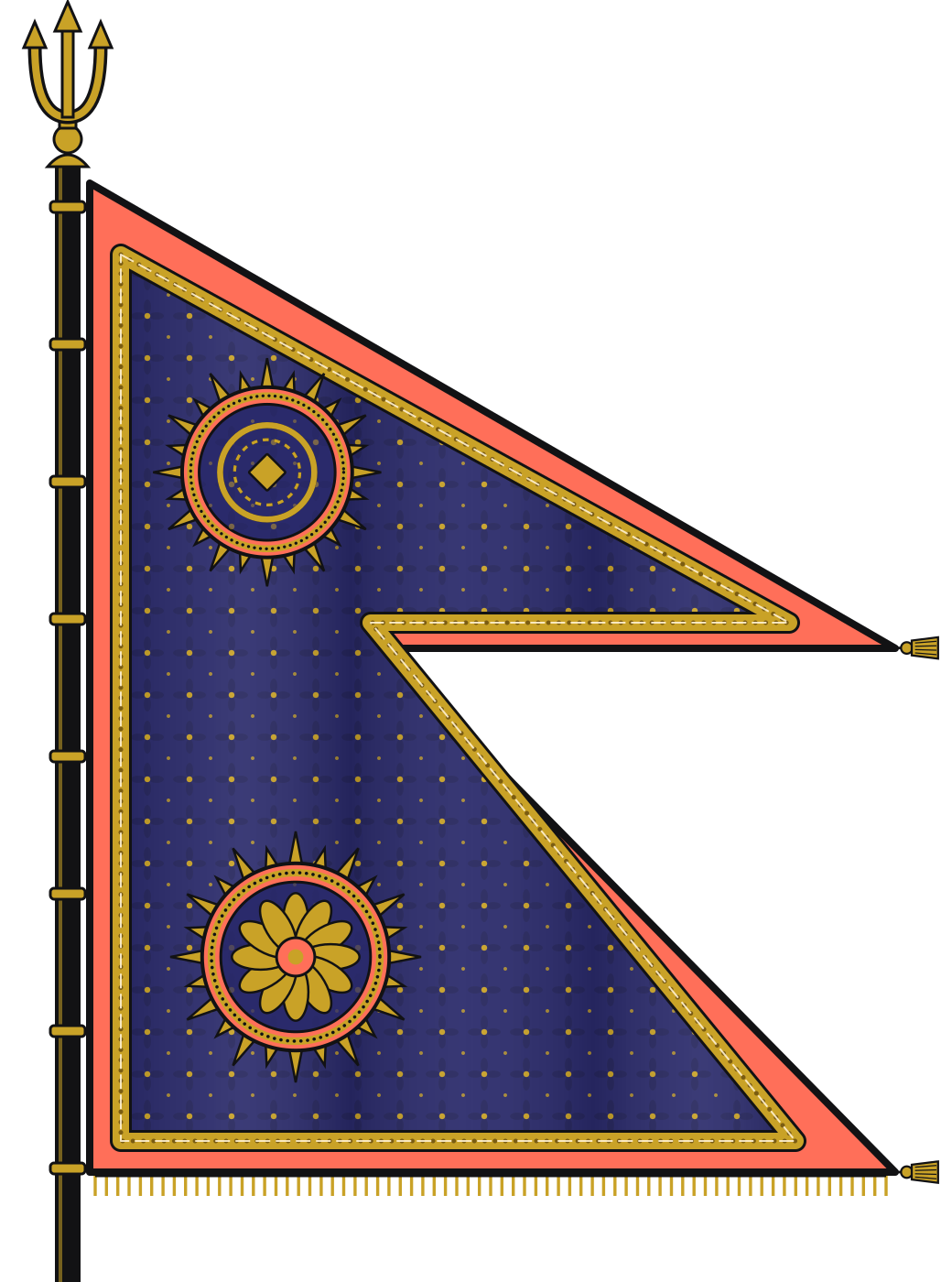
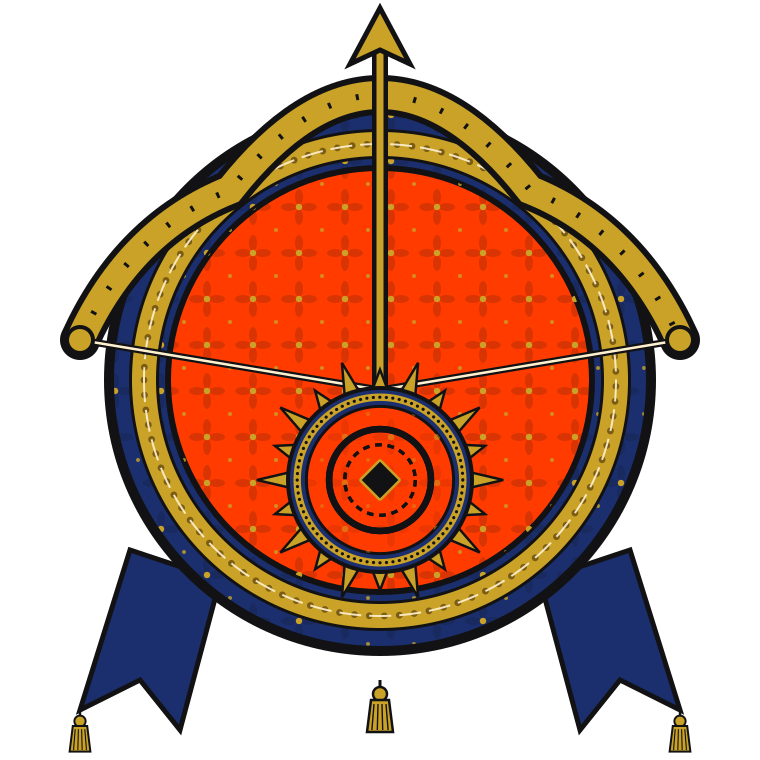
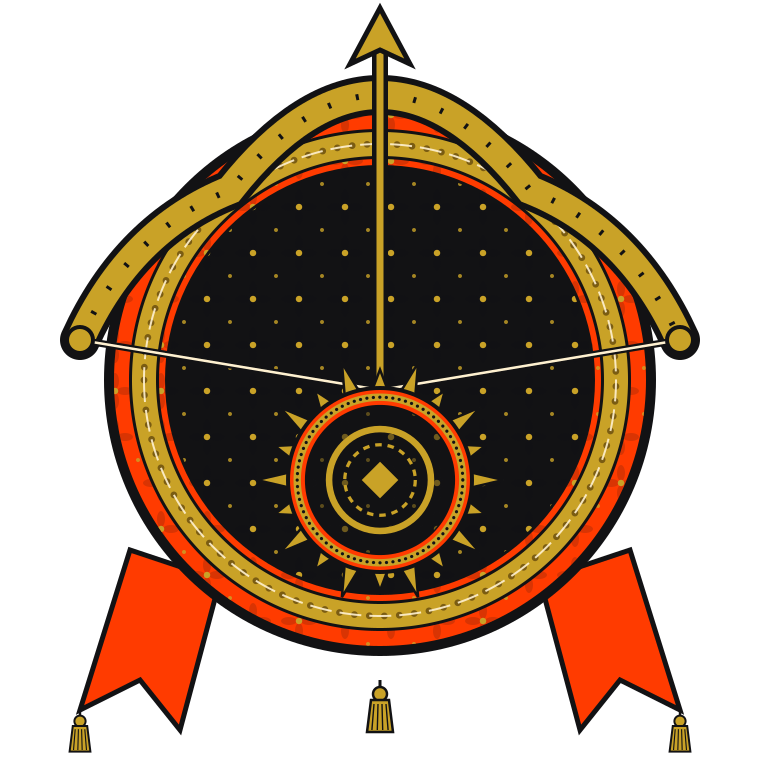
No seal, coin, banner or symbol of the Andh is recorded in the extracts; Wikipedia's page lists no totems, symbols or instruments beyond Shiva worship and Pola bull worship[1]. The emblem below is a design made for the project.
| Part of the kit | This clan |
|---|---|
| Field | Warm Red-Orange #FF6F59 |
| Accent | Deep Cosmic Blue #9BB0FF |
| Emblem colour | Charcoal Black #121214 |
| Zari metal | Gold |
| Main emblem | A plateau with a single plough |
| Second image | A jowar (sorghum) stalk |
| Night and day | Every visual accessory has two versions: by night the emblem on the dark field, by day the clan's field colour on cloth woven from its metal. |
6. Flags
Every clan has every flag type; the type says the occasion and the colours say the clan. The outlined card is the flag the Atlas assigns.
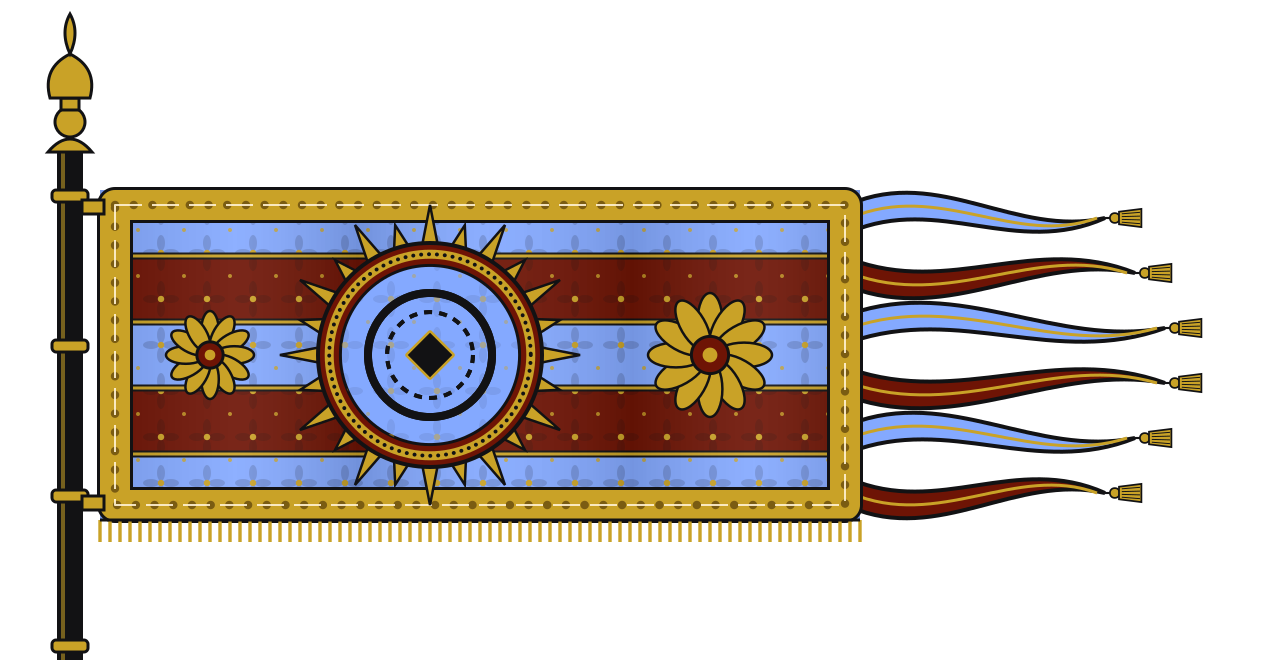
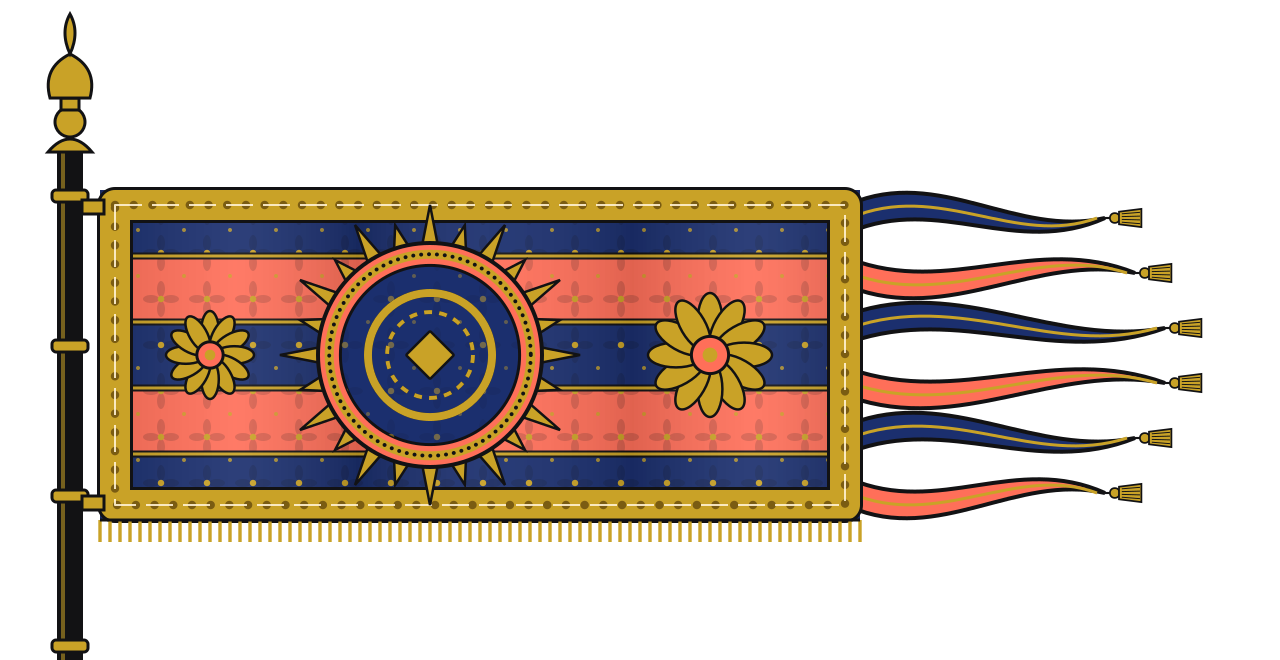
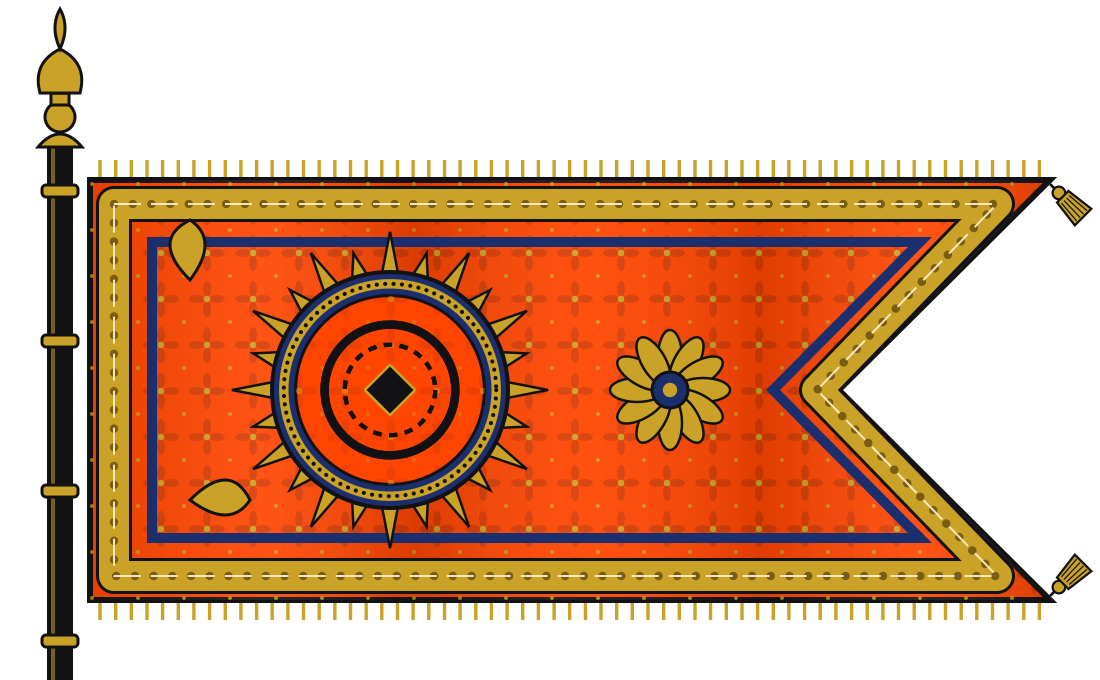
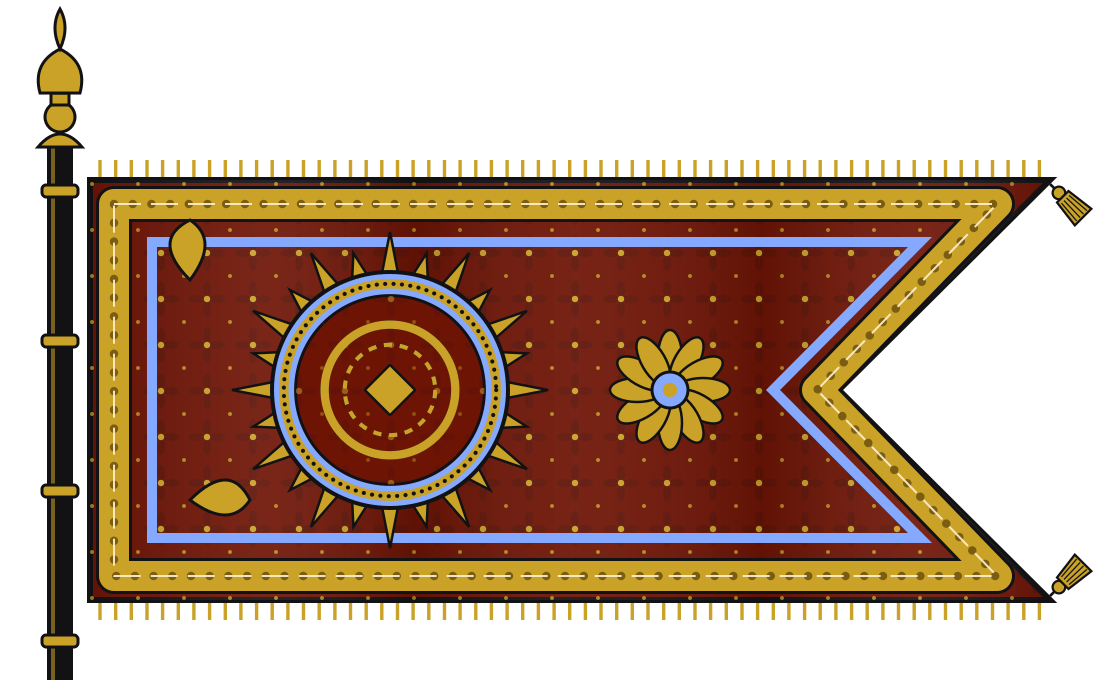
Historic banner
None known
New flag types
| Accessory | For this clan | Basis |
|---|---|---|
| A9 Pota-dhvaja · ship and trade flag For ships, caravans and markets | Not yet designed for this clan | Design |
| A10 Utsava-patāka · festival flag Light, bright flag for fairs and festivals | Not yet designed for this clan | Design |
| A11 Shoka-dhvaja · mourning flag White cloth with the emblem outline in the clan's metal | Not yet designed for this clan | Design |
7. Regalia
| Accessory | For this clan | Basis |
|---|---|---|
| E1 Chhatra · house parasol The ceremonial umbrella | Not yet designed for this clan | Design |
| E2 Chamara · fly-whisks The pair of whisks beside the head of the house | Not yet designed for this clan | Design |
| E3 Danda · staff of office Staff or scepter | Not yet designed for this clan | Design |
| E4 Simhasana · seat The seat of the house, covered in clan cloth | Not yet designed for this clan | Design |
| E5 Khetaka · shield A round shield; the Changi and Dhanush are its flag forms | Not yet designed for this clan | Regional tradition |
| E6 Kula-ayudha · clan weapon The weapon the clan honours | Not yet found for this clan | Under research |
8. Worn
| Accessory | For this clan | Basis |
|---|---|---|
| F1 Kula-vastra · clan cloth The clan's woven pattern in its kit colours | Not yet designed for this clan | Design |
| F2 Kirti-vastra · honour cloth A cloth earned for a deed, not inherited | Not yet designed for this clan | Design |
| F3 Kula-mala · garland flower The flower or leaf the clan wears as a garland | Not yet found for this clan | Under research |
| F4 Chinha · house pin A metal badge with the pin emblem | Not yet designed for this clan | Design |
9. Records
| Accessory | For this clan | Basis |
|---|---|---|
| H1 Clan words A traditional line in the native script | · “” Under research: no line of the Andh's own is sourced in the extracts; see open questions. | Documented |
| H2 Biruda · titles The house's title or titles | Not yet found for this clan | Under research |
| H3 Prashasti · praise genealogy The lineage as written at the head of a grant | Not yet found for this clan | Under research |
| H4 Vahi · clan register The book of the clan's births, marriages and deaths | Not yet found for this clan | Under research |
| H5 Rana-ghosha · war cry The clan's cry in battle or celebration | Not yet found for this clan | Under research |
10. VishwaVit · knower of the world
Game values are design choices for this project, not historical claims.
References
- Wikipedia, "Andh people", read 7 Nov 2026, https://en.wikipedia.org/wiki/Andh_people
- Wikipedia, "Andh language", read 7 Nov 2026, https://en.wikipedia.org/wiki/Andh_language
- Ministry of Tribal Affairs, State/UT-wise list of Scheduled Tribes (Constitution (ST) Order 1950 as amended; list dated 09-07-2024), via the Atlas entries ST-015 and ST-093.
- Auchitya (Mahima Singh), "Andh and Sadhu Andh: The Tribes of Andhra Pradesh", read 7 Nov 2026, https://auchitya.com/?p=3511
- IPL Myths blog, "Mythologies of the Andh Tribes", Oct 2024, read 7 Nov 2026, https://iplmyths.blogspot.com/2024/10/mythologies-of-andh-tribe.html
- Sri Jangu Bai pilgrimage, Indian Temples Magazine via Sphoorthi Theatre blog, Feb–Mar 2021, drawing on Haimendorf (read 29 Oct 2026, KulDevi run 351).
- Indianetzone, "Andh Tribe", read 7 Nov 2026, https://www.indianetzone.com/andh_andhra_pradesh
- Verdictum, Tellam Venkata Rao v Union of India (report, 26 July 2025), read 2026-10-10, https://www.verdictum.in/court-updates/supreme-court/tellam-venkata-rao-v-union-of-india-lambadas-sugalis-banjaras-scheduled-tribe-telangana-1586192