The Ahoms are the people of Assam who descend from Tai migrants led by Sukaphaa and from the many local peoples they absorbed[1]. Tradition dates Sukaphaa's crossing of the Patkai hills to 1228; a recent study (Daniels 2023) argues the state took shape in the 14th century[1]. Their kingdom kept written chronicles called buranjis, fought the Mughals from 1615 to 1682, and lasted until the Treaty of Yandabo in 1826[2]. Today the Ahoms speak Assamese and live mainly in upper Assam, where they are reviving their Tai language and script[1][3].
01Faith and deities
In the Tai Ahom religion Pha Tu Ching is the formless supreme being, and Lengdon is the ruler of the universe[4]. The dynasty's own deity was the relic Chumpha.
Patronised by the later Hindu Ahom kings[5]
A recorded tie between the clan and the goddess.
| Deity or tradition | Place in the clan's life | Evidence |
|---|---|---|
| Pha Tu Ching | Formless supreme being | [4] |
| Lengdon living | Ruler of the universe | [4] |
| Chumpha (Chumpha-Rung Seng-Mong) | Titular deity of the dynasty (dynastic relic) | [4] |
| Khao Kham and Ai Leng Din | Deities of water and of earth | [4] |
| Jasing Pha | The wise forefathers | [4] |
| Dam and Phi living | The dead become Dam, honoured at the kitchen pillar (Pho Kam); after fourteen generations they become Phi | [4] |
| Rik-Khwan Mong Khwan | Rite named on the religion page; no further detail given | [4] |
| Phuralung revived | Form without blood sacrifice; Assam Phuralung Society (1975, uncited on the source page) | [4] |
| Vaishnavism | Kings formally adopted Hinduism in 1648; Jayadhwaj Singha initiated by Niranjan Bapu of Auniati Satra | [2][1] |
| Kamakhya (KulDevi) | Inscriptions of Rajeswar Singha (1759) survive at the temple | [5] |
02Temples
The old Ahom faith worshipped at household pillars (Pho Kam).
Built by the clan
| Temple | Deity | Built by | When | Where |
|---|---|---|---|---|
| Sivasagar group | Various | Ahom kings | Kingdom period | Sivasagar[2] |
| Jaysagar and Gaurisagar groups | Various | Ahom kings | Kingdom period | Upper Assam[2] |
| Negheriting temple | Named among the kingdom's temples | Ahom kings | Kingdom period | Upper Assam[2] |
| Ho phi living | Ancestor spirits | Ahom communities | Each year | Octagonal hall raised for Me-Dam-Me-Phi[4] |
Given patronage or grants by the clan
| Temple | Deity | What the clan gave | When | Where |
|---|---|---|---|---|
| Kamakhya Temple | Kamakhya | Inscriptions of Rajeswar Singha (1759) | 1759 | Nilachal hill, Guwahati[5] |
| Umananda, Sukreswar, Basistha | Various | Listed among the kingdom's temples | Kingdom period | Assam[2] |
03Languages and scripts
| Language or script | Kind | Under the clan | Evidence |
|---|---|---|---|
| Ahom revived | Southwestern Tai (close to Shan and Khamti) | Court and chronicle language (13th–18th c.); no native speakers since the early 18th century; kept by priests for chants; revived since 1954 | [3] |
| Ahom script revived | Script for buranjis, astrology and ritual books | Buranjis, astrology and ritual books; encoded in Unicode | [1][3] |
| Assamese living | Entered the court in the 17th century and became the Ahoms' everyday language | [3][2] |
04Books and literature
The Ahom court was a 'kingdom of paper' (kaghazi raj)[2].
Written during the clan's history
| Work | Author | Kind | When | Link to the clan |
|---|---|---|---|---|
| Buranjis | Chronicles of the kingdom | Late 14th–16th centuries (scholarly dating) | [2][3] | |
| Lit Lai Pak Peyn Ka Ka | Priestly tradition | Main scripture | Undated | [4] |
| Lit Me-Dam Me-Phi | Priestly tradition | Ancestor rites | Undated | [4] |
| Lai Lit Nang Hoon Pha | Priestly tradition | The Chaklong wedding rite | Undated | [4][1] |
| Khyek Lai Bet | Priestly tradition | The spring festival Poi Cheng Ken | Undated | [1] |
| Pun Ko' Muong; Phi Luong–Phi Wan | Priestly tradition | Genesis account; astrology | Undated | [4] |
| Bar Amra | Ahom–Assamese lexicon | 1795 | [3] |
Given patronage by the clan
Not recorded.
05Thinkers and scholars
| Name | Field | Era | Contribution |
|---|---|---|---|
| Krishna Kanta Handique | Named on the people page; no detail given | Date not given | Named in the people page's figures list[1] |
| Padmeswar Gogoi | History and religion | 20th century | P. Gogoi (1968; 1976)[1][4] |
| Nomal Chandra Gogoi | Language | 20th century | A dictionary by N. C. Gogoi (1987)[3] |
No thinker of the kingdom period is named in the sources read. Leads: the authors of the Assamese buranjis; the Deodhai and Mohan priestly scholars.
06Art and architecture
Ahom art survives mostly as buildings, tanks and burial mounds.
Painting and wall art
Not recorded.
Sculpture and temple art
Not recorded.
Temple and building architecture
| Art form | What it is | Era | Evidence |
|---|---|---|---|
| Moidams of Charaideo living | Royal burial mounds; listed by UNESCO as a World Heritage Site in July 2024; after the kingdom fell many were dug up for treasure, by British officials and others and by Purandar Singha himself | Kingdom period | [6][2][7] |
| Rang Ghar | Where early Bihu festivities began; built by Pramatta Singha | 18th century | [2][8] |
| Talatal Ghar and Kareng Ghar | Palaces at Rangpur and Garhgaon | Capitals of 1540–1794 | [2] |
| Royal tanks | About 200 tanks dug, among them Borpukhuri (Sivasagar), Jaysagar, Gaurisagar | Kingdom period | [2] |
Weaving and textiles
| Art form | What it is | Era | Evidence |
|---|---|---|---|
| Mekhela-chador of Assam silk living | Women's dress woven at home for the new season (Assamese, not Ahom only) | Today | [8] |
Clothing and jewellery
Not recorded.
Coins, pottery and crafts
| Art form | What it is | Era | Evidence |
|---|---|---|---|
| Bark manuscripts (xasi) | Books written on prepared bark | Kingdom period | [4] |
07History
Coming over the Patkai (1228–1253)
Sukaphaa, a Tai leader from Mong Mao (today Dehong in Yunnan), crossed the Patkai range into the Brahmaputra valley in 1228; the accounts give him about 9,000 followers. He moved between several sites and settled at Charaideo in 1253[2][1]. Another view traces the band to the Hukawng valley in Myanmar (Terwiel 1996)[1].
He made peace with the Borahi and the Moran and married into them; most of the newcomers were men who took local wives (Morey 2014)[1]. The date 1228 is the traditional one: Daniels (2023) argues the polity was founded in the 14th century, and the Ahom script is dated to the late 14th–16th centuries[1].
A small Tai state (1253–1497)
The early state, called Mong Dun Sun Kham, paid tribute to Mong Mao until about the early 14th century[2]. Sudangphaa (Bamuni Konwar, 1397–1407) moved the capital to Charagua, held the first Singarighar-utha coronation, and in 1401 fixed the Patkai as the border with Mong Kawng. The name Assam came into use in the 15th century[2].
Becoming a kingdom (1497–1603)
Under Suhungmung, the Dihingia Raja (1497–1539), the Ahom state became a full kingdom: fought and annexed the Chutia kingdom (1523–1524), took Kachari lands (1526, 1536), drove back the Turbak invasion in 1532 as far as the Karatoya, and added a third great counsellor, the Borpatrogohain (1527)[2].
Against the Mughals (1603–1682)
Pratap Singha (1603–1641) created the offices of Borbarua and Borphukan and reorganised the paik system into khels (1609) and allied with the Koch. The Mughal–Ahom wars ran from 1615 to 1682[2].
Mir Jumla's invasion took the capital Garhgaon in 1662[2] and left the kingdom depopulated, its forts destroyed and its treasury empty[9]. By the Treaty of Ghilajharighat (January 1663) the Ahoms paid an indemnity, accepted Mughal overlordship and gave up the land from the Manas river to Guwahati, with more land east to the Bharali (north bank) and the Kolong (south bank). Jayadhwaj Singha died in despair, asking his cousin and successor Chakradhwaj Singha to "remove the spear of humiliation from the bosom of the nation"[9].
Chakradhwaj Singha resettled the displaced, raised food and arms production, built forts and renewed alliances with the Jaintia and Kachari kingdoms. When the faujdar Firuz Khan pressed new demands (March 1667), the army under Lachit Borphukan and Atan Burhagohain sailed downstream in August 1667; Bahbari fell in September and the fort of Itakhuli in November 1667, and Guwahati was retaken[9][10].
Aurangzeb sent Ram Singh I of Amber, who reached Rangamati in February 1669 with Rajput, Mughal and Koch troops and a fleet. The Ahoms held Guwahati behind earthworks, Atan Burhagohain on the north bank and Lachit on the south, with the Garos, Jaintias, Nagas, the Rani of Darrang and the Raja of Rani as allies. The Mughals won at the Manas (March–April 1669); at the Alaboi hills (about August 1669) the Ahoms routed one Mughal force and then lost some 10,000 men. Offers to return to the 1639 Treaty of Asurar Ali for 300,000 rupees were refused on Atan Burhagohain's advice[9].
In mid-March 1671, at Saraighat, Lachit, ill at Itakhuli, ordered every force to attack and joined the river fight on a war boat; a bridge of boats let the Ahoms strike the Mughal fleet front and rear. The admiral Munnawar Khan was shot, the Mughals lost three commanders and about 4,000 men, and Ram Singh left Kamrup on 7 April 1671. No pursuit followed[9]. Lachit died at Kaliabor in April 1672[10].
Laluksola Phukan gave Guwahati up to the Mughals in 1679. Gadadhar Singha won it back at Itakhuli in 1682; the Manas river became the western border. Saraighat was the Mughals' last major attempt on Assam, and a Saraighatia faction later took part in Ahom succession struggles[9][2].
The Tungkhungia kings (1682–1769)
Gadadhar Singha (1682–1696) began the Tungkhungia line. Rudra Singha (1696–1714) brought the kingdom to its height. Under Siva Singha (1714–1744) his queen was Phuleshwari; Pramatta Singha built the Rang Ghar; and the Ahoms sent armies to Manipur (1765, 1767)[2]. The kingdom's population was about 2.88 million in 1711[2].
Fall (1769–1826)
The Moamoria rebellion (1769–1805) and Burmese invasions from 1817 to 1825 came before the Treaty of Yandabo (1826), after which the British stayed in Assam[11].
In 1818 Ruchinath Burhagohain and Brajanath Gohain deposed Chandrakanta Singha and set up Purandar Singha as king, but a Burmese army beat them at Phulpanichiga (February 1819) and at Khagarijan (June 1819), and they fled to Bengal. The Burmese invaded again in 1821 and 1822; the war ended with the Treaty of Yandabo (24 February 1826)[7].
Under the Company (1826–1858)
The British had promised to withdraw after the war. When they stayed, the Ahom prince Gomdhar Konwar, with Dhanjoi Borgohain and Jayram Kharagoria Phukan, rose in 1828 and attacked the British post at Rangpur; the rising was put down near Deberapar Marangial Namghar (Jorhat), and Gomdhar Konwar, handed over from the Naga Hills, had a death sentence cut to seven years' exile. It is called the first demand for freedom from British rule in Assam[11].
In April 1833 the Company made Purandar Singha a protected prince of Upper Assam (without Sadiya and Matak), with Jorhat as capital, a tribute of 50,000 rupees a year and a British garrison; Maniram Dewan held the real power. After he fell behind on the tribute, the British annexed Upper Assam in September 1838, ending about 600 years of Ahom rule, and divided it into Sibsagar and Lakhimpur districts. Purandar refused a pension and petitioned in vain; he died at Jorhat on 1 October 1846[7].
His grandson Kandarpeswar Singha, made Charing Raja in 1848, was arrested in 1857; Maniram Dewan, who had held the real power under Purandar Singha and then petitioned for the kingdom's return, was executed on 26 February 1858[7]. The All Assam Ahom Association followed in 1893[1]; its political history follows in the next section.
The political movement (1893 to today)
The All Assam Ahom Association (Sadou Asam Ahom Sabha) was founded in 1893, according to NE NOW (24 Dec 2025)[12]. A 2005 paper by R. Buragohain on the association and the politics of Surendranath Buragohain is listed as a record only; its text was not read, and the sources read do not name the founders or the seat[13]. A blog post (grstudyetc, 6 Sep 2023, weak and unverified) credits Padmanath Gohain Barua as founder, but cites no sources, gives 13 May 1893 in its headline and opening and 30 Dec 1920 in its closing section, and names no seat[14].
In an opinion piece (NE NOW, 17 Dec 2025), Dipanjon Konwar sets out an early sequence of events. In 1908 Manik Chandra Baruah, first elected to the Council of Eastern Bengal and Assam, warned that Ahoms and Assamese Hindus risked being "elbowed out". The 1911 census, he writes, recorded very low English-and-Assamese literacy among Ahoms; the 1931 census (C. S. Mullan) recorded over half a million immigrants. On 18 May 1941 the Kenduguri Convention of the Ahom Sabha passed a resolution; on 2 July 1941 a "Memorandum on the Ahoms as Minority" went to the British Government[15]. On 20 November 1943 Surendra Nath Buragohain proposed recognising the Ahoms as a minority in the Assam Assembly; it was not passed. In 1950, he writes, other Tai-origin groups were declared Scheduled Tribes and the Tai-Ahoms were excluded[15].
On 7 August 1967 the All Assam Ahom Sabha sent a memorandum to the Union Home Minister[12][15]. NE NOW describes its 22 pages as backing autonomous hill district councils and a federal structure[12]; Konwar records a request for an autonomous unit covering Lakhimpur and Sibsagar districts, and says the memorandum "fully supports" the Centre's federal plan for Assam[15]. The two accounts differ and the memorandum itself has not been read. The same year the Ahom Tai Mangoliya Rajya Parishad first raised the Ahomland demand for undivided Sivasagar and Lakhimpur districts. It was renamed Ujoni Asom Rajya Parishad in 1973, and the agitation ran to 1983, when it faded behind the wider Assam agitation[16].
From August 1997 the Tai-Ahom Co-ordination Committee petitioned the Prime Minister for ST inclusion; in June 2005 the Ahom Sabha approached the Chief Minister, and since 2014 the state government has been consulted[15]. The Government of India procedure for ST claims (1999, revised 2002) was then followed. The Registrar General of India has examined the claim since 2006; fresh ethnographic reports came in 2014; an MHA committee was formed on 26 February 2016; and the National Commission for Scheduled Tribes, at its 110th meeting on 7 January 2019, concluded that the six communities qualify. An ST (Amendment) Bill was prepared in 2019 and shelved during COVID. A Group of Ministers then proposed ST (Hills), ST (Plains) and ST (Valley) categories; a recommendation was received, per Lok Sabha replies of 23 July 2023 and 6 February 2025[15].
On 15 Sep 2010 the Assam Tribune reported that the central committee of the Tai Ahom Yuva Parishad Assam (TAYPA) demonstrated at the Sivasagar deputy commissioner's office for ST status and an autonomous council for 36 upper Assam districts, with satellite zones in Nagaon, Morigaon, Kamrup and Biswanath. It asked for undivided Sivasagar and Lakhimpur as the mainland and for six Lok Sabha and three Rajya Sabha seats, and sent a memorandum to the Chief Minister. Suraj Dihingia (Sivasagar president) and Haren Phukan (chief adviser) were named; Diganta Tamuli warned of consequences if ST status was not granted 'before January 26'. The page's own dateline reads 'Oct 19', so the date is not firm[17].
On 30 August 2020 Chief Minister Sarbananda Sonowal said the state would soon send the Group of Ministers' report on the modalities for ST status for six communities (Koch Rajbongshi, Tai Ahom, Chutia, Matak, Moran and Tea tribes) to the Centre, with the aim of ST status 'without affecting the rights and privileges of the existing scheduled tribes'[18]. The Lok Sabha reply of 6 February 2025 gives the modalities, set on 15.6.1999, amended on 25.6.2002 and 14.9.2022: a proposal is considered only if the state recommends it and justifies it, and the Registrar General of India and the National Commission for Scheduled Tribes concur[19].
On 5 Sep 2022 The Sentinel reported that TAYPA sought ST status and an autonomous council for the Ahom, announced a 'serial stir' with simultaneous protests in Dispur and New Delhi, and alleged that the Centre and the State had betrayed the community. The decision came from a meeting at the Tai Ahom Kala-Kristi Bikash Kendra, North Lakhimpur, with office bearers from 20 district and subdivisional bodies, chaired by working president Bhrigu Hatimuriya; joint secretary Diganta Tamuli explained the aim[20].
In March 2023 the Tai Ahom Yuba Parishad Assam (TAYPA) revived the demand with memoranda to the President, the Prime Minister and the Home Minister. A sit-in of more than 300 people at Sachal, Guwahati, followed on 3 April 2023, with plans for an August meeting and a September sit-in at Jantar Mantar. EastMojo names the Election Commission's draft delimitation of 20 June 2023 as the trigger: under it, Tai Ahom-dominated assembly seats would fall from nine to three. Six Ahom leaders in the BJP-led government said the Ahom-held seats would not be affected[16].
The proposed Ahomland, as EastMojo reports it, would run from Sadiya in the east to Aswaklanta, Guwahati, in the west, bounded to the north by Dhemaji, Lakhimpur, Gohpur and Biswanath and to the south by Karbi Anglong and Nagaland. It asks for 70 per cent seat reservation for indigenous people, an inner line permit, the Sixth Schedule, an upper house and a separate high court[16]. TAYPA's president, Bijay Rajkonwar, says the BJP promised ST status from the 2014 Lok Sabha election but refused on the advice of the All Assam Tribal Sangha; he claims that no Ahom was a cabinet minister between 1947 and 1972, and that an Ahomland is needed to protect upper Assam from influx. These are his claims as reported. An unnamed BJP leader told the paper that the party does not encourage further division of the state[16].
The Assam cabinet approved the report of a Group of Ministers (Ranoj Pegu, Pijush Hazarika and Keshab Mahanta) on granting ST status to six communities (reported 27 Nov 2025): Tai Ahom, Chutia, Moran, Motok, Koch-Rajbongshi and Tea Tribes. Chief Minister Himanta Biswa Sarma announced it, and the report was to go to the assembly through the Tribal Affairs Department[21]. The Assam Tribune adds that it was to be placed in the Assembly and then sent to the MHA, and reports no Centre action[22]. The Association's press release of 24 Dec 2025 backed Karbi rights under the Sixth Schedule; the page does not discuss ST status[12]. The release was issued by President Chao Sasanka Neog and General Secretary Chao Tapan Kumar Gogoi, and warns of demographic shifts in upper Assam after the 2027 census[12]. The opinion piece of 17 Dec 2025 calls the ST question "the unresolved issue"[15]. No later decision is in the sources read.
The All Tai Ahom Students' Union (AATASU) was founded on 14 July 1988. Its founder committee was led by Amrit Kumar Chetia (chief adviser), Promod Boruah (president) and Daya Krishna Gogoi (working president); Wikipedia calls it the leading Ahom students' body, with ST status for the Ahom as its main aim. One committee member, Dimbeswar Gogoi, was murdered by ULFA on 3 November 1989[23]. The 1893 association is not named in that article.
The Group of Ministers' report was laid in the Assembly on 29 November 2025. PTI reports that it proposes a three-tier ST reservation so that existing quotas are not affected[24]. Compass, a coaching-site explainer that cites no source, places Tai Ahom, Chutia, Tea Tribes and Koch-Rajbongshi (except undivided Goalpara) in the Valley category. It sets out the procedure as a state proposal to the Ministry of Tribal Affairs, an RGI ethnographic assessment, NCST advice, a Union Cabinet note, a Bill under Articles 341 and 342 passed by simple majority, and a Presidential notification[25].
The categories in the interim report are reported differently. PTI (via ThePrint, 29 Nov 2025) sets ST (Valley) as Ahom, Chutia, Tea Tribes and Koch-Rajbongshi (excluding undivided Goalpara), and ST (Plains) as Moran, Matak and Koch-Rajbongshi from Goalpara[26]. Free Press Journal (29 Nov 2025) puts Moran and Matak in ST (Valley), and Koch-Rajbongshi of undivided Goalpara and old Kokrajhar in ST (Plains)[27]. The two do not agree on Moran and Matak, and neither names a community under ST (Hills). FPJ says ST (Valley) carries no job reservation, no reserved Assembly or Parliament seats and no central job quotas, and that the GoM found no 'viable mechanism' for full ST status and forwarded the matter to the Centre; these are the article's statements[27]. PTI reports that only limited copies of the report were laid, and party leaders received sealed envelopes[26].
Chief Minister Himanta Biswa Sarma said the report 'has been able to satisfy all sections of people'. BJP spokesperson Pranjal Kalita called it historic and expected the Centre to act soon. Congress state president Gaurav Gogoi backed the claim without affecting existing ST rights, cited an earlier Assembly resolution under Tarun Gogoi, and accused Sarma of divide-and-rule. AIUDF's Rafiqul Islam said the BJP did not intend to grant ST status, and UPPL's Lawrence Islary said the report is only a GoM report, not a bill or resolution[24].
Lurinjyoti Gogoi, president of the AJP and a political opponent, called the report a 'poll plank' before the 2026 Assembly elections and said the government's claim that it had cleared the path was baseless. He said the Constitution (Scheduled Tribes) Order (Amendment) Bill, 2019, introduced in the Rajya Sabha in November 2019, had lain untouched for nearly six years, and that both Houses must pass it and it must receive assent before a notification. The NE NOW article gives 1960 as the first formal ST proposal (for the Koch-Rajbongshi) and 8 November 2018 as the date of a Union Cabinet approval; these are the article's dates, which this page has not checked against another source[28].
Protests followed. ST student groups at Cotton University (30 November) demanded that no new groups be added; the Dimasa Students' Union planned a rally at Haflong; and Bodoland University students stormed the BTC secretariat hall in Kokrajhar on 29 November and vandalised property, after which Section 163 orders were imposed there[24]. Himanta said the government would invite the protesters to talks; no date or format was given[29].
Two 2026 reports do not agree on the state of the proposal. The Assam Tribune (dated 30 Jan 2026) reports Union MoS Tribal Affairs Durgadas Uikey telling the Lok Sabha that the proposal 'has been received from the State government of Assam'; it is under examination, goes first to the Registrar General of India and then to the National Commission for Scheduled Tribes, and no decision is reported[30]. ThePrint (PTI, 29 July 2026) reports that the status is 'not granted' and 'pending', that the GoM interim report, laid in November 2025, 'has not yet been sent to the Centre', and that Minister Ranoj Pegu said it cannot happen 'Unless the Registrar General of India gives a positive report and a bill is passed in Parliament'[31]. This page does not say which report is right. On 14 July 2026 Congress and Raijor Dal walked out of the Assembly over the issue, and LoP Wajed Ali Choudhury raised it under Rule 301[31]; the state had reserved some medical college seats for the communities in the meantime. ThePrint lists the GoM's three tiers: ST (Valley) Tai-Ahom, Chutia, Tea Tribes and Koch-Rajbongshi (excluding undivided Goalpara); ST (Plains) Moran, Motok and Koch-Rajbongshi (Goalpara). Final approval needs a constitutional amendment by Parliament[31].
08Journey and migrations
The Ahoms came from the Tai world east of the Patkai and moved their capital down the Dikhow and Brahmaputra plains as the kingdom grew.
| When | From | To | Why | Evidence |
|---|---|---|---|---|
| 1228 | Mong Mao (Dehong, Yunnan) or the Hukawng valley (Myanmar) | Across the Patkai into the Brahmaputra valley | Sukaphaa's band, about 9,000 strong, came to settle | [2][1] |
| 1228–1253 | Several sites in upper Assam | Charaideo | About thirty years of moving before the first lasting capital | [1][2] |
| 1397 | Charaideo | Charagua | Sudangphaa's new capital | [2] |
| 1540 → 1707 → 1794 | Garhgaon | Rangpur, then Jorhat | Capitals of the later kingdom | [2] |
| Today | Upper Assam | Districts of upper Assam (Sivasagar, Charaideo, Jorhat, Golaghat, Dibrugarh, Tinsukia and others) and Arunachal Pradesh | Where Ahoms live now | [1] |
09Seats and lands
| Place | Role | Where today |
|---|---|---|
| Charaideo | First capital (1253–1397); the royal burial mounds (moidams) | Upper Assam, east of the Dikhow[1] |
| Charagua | Capital from 1397 | Upper Assam[2] |
| Garhgaon | Capital 1540–1707; the Kareng Ghar palace | Upper Assam[2] |
| Rangpur | Capital 1707–1794; Talatal Ghar, Rang Ghar, Gola Ghar | Upper Assam[2][7] |
| Jorhat | Last capital 1794–1826, and Purandar Singha's capital 1833–1838; his tomb, the Raja Maidam | Jorhat, Assam[2][7] |
| Guwahati and Saraighat | Western frontier; lost by the Treaty of Ghilajharighat (1663), retaken 1667; Lachit's headquarters at Andharubali, the fort of Itakhuli, and the battle of 1671 | Guwahati[10][9] |
| Rangpur fort | British post attacked in the rising of 1828, which was put down near Deberapar Marangial Namghar, Toratoli | Upper Assam (Rangpur, present-day Jorhat)[11] |
10Notable figures
| Name | Role | Era | Known from |
|---|---|---|---|
| Sukaphaa | Leader of the Tai band that crossed the Patkai; royal title Chao-Pha | 13th century | Ahom kingdom page[2] |
| Sudangphaa (Bamuni Konwar) | King; first Singarighar-utha coronation | 1397–1407 | [2] |
| Suhungmung (Dihingia Raja) | King who made the Ahom state a kingdom | 1497–1539 | [2] |
| Pratap Singha | King; reformer of the paik system | 1603–1641 | [2] |
| Momai Tamuli Borbarua | Father of Lachit Borphukan | [2][10] | |
| Jayadhwaj Singha | King; first Ahom coins; initiated into Vaishnavism | 17th century | [2][1] |
| Lachit Borphukan | Commander who won Saraighat | 1622–1672 | [10] |
| Gadadhar Singha | King; founder of the Tungkhungia line | 1682–1696 | [2] |
| Rudra Singha | King at the kingdom's height | 1696–1714 | [2] |
| Phuleshwari | Queen of Siva Singha | 1714–1744 | [2] |
| Kirti Chandra Borbarua | Minister who had buranjis burned | [2] | |
| Kushal Konwar | Named among Ahom figures; the source gives no detail | [1] | |
| Padmanath Gohain Baruah | Named among Ahom figures; the source gives no detail | [1] | |
| Chakradhwaj Singha | King who rebuilt the kingdom after 1663 | 17th century | [9] |
| Atan Burhagohain | Great counsellor; commanded the north bank in 1667–1671 | 17th century | [9] |
| Udayaditya Singha | King during the Saraighat campaign | 17th century | [9] |
| Gomdhar Konwar | Ahom prince who led the rising of 1828 | 19th century | [11] |
| Purandar Singha (Suremphaa II) | Last Ahom king (1818–1819; Upper Assam 1833–1838) | c. 1807–1846 | [7] |
| Maniram Dewan | Ran Purandar Singha's government; executed 1858 after petitioning for the kingdom's return | 19th century | [7] |
| Kandarpeswar Singha | Purandar's grandson, Charing Raja (1848); arrested in 1857 | 19th century | [7] |
| Surendra Nath Buragohain | Proposed recognising the Ahoms as a minority in the Assam Assembly (not passed) | 20 Nov 1943 | [15][13] |
| Bijay Rajkonwar | President of the Tai Ahom Yuba Parishad Assam (TAYPA), 2023 | 2023 | [16] |
| Chao Sasanka Neog | President of the All Assam Ahom Association | Dec 2025 | [12] |
| Chao Tapan Kumar Gogoi | General secretary of the All Assam Ahom Association | Dec 2025 | [12] |
11Allies, rivals and marriages
| People | Relationship | When |
|---|---|---|
| Borahi and Moran (Moran NE-007) | Won over by Sukaphaa, who married into them | 13th century[1] |
| Mong Mao and Mong Kawng | Homeland; tribute until the early 14th century; Patkai border treaty of 1401 | Early 14th century; 1401[2] |
| Chutia (NE-003) | Rival kingdom annexed 1523–1524; its people absorbed, some Ahom clans have Chutia founders | 16th century[2][1] |
| Dimasa-Kachari (ST-071) | Peace in 1490 sealed with a princess; lands taken 1526 and 1536; alliance renewed by Chakradhwaj Singha after 1663 | 15th–18th centuries[2][9] |
| Koch (ST-136) | Ally from 1603; Koch Bihar sent archers and shieldmen with the Mughal army of 1669–1671 | 17th century[2][9] |
| Mughals | Enemy in the wars of 1615–1682: Mir Jumla took Garhgaon (1662) and imposed the Treaty of Ghilajharighat (1663); Ram Singh I of Amber was beaten at Saraighat (1671); Itakhuli (1682) | 17th century[2][10][9] |
| Jaintia (ST-108) | Alliance renewed by Chakradhwaj Singha after 1663 | 17th century[2][9] |
| Meitei of Manipur (NE-006) | Ahom expeditions sent to Manipur; Purandar Singha's queen Chandrakala was a Manipuri princess | 1765, 1767[2][7] |
| Burmese (Konbaung) | Invaders (1816–17, 1819, 1821–1822) | 1817–1825[2][7] |
| Naga, Nocte, Miri, Abor, Mishmi, Dafla | Hill peoples on the frontier | [2] |
| Tibet and Twipra | Trade with Tibet | [2] |
| Garo (ST-084), Rani of Darrang, Raja of Rani | Allies of the Ahoms in the Saraighat campaign, with Jaintias and Nagas | 1669–1671[9] |
| East India Company | Stayed in Assam after the Treaty of Yandabo (1826); fought the 1828 rising; made Purandar Singha a protected prince, then annexed Upper Assam (1838) | 1826–1858[11][7] |
12Society and livelihood
A Tai aristocracy ruled with the help of the paik labour service[2].
Government and social order
| Institution or group | What it was | Evidence |
|---|---|---|
| Swargadeo | The king (Swargadeo) | [2] |
| Great counsellors | Burhagohain, Borgohain and Borpatrogohain (1527) | [2] |
| Borbarua and Borphukan | Created under Pratap Singha | [2] |
| Phukans, Baruas and Rajkhowas | Officials of the royal service | [2] |
| Paik system | Every adult man (paik) owed labour or service; officers ranked Bora (20), Saikia (100), Hazarika (1,000), Rajkhowa (3,000), Phukan (6,000) | [2] |
| Satghariya | The seven founding houses, defined under Subinphaa (1281–1293) | [2][1] |
| Ban-Mong | A ban was a family unit by a river; many bans made a mong (Gogoi 1995) | [1] |
| Ahomisation | Outsiders could become Ahom through Ahomisation; the status was acquired and could be revoked (Y. Saikia 2004) | [1] |
| Chaklong marriage living | 101 lamps; the bride gives the groom a sword (heng-dan) | [1][4] |
Livelihood over time
| Era | Livelihood | Evidence |
|---|---|---|
| Kingdom period | Wet-rice farming with embankments, turning the marshy plains of upper Assam into rice fields | [2][1] |
| Kingdom period | Paik service, war and river navy; coins from Jayadhwaj Singha; trade with Tibet | [2] |
| Home | Stilt houses (rwan huan) | [1] |
13Sub-clans and related clans
The Ahom were organised in clans (phoids). Seven founding houses (Satghariya); noble, priestly and gentry clans did not intermarry, and absorbed peoples came in through Ahomisation[1].
| Clan | Relation | Where | Size | In the Atlas | Evidence |
|---|---|---|---|---|---|
| Su (Chao-Pha) clan | Sub-clan | Royal clan of Sukaphaa | new clan candidate | [1] | |
| Saringiya | Sub-clan | One of the seven sub-clans of the royal Su clan | NE-053 | [1] | |
| Tipamiya | Sub-clan | Royal Su sub-clan | NE-055 | [1] | |
| Dihingiya | Sub-clan | Royal Su sub-clan; also a later noble clan (Dihingia) | NE-016 | [1] | |
| Samuguriya | Sub-clan | Royal Su sub-clan | NE-051 | [1] | |
| Tungkhungiya | Sub-clan | Royal Su sub-clan; the Tungkhungia kings (from 1682) | NE-056 | [1][2] | |
| Parvatiya | Sub-clan | Royal Su sub-clan | NE-050 | [1] | |
| Namrupiya | Sub-clan | Royal Su sub-clan | NE-048 | [1] | |
| Burhagohain clan | Sub-clan | Satghariya; the great counsellor Chao-Phrung-Mung; eight sub-clans | NE-014 | [1] | |
| Borgohain clan | Sub-clan | Satghariya; the great counsellor Chao-Thao-Mung; sixteen sub-clans | NE-011 | [1] | |
| Deodhai | Sub-clan | Satghariya priestly clan (Mo-sham); twelve sub-clans | NE-015 | [1] | |
| Mohan | Sub-clan | Satghariya priestly clan (Mo-hang); seven sub-clans | new clan candidate | [1] | |
| Bailung | Sub-clan | Satghariya priestly clan (Mo-plang); eight sub-clans | NE-010 | [1] | |
| Siring (Chiring) | Sub-clan | Priestly clan; eight sub-clans | NE-054 | [1][2] | |
| Sandikoi (Miri-Sandikoi) | Sub-clan | Noble clan of Mising origin | NE-052 | [1] | |
| Lahon | Sub-clan | Noble clan; founders were Chutias (Dutta 1985) | NE-043 | [1] | |
| Duarah | Sub-clan | Noble clan | NE-040 | [1] | |
| Chetia | Sub-clan | Clan whose founders were Chutias (Dutta 1985) | NE-013 | [1] | |
| Moran-Patar | Sub-clan | Clan of Moran origin | NE-046 | [1] | |
| Naga-Bailung | Sub-clan | Priestly clan (Gogoi 1976) | NE-047 | [1] | |
| Miri-Bailung | Sub-clan | Priestly clan (Gogoi 1976) | NE-045 | [1] | |
| Nara-Bailung | Sub-clan | Priestly clan (Gogoi 1976) | NE-049 | [1] | |
| Chaodang | Sub-clan | Gentry clan | NE-012 | [1] | |
| Gharphalia | Sub-clan | Gentry clan | NE-041 | [1] | |
| Likchow | Sub-clan | Gentry clan | NE-044 | [1] | |
| Tai Phake | Related people | Assam; linked with the Ahom in the Patsaku society (1954) | NE-008 | [1] | |
| Tai Khamti | Related people | Linked in the Patsaku society; Khamti is a close language | ST-303 | [1][3] | |
| Tai Aiton | Related people | Assam; Aiton is a living sister language of Ahom | ST-352 | [1][3] | |
| Tai Khamyang | Related people | Assam; linked in the Patsaku society | NE-038 | [1] | |
| Tai Turung | Related people | Assam; listed among the related Tai groups | NE-039 | [1] | |
| Shan | Related people | Language close to Ahom | NE-037 | [1][3] | |
| Moran | Related people | Absorbed in part through marriage and adoption | NE-007 | [1] | |
| Chutia | Related people | Large sections absorbed until the mid-16th century | NE-003 | [1] | |
| Dimasa | Related people | Large sections absorbed until the mid-16th century | ST-071 | [1] | |
| Mising | Related people | Origin of the Miri-Sandikoi clan | ST-221 | [1] | |
| Borahi | Related people | Early people absorbed by Sukaphaa's band | NE-036 | [1] | |
| Koch-Rajbongshi | Related people | One of the six communities in the state's ST report (GoM, Nov 2025); Compass places it in ST (Valley) except undivided Goalpara | NE-004 | [21][25] | |
| Tea Tribes | Related people | One of the six communities in the state's ST report (GoM, Nov 2025) | NE-009 | [21][25] | |
| Matak | Related people | Named in The Week's list of the six communities (PTI, 30 Nov 2025); ETV names Motok in the same list | NE-005 | [24][21] | |
| Motok | Related people | Named as one of the six communities in the GoM report (ETV Bharat, 27 Nov 2025) and placed in ST (Plains) by ThePrint (29 Jul 2026);, no Motok entry | new clan candidate | [31][21] |
Clans marked "new clan candidate" are not in the Atlas yet.
14Surnames
Many Ahom family names are clan names or old titles of the kingdom. Offices such as Bora, Saikia, Hazarika, Rajkhowa and Phukan were ranks of the paik system and of the royal service[2]; whether, and how widely, they are shared as surnames with other communities is not yet sourced. A surname never tells a person's origin.
| Surname | Clan or sub-clan | Where | People with this surname | Also used by other communities |
|---|---|---|---|---|
| Borgohain | Borgohain clan | Upper Assam | not yet counted | Not checked |
| Burhagohain (Buragohain) | Burhagohain clan | Upper Assam | not yet counted | Not checked |
| Gogoi | Not given in the source | Assam | not yet counted | Not checked |
| Konwar | Royal title (Bamuni Konwar, Gomdhar Konwar) | Assam | not yet counted | Not checked |
| Deodhai | Deodhai (priestly) | Upper Assam | not yet counted | Not checked |
| Mohan | Mohan (priestly) | Upper Assam | not yet counted | Not checked |
| Bailung | Bailung (priestly) | Upper Assam | not yet counted | Not checked |
| Dihingia | Dihingiya | Upper Assam | not yet counted | Not checked |
| Sandikoi | Miri-Sandikoi | Upper Assam | not yet counted | Not checked |
| Lahon | Lahon | Upper Assam | not yet counted | Not checked |
| Duarah | Duarah | Upper Assam | not yet counted | Not checked |
| Chetia | Chetia | Upper Assam | not yet counted | Not checked |
| Patar | Moran-Patar | Upper Assam | not yet counted | Not checked |
Counts are of everyone with the surname, from the cited source and year, not only members of this clan. A surname shared with other communities says nothing about any one person's origin.
15Songs and music
No Ahom song text is sourced yet; Bihu songs and Husori carols are the living song forms of upper Assam[32].
Ahom priestly chants living
The Ahom language survives chiefly in liturgy and chants kept by the priestly clans[3][4]
Husori living
Bands of men start at the Naamghar, announce themselves at the gate with drums, sing and dance in a ring, receive betel and areca nut on a xorai and bless the house[32]
Bihugeet (Bihu songs) living
Mostly songs of love; Prafulladatta Goswami's collections (1966, 1988) are cited[32]
Instruments and styles
| Instrument or style | What it is | Evidence |
|---|---|---|
| Court music | Musicians were sent to Delhi | [2] |
| Bihu instruments living | Dhol (drum), taal, pepa (buffalo-horn pipe), toka, baanhi (flute), xutuli and gogona (bamboo) | [32] |
16Poems, lullabies and children's rhymes
None recorded yet.
17Stories, legends and proverbs
Stories and legends
| Story | What happens | Told by | Evidence |
|---|---|---|---|
| The four golden eggs legend | Khun Theu Kham and his consort have four golden eggs; one of the hatched gods, Seng-Kam-Pha, rebels | Ahom scripture | [4] |
| Kun Lung and Kun Lai legend | Kun Lung and Kun Lai bring the relic Chumpha down from Mong Phi | Ahom tradition | [4] |
| Lachit at Saraighat | The commander's river battle against the Mughals; the wordings the sources give include "It is a tragedy that my country is facing this dire catastrophe during my Phukanship" and "The King has put all the people in my hands to fight the Bongal. Shall I go back to my wife and children?"; S. K. Bhuyan's biography (1947) is among the sources | Buranjis; later Assamese tradition | [10][9] |
| Lachit and his uncle legend | The tradition that Lachit had his uncle put to death; the Saraighat page notes it is in no historical document | Later Assamese tradition | [9] |
Proverbs and sayings
Not recorded.
18Festivals and fairs
| Festival or fair | When | Where | What happens |
|---|---|---|---|
| Me-Dam-Me-Phi living | 31 January (originally Duin-Ha) | Across upper Assam | Communal worship of the ancestors in a ho phi hall[1][4] |
| Poi Cheng Ken revived | Duin-Ha (spring) | Ahom villages | Cattle bathed, ancestors honoured, the Chum Pha insignia worshipped[1] The Ahoms' own spring festival Chyeng-Ken is described in the Khyek-Lai-Bet manuscript; they later took up Bihu[32] |
| Pi-Mau Tai | Duin-Shing (November–December) | Ahom communities | Tai new year[1] |
| Rongali (Bohag) Bihu living | Mid-April | Sivasagar and all Assam | Assamese new year; the Rang Ghar at Sivasagar is where early Bihu festivities began; Goru Bihu for cattle, Manuh Bihu for elders, Husori visits[8][32] |
| Lachit Dibox living | 24 November | Upper Assam | Lachit Borphukan's birthday, kept since the early 20th century[10] |
| Bhogali (Magh) Bihu living | January | All Assam | Harvest feast; the Meji bonfire and the Bhelaghar hut; buffalo, egg, cock and nightingale fights[32] |
| Kongali (Kati) Bihu living | October–November | All Assam | [32] |
19Food, dress and games
Food
| Item | What it is | Evidence |
|---|---|---|
| Rice dishes living | Thu-dam, Khao-Moon, Chunga Chaul, Til pitha, Tupula Khao | [1] |
| Meat and fish living | Pork, duck, chicken, fish, hukoti maas, red-ant eggs, muga lota | [1] |
| Luk-Lao (Nam-Lao) living | Rice beer; khar | [1] |
Dress
| Item | What it is | Evidence |
|---|---|---|
| Gamosa living | Woven cloth worn by men (Assamese, not Ahom only) | [8] |
| Muga silk living | Muga silk worn by Mukoli Bihu dancers (Assamese, not Ahom only) | [32] |
Games and martial arts
| Item | What it is | Evidence |
|---|---|---|
| Bihu contests living | Buffalo fights, egg fights, cock fights and nightingale fights at Magh Bihu (Assamese, not Ahom only) | [32] |
Tags: living still practised · revived brought back after a break · lost known only from records · research reported but not yet confirmed from a source. Songs and poems under copyright are listed by title only; restricted or sacred material is noted without its content.
20Status today
The Ahom are a living community of upper Assam and of Arunachal Pradesh[1]. They speak Assamese; the Tai Ahom language and script are being revived by bodies such as the Patsaku society (1954) and Ban Ok[3][1]. They have asked for Scheduled Tribe status since the 1930s–40s[1].
Who carries the name today
| Community | Link | Basis | Evidence |
|---|---|---|---|
| Ahom (NE-001) | The living Ahom community | Documented | Descendants of Tai migrants and of the peoples absorbed through Ahomisation[1] |
Recognised heritage
| What | Recognition | Evidence |
|---|---|---|
| Moidams, Charaideo | UNESCO World Heritage Site (July 2024) | [6] |
| Ahom script | Encoded in Unicode | [1] |
| Tai Ahom studies | Institute of Tai Studies and Research, Moran (2001); courses at Gauhati and Dibrugarh universities | [3] |
| Ahom rising of 1828 | A sculpture of the rebellion stands in Shaheedi Park, Delhi | [11] |
Not yet reviewed by the community.
21For children
The prince who crossed the mountains
Long ago, a Tai leader named Sukaphaa lived far to the east, beyond the Patkai hills. In 1228 he led thousands of people over the hills into a wide green valley with a great river, the Brahmaputra. They wandered for many years, looking for the right place. At last they built their home at Charaideo. They turned wet marshes into rice fields. Their kings kept written chronicles called buranjis. Today their children still honour their grandparents each year at the festival of Me-Dam-Me-Phi.
Written for this project
Riddle: I am a big house the Ahom kings built at Sivasagar, where the first Bihu fun began. What am I? (The Rang Ghar at Sivasagar.)
22Across the project
| Project | What carries this clan | Status |
|---|---|---|
| Atlas of the Janas | Pin at Sivasagar (NE-001); area drawn from the Codex districts, with outlines for 1253 and c. 1700 | Live |
| KulDevi and GrahDevi | Kamakhya; inscriptions of Rajeswar Singha (1759) survive at the temple | Documented[5] |
| Planet naming | Not yet checked against the Tier registers | To check |
| Renaming and waters | Brahmaputra (Lauhitya), Dikhow, Dihing and the royal tanks of Sivasagar are candidates; not yet checked against the renaming register | To check |
23Open questions
- Founding date: 1228 (tradition) against a 14th-century founding (Daniels 2023): set out both sides once Daniels is read.
- Clan words: Mong Dun Sun Kham is the kingdom's name, used as an illustrative line. Is there a royal motto, coin legend or buranji line in Ahom script to use instead (e.g. Jayadhwaj Singha's coin)?
- Main deity: Lengdon chosen over Pha Tu Ching (formless) and Chumpha (dynastic relic); check against P. Gogoi (1976).
- Official status: quote the Assam OBC list entry and its date. The ST demand's dated record runs to 29 Jul 2026 (ThePrint); a later decision needs its own dated source.
- Population: a dated census or survey figure for the Ahom today.
- Names of the sub-clans of the Burhagohain, Borgohain, Deodhai, Mohan, Bailung and Siring houses.
- Surname counts, and which of Bora, Saikia, Hazarika, Phukan, Rajkhowa and Barua are shared with other communities.
- Bihu songs, Husori and Ahom-era court music; a sourced lullaby or rhyme; Ahom proverbs.
- The story of Lachit's uncle is a later tradition: the Saraighat page says the execution is in no historical document. Find the earliest written form.
- Army sizes at Saraighat: the page's figures (10,000 Koch archers, or 2,000 per Sarkar 1992) need checking against Bhuyan (1947) and Sarkar (1992).
- Gomdhar Konwar's rising: the Ahom rebellion page says the British then handed the land to Purandar Singha, but his own page dates that to 1833. Check against Bhuyan, Tunkhungia Buranji (1968).
- Did Purandar Singha (1833–1838) or Brajanath (1818) strike coins with an Ahom-script or Sanskrit legend? Brajanath struck coins in his own name (read the legend in a coin catalogue).
- Matak or Motok: Matak is named in the 30 Aug 2020 statement (Tribune), the 6 Feb 2025 Lok Sabha reply, the PTI interim report of 29 Nov 2025[26] and the Assam Tribune report dated 30 Jan 2026; Motok in the 27 Nov 2025 ETV Bharat and Assam Tribune reports and the 29 Jul 2026 ThePrint report, which does not name Matak[22]. Are they the same people? From the Atlas: Matak (NE-005) is listed and Motok is not.
- ST categories: the 29 Nov 2025 categories are sourced from PTI (via ThePrint) and FPJ, but the two disagree on Moran and Matak[26][27]. ThePrint (29 Jul 2026)[31] places Motok, not Matak, in ST (Plains) and names no ST (Hills) member. Konwar (17 Dec 2025)[15] says the GoM proposes ST (Hills), ST (Plains) and ST (Valley), without naming a Hills member. Read the GoM report text, laid 29 Nov 2025, to settle the Moran and Matak conflict and whether any Hills category exists.
- The 2019 ST bill: NE NOW (1 Dec 2025) says the Constitution (Scheduled Tribes) Order (Amendment) Bill was introduced in the Rajya Sabha in November 2019; NE NOW (17 Dec 2025) says it was prepared and shelved during COVID. Check the Rajya Sabha record.
- Centre status, 2026 (conflict): ThePrint (29 Jul 2026)[31] says the GoM interim report "has not yet been sent to the Centre"; the Assam Tribune (dated 30 Jan 2026)[30] reports the state's proposal "has been received" by the Centre and is under examination. Both are cited; the sources read do not settle which is right. Check the Lok Sabha or RGI record.
- The 1941 and 1943 minority claims (the Kenduguri Convention resolution, the 2 July 1941 memorandum, and the resolution of 20 November 1943) rest on one opinion piece that is not independently verified[15]. Find the 1941 memorandum or the 1943 Assembly record.
- 1967 memorandum (contradiction): NE NOW (24 Dec 2025, citing the association release)[12] says its 22 pages backed autonomous hill district councils and a federal structure; Konwar (17 Dec 2025)[15] says it sought an autonomous unit covering Lakhimpur and Sibsagar and 'fully supports' the Centre's federal plan. Both are cited; the memorandum itself has not been read.
- The 1893 association: its founder and seat are unanswered. The only source that names a founder is a weak, unsourced blog (grstudyetc, 6 Sep 2023), which gives 13 May 1893 and 30 Dec 1920 on the same page and names no seat[14]; treat it as unverified. Needed: the association's own record or a dated report of 1893.
- TAYPA's 2010 demand: the Assam Tribune report is dated 15 Sep 2010, but the page's dateline reads 'Oct 19'[17]. Confirm the date from the print edition.
24Astitva
अस्तित्व · being, existence: everything by which the clan is known
The sources read so far give the Ahom kings' titles, their first coins, a royal relic and insignia, and the war boats of their navy; no coin legend or seal has yet been read[2][7].
Every clan has every accessory, royal objects included. Each one says how it is known: Documented This clan's own object is recorded. · Regional tradition Recorded for the region or for peoples like this one, not for this clan. · Design Made for this project, with no historical claim. · Under research To be found for this clan from sources. Legends and titles are written in the clan's own script.
1. Seals and coins
| Accessory | For this clan | Basis |
|---|---|---|
| B1 Rajamudra · house seal Round seal with the clan emblem and a short legend in the clan's script | Not yet designed for this clan | Design |
| B2 Anguliya-mudra · signet ring Personal seal ring of the head of the house | Not yet designed for this clan | Design |
| B3 Chhapa · house stamp Ink or block stamp for letters, goods and cloth | Not yet designed for this clan | Design |
| B4 Tamrapatra · charter plate Copper-plate grant on a ring, closed with the house seal | Not yet designed for this clan | Design |
| B5 Shreni-mudra · guild or trade seal Seal for the clan's trade, craft or caravan | Not yet designed for this clan | Design |
| C1 Clan coin Emblem or deity on one side, a legend in the clan's script | Ahom coinage, begun under Jayadhwaj Singha (17th century); Brajanath Gohain struck coins in his own name | Documented |
| C2 Coin die The die that strikes the coin | Not yet designed for this clan | Design |
2. Living symbols
| Accessory | For this clan | Basis |
|---|---|---|
| I1 Totem trio The tree, bird and animal the clan protects | Not yet found for this clan | Under research |
| I2 Kaval-maram · guardian tree The tree that stands at the clan's seat | Not yet found for this clan | Under research |
3. Stone and gate
| Accessory | For this clan | Basis |
|---|---|---|
| G1 Torana · gateway The built gate of the seat; the cloth Toran hangs in it | Not yet designed for this clan | Regional tradition |
| G2 Viragallu · hero stone Carved panel stone for a member who died defending the clan | Not yet designed for this clan | Regional tradition |
| G3 Kula-shila · clan stones Standing and table stones that remember the ancestors | Not yet designed for this clan | Design |
| G4 Jayastambha · victory pillar A pillar raised for a victory | Not yet designed for this clan | Design |
| G5 Sima-shila · boundary stone Marks the clan's land, with a line in the native script | Not yet designed for this clan | Design |
4. Sounds
| Accessory | For this clan | Basis |
|---|---|---|
| D1 Pancha-mahashabda · five great sounds The right to five instruments | Not yet designed for this clan | Design |
| D2 Shankha · clan conch The clan's own named war conch | Not yet designed for this clan | Design |
| D3 Murasu · house drums Three drums: war, charity and justice | Not yet designed for this clan | Design |
5. Kit: colours, metals and emblems
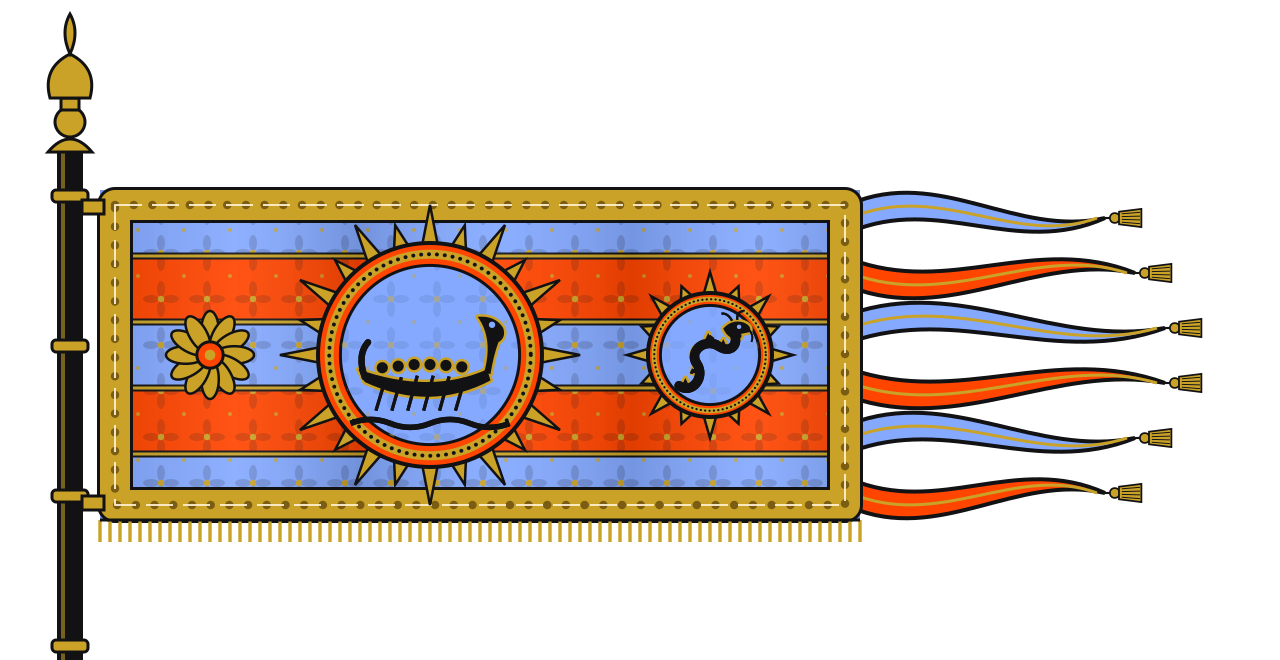
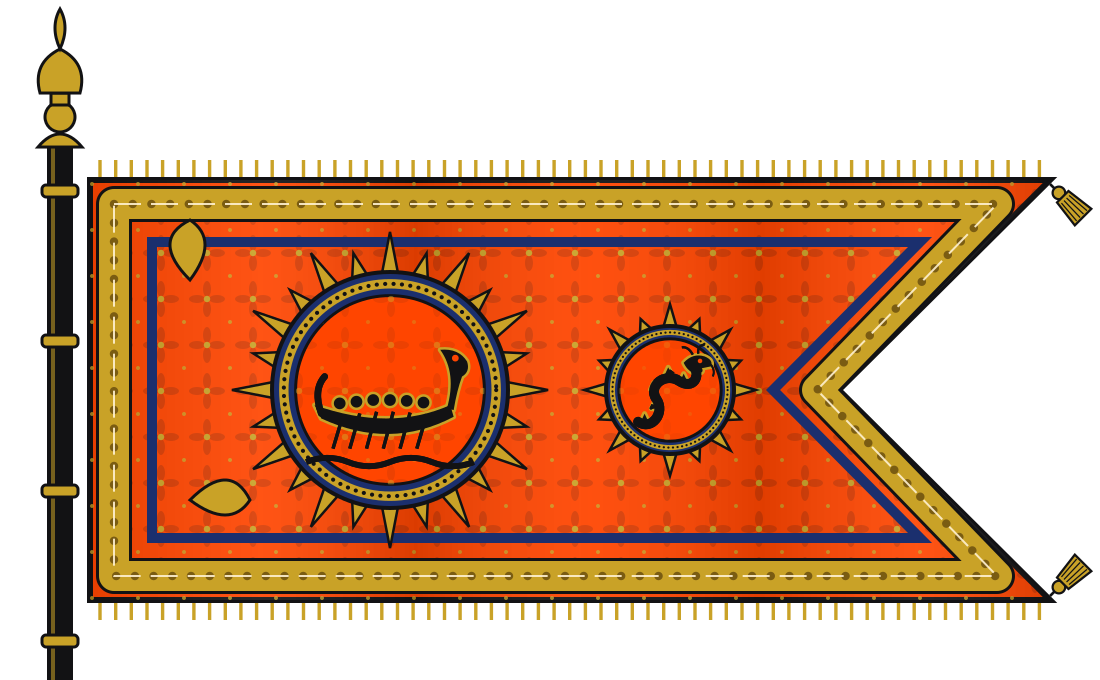
The Atlas gives the Ahom a war boat, for the river navy that won at Saraighat, and a dragon, for the royal insignia Ngi-ngao-kham, a winged lion-dragon[2]. From the Atlas, the flag type is a Vaijayanti.
| Part of the kit | This clan |
|---|---|
| Field | Intense Electric Blue #84A9FF |
| Accent | Fiery Vermilion #FF4500 |
| Emblem colour | Charcoal Black #121214 |
| Zari metal | Gold |
| Main emblem | A war boat |
| Second image | A dragon |
| Night and day | Every visual accessory has two versions: by night the emblem on the dark field, by day the clan's field colour on cloth woven from its metal. |
6. Flags
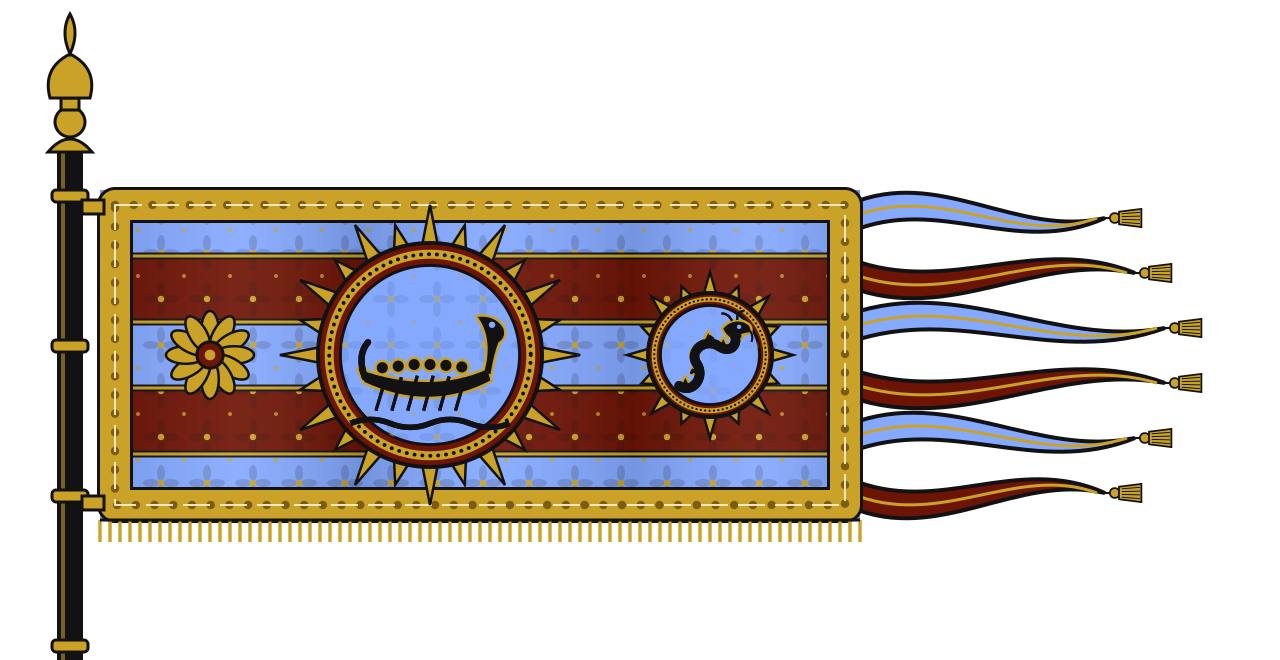
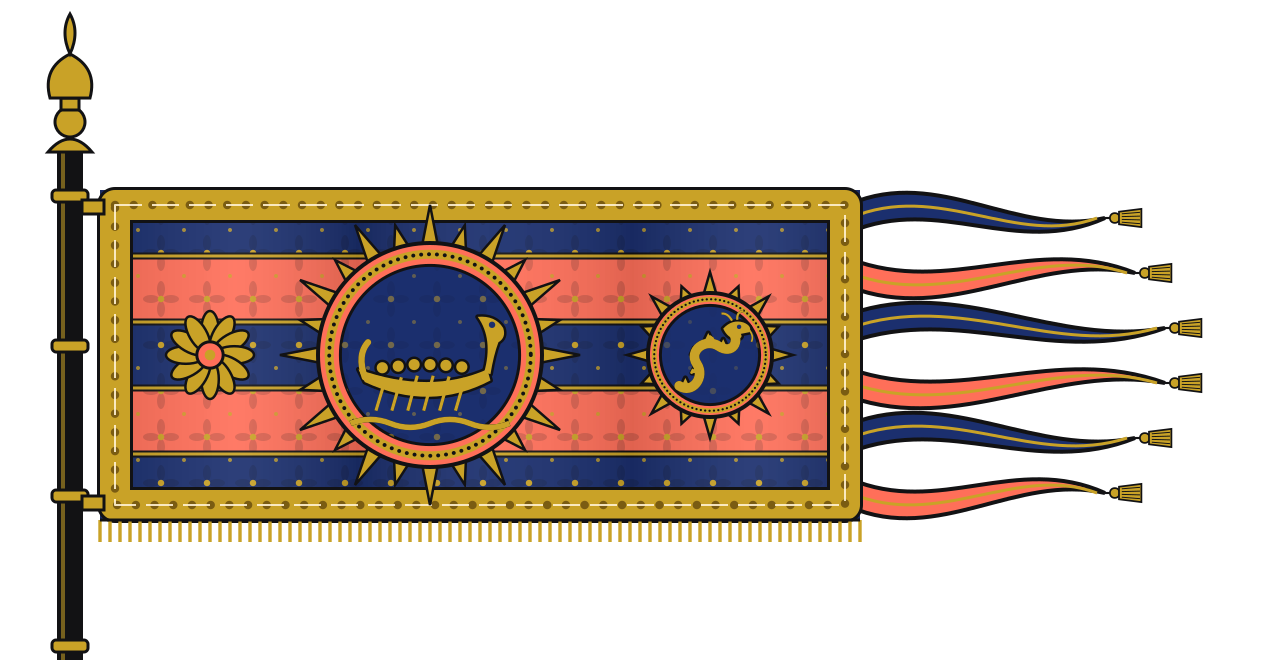
Every clan has every flag type; the type says the occasion and the colours say the clan. The outlined card is the flag the Atlas assigns.
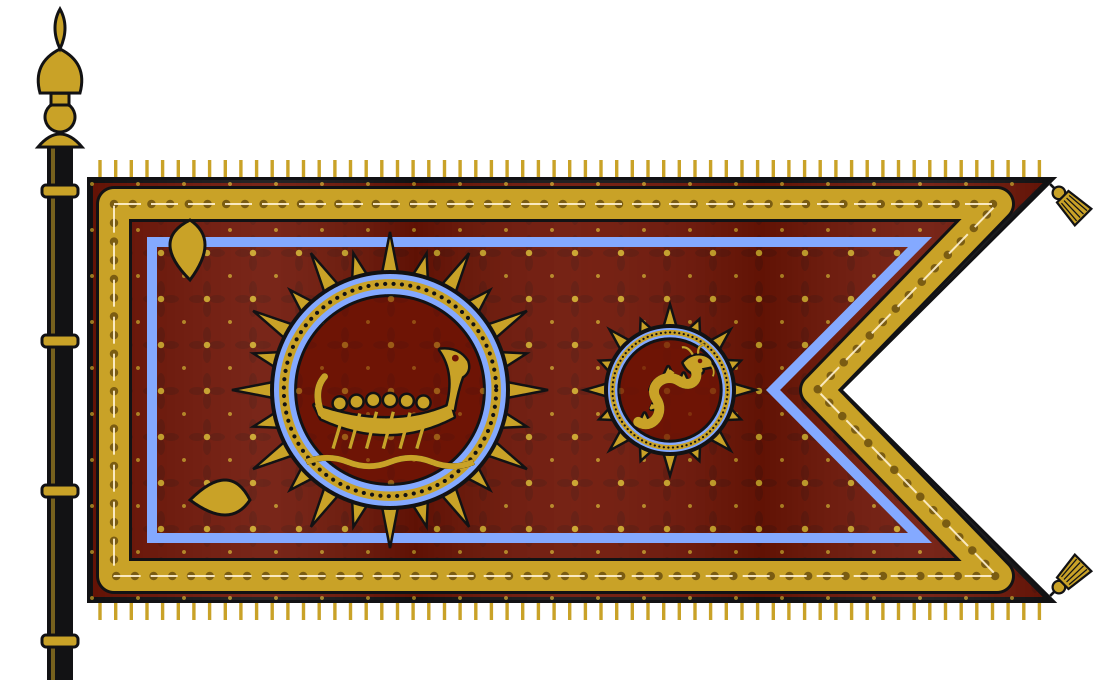
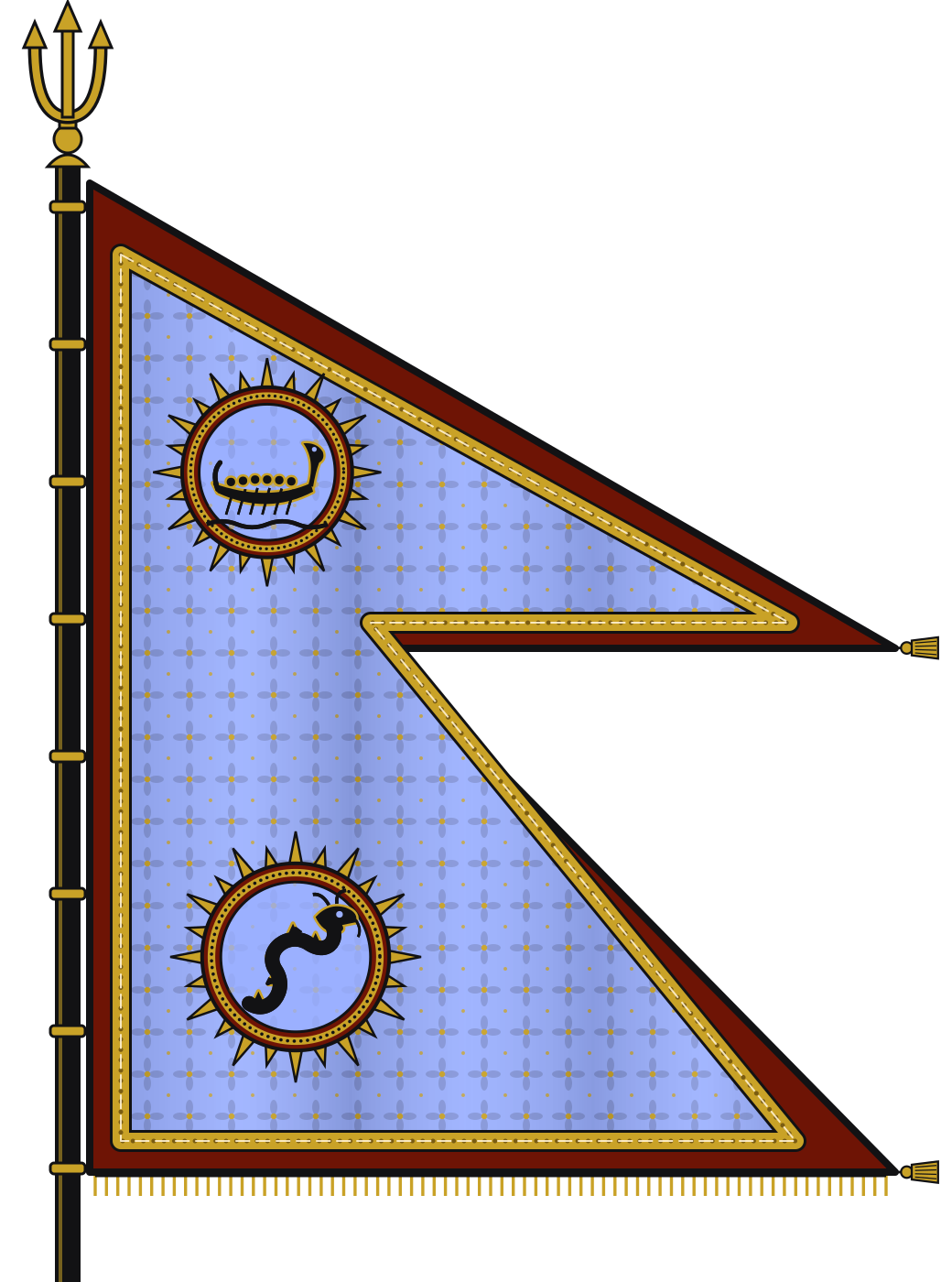
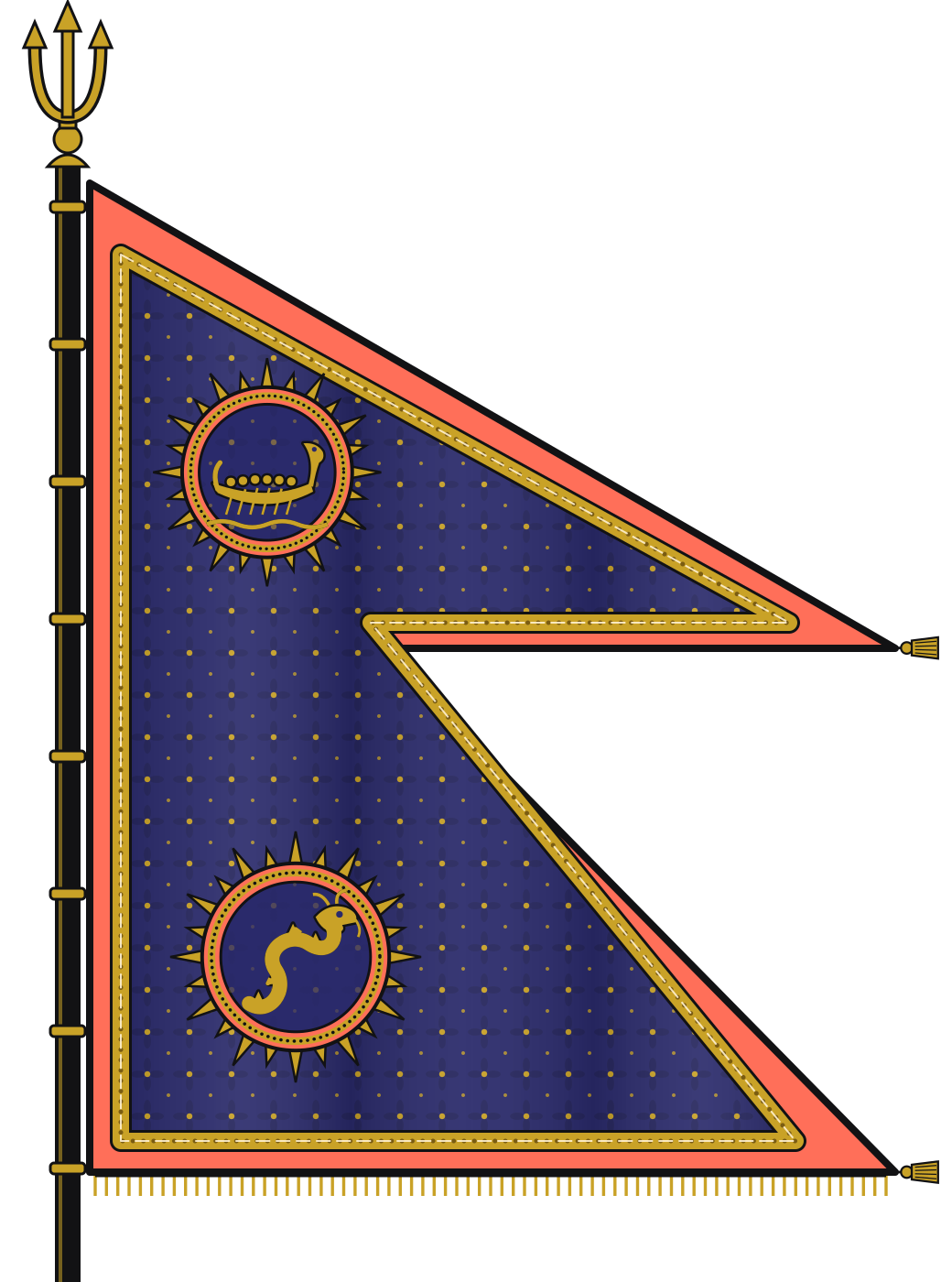
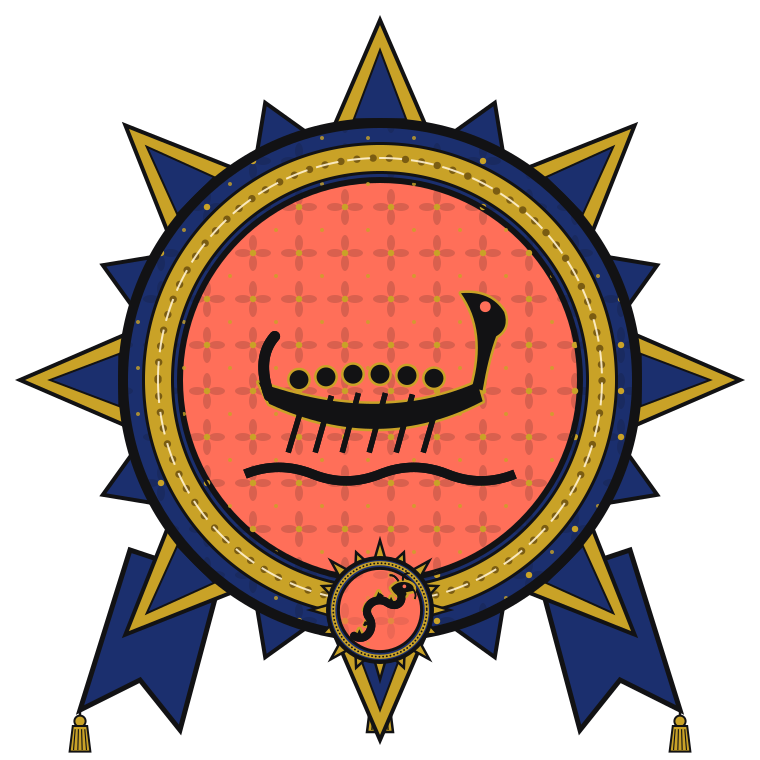
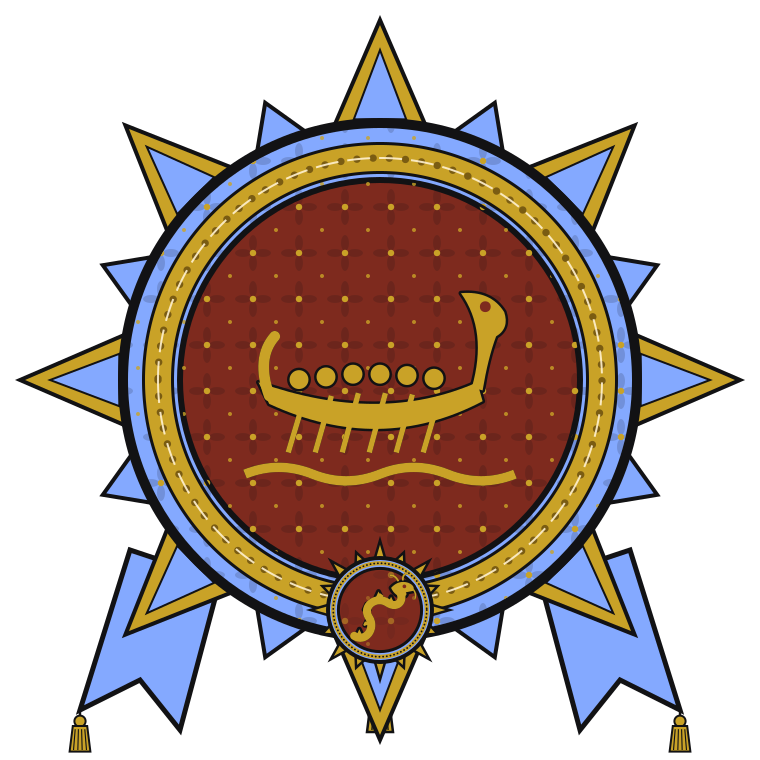
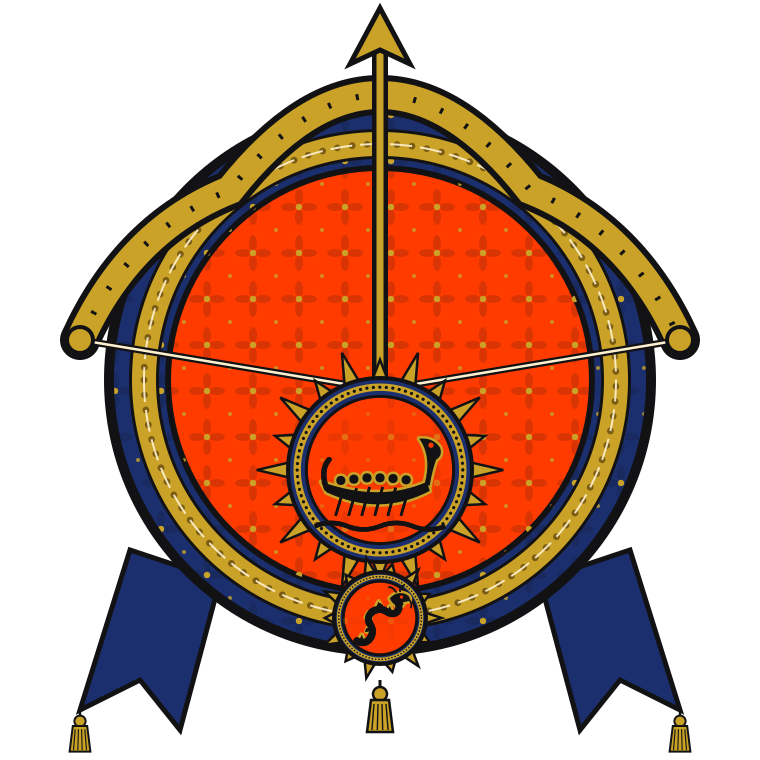
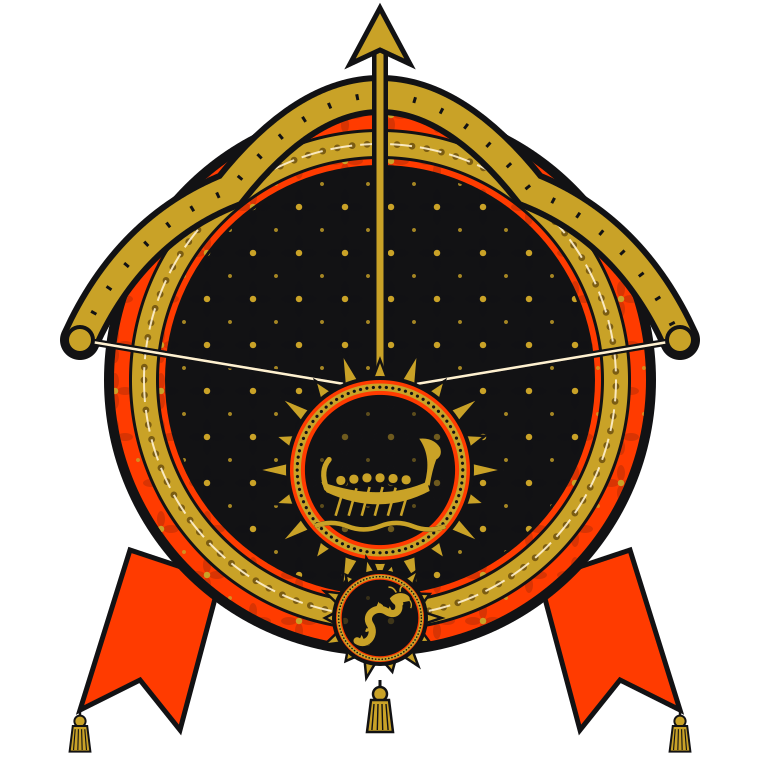
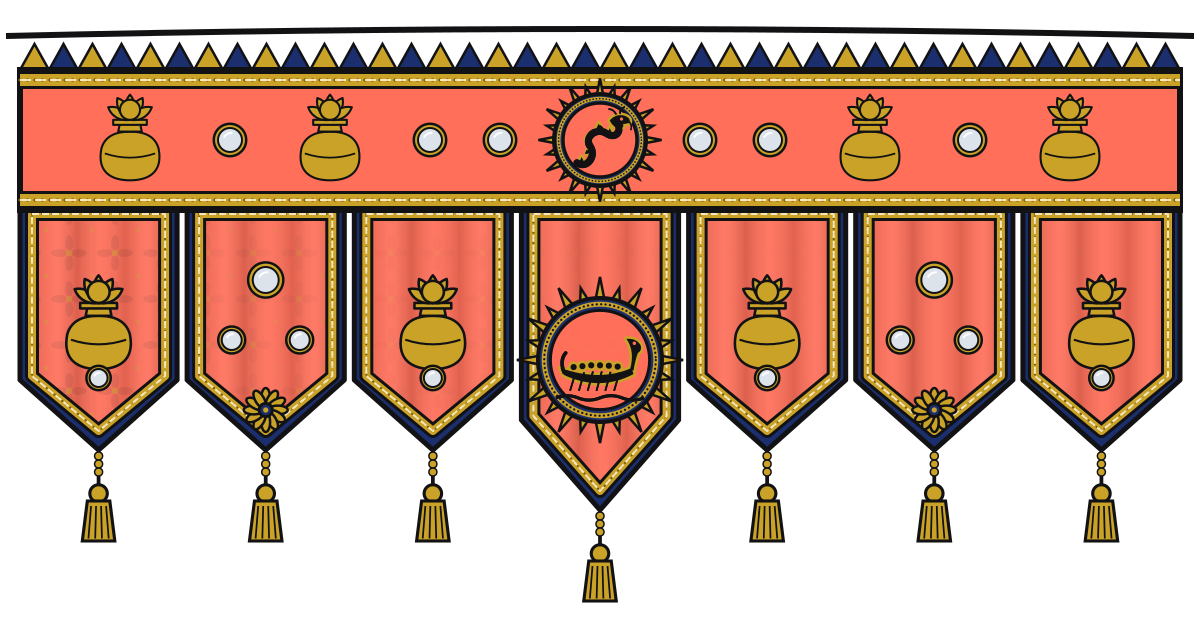
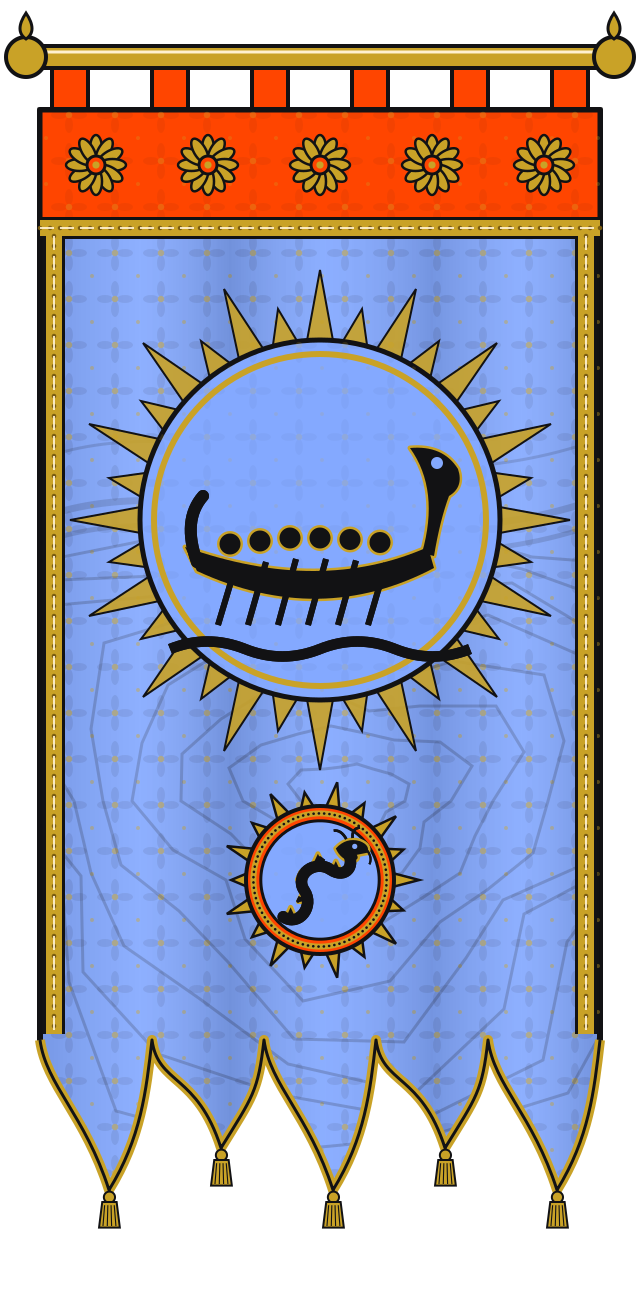
Historic banner
The Ahom kings' royal flag bore a dragon (Ngi-ngao)
New flag types
| Accessory | For this clan | Basis |
|---|---|---|
| A9 Pota-dhvaja · ship and trade flag For ships, caravans and markets | The bachari war boat The Ahom navy's war boats, the bacharis, fought at Saraighat (1671) on a bridge of boats[9] | Documented |
| A10 Utsava-patāka · festival flag Light, bright flag for fairs and festivals | Not yet designed for this clan | Design |
| A11 Shoka-dhvaja · mourning flag White cloth with the emblem outline in the clan's metal | Not yet designed for this clan | Design |
7. Regalia
| Accessory | For this clan | Basis |
|---|---|---|
| E1 Chhatra · house parasol The ceremonial umbrella | Not yet designed for this clan | Design |
| E2 Chamara · fly-whisks The pair of whisks beside the head of the house | Not yet designed for this clan | Design |
| E3 Danda · staff of office Staff or scepter | Not yet designed for this clan | Design |
| E4 Simhasana · seat The seat of the house, covered in clan cloth | Singarighar-utha, the coronation rite Sudangphaa held the first Singarighar-utha coronation (1397–1407)[2] | Documented |
| E5 Khetaka · shield A round shield; the Changi and Dhanush are its flag forms | Not yet designed for this clan | Regional tradition |
| E6 Kula-ayudha · clan weapon The weapon the clan honours | The heng-dan sword A sword with a place in Ahom rite: at the Chaklong wedding the bride gives the groom a heng-dan sword (manuscript Lai Lit Nang Hoon Pha)[1] | Documented |
8. Worn
| Accessory | For this clan | Basis |
|---|---|---|
| F1 Kula-vastra · clan cloth The clan's woven pattern in its kit colours | Not yet designed for this clan | Design |
| F2 Kirti-vastra · honour cloth A cloth earned for a deed, not inherited | Not yet designed for this clan | Design |
| F3 Kula-mala · garland flower The flower or leaf the clan wears as a garland | Not yet found for this clan | Under research |
| F4 Chinha · house pin A metal badge with the pin emblem | Not yet designed for this clan | Design |
9. Records
| Accessory | For this clan | Basis |
|---|---|---|
| H1 Clan words A traditional line in the native script | Mong Dun Sun Kham · “The Ahoms' own name for their kingdom” Clan words · the kingdom's name in the Ahom language[2] | Design |
| H2 Biruda · titles The house's title or titles | Swargadeo (the king); Chao-Pha (the royal title of Sukaphaa's line); Charing Raja (a royal title) | Documented |
| H3 Prashasti · praise genealogy The lineage as written at the head of a grant | Not yet found for this clan | Under research |
| H4 Vahi · clan register The book of the clan's births, marriages and deaths | Not yet found for this clan | Under research |
| H5 Rana-ghosha · war cry The clan's cry in battle or celebration | Not yet found for this clan | Under research |
10. VishwaVit · knower of the world
Game values are design choices for this project, not historical claims.
References
- Ahom people (Wikipedia, read 2026-10-08), citing A. Guha (1983), B. J. Terwiel (1996), Y. Saikia, Fragmented Memories (2004), P. Gogoi (1976), N. K. Gogoi (2006), S. Morey (2014), C. Daniels (2023) and Gogoi, Morey & Pittayaporn (2020).
- Ahom kingdom (Wikipedia, read 2026-10-08), citing A. Guha (1978–1986), S. L. Baruah (1986), Y. Saikia (1997, 2004), J. N. Phukan (1991, 1992), J. N. Sarkar (1992) and S. K. Bhuyan.
- Ahom language (Wikipedia, read 2026-10-08), citing B. J. Terwiel (1992, 1996), S. Morey (2014, 2015), A. Diller (1992) and N. C. Gogoi, Assamese-English-Tai Dictionary (1987).
- Ahom religion (Wikipedia, read 2026-10-08), citing P. Gogoi, Tai Ahom Religion and Customs (1976), S. Gogoi, Tai Ahom Religion: A Philosophical Study (PhD, 2011) and N. K. Gogoi (2006).
- Kamakhya Temple, Wikipedia (citing Shin 2010, Urban 2009–2019, Banerji 1925, Sarma 1981/1988, Nath 1989, Kakati 1989, Neog 1980).
- "India's moidam royal burial mounds are its latest World Heritage Site", Associated Press report, 26 July 2024 (headline seen in a search, 2026-10-08).
- Purandar Singha (Wikipedia, read 2026-10-09), citing S. K. Bhuyan, Tunkhungia Buranji (1968), H. Barbaruah, Ahomar-Din (1981), Gunaviram Barua, Assam Buranji, and E. A. Gait, A History of Assam (1906, 1926).
- Arnab Bhaumik, "Ekasarana Dharma of the Ahoms: Rongali Bihu of Sibsagar", photo-essay, Sahapedia (read 2026-10-08).
- Battle of Saraighat (Wikipedia, read 2026-10-09), citing S. L. Baruah (1986), S. C. Dutta (1981), S. K. Bhuyan, Lachit Barphukan and His Times (1947), P. Gogoi (1968), S. Kakoty (2003) and J. N. Sarkar (1992, 1994).
- Lachit Borphukan (Wikipedia, read 2026-10-08), citing S. K. Bhuyan, Lachit Barphukan and His Times (1947), J. Sharma (2004), J. N. Sarkar (1992) and A. Saikia (2008).
- Ahom rebellion (Wikipedia, read 2026-10-09), citing D. J. Das (2022), S. K. Bhuyan, Tunkhungia Buranji (1968) and H. Barbaruah, Ahomar-Din (1981).
- NE NOW, All Assam Ahom Association press release, 24 Dec 2025 (read 2026-10-10, URL)
- R. Buragohain, "The all Assam Ahom Association and Ahom politics of Surendranath Buragohain", Proceedings of North East India History Association, 26th session, Kokrajhar (2005), pp. 183-191 (record only, read 2026-10-10, URL)
- grstudyetc blog, 'When was the All Assam Ahom Sabha established?', 6 Sep 2023 (no sources cited; self-contradictory dates), read 2026-11-17, link
- Dipanjon Konwar, "The unresolved issue: Assam's six communities' ST status" (opinion), NE Now, 17 Dec 2025 (read 2026-10-10, URL)
- EastMojo, "Assam: Ahomland movement revives over delimitation draft", 20 Jul 2023 (read 2026-10-10, URL)
- Assam Tribune (Correspondent), 'Tai body demands autonomous council', dated 15 Sep 2010, read 2026-11-17, link
- The Tribune (PTI), Assam to send GoM report to Centre for granting ST status to 6 ethnic communities: CM, 30 Aug 2020, read 2026-10-29, link
- Lok Sabha Unstarred Question 627, ST status to the tribes in Assam, 6 Feb 2025, eparlib.sansad.in, read 2026-10-29, link
- The Sentinel (Digital Desk), 'Tai Ahom Yuba Parishad, Assam demands tribal status, autonomous council for Ahom community', 5 Sep 2022, read 2026-11-17, link
- ETV Bharat, "Assam Govt Approves GoM's Report on Granting ST Status to 6 Communities", 27 Nov 2025 (read 2026-10-10, URL)
- Ananya Bhattacharjee, "Six Assam communities move closer to ST status after cabinet approval", Assam Tribune, 27 Nov 2025 (read 2026-11-04), link
- Wikipedia, All Tai Ahom Students' Union, read 2026-10-24, link
- PTI, "Assam oppn claims ST status report 'vague', govt says 'all satisfied'", The Week, 30 Nov 2025 (read 2026-10-24, link)
- Compass by Rau's IAS, "ST Status for Six Communities in Assam: Key Recommendations and Constitutional Procedure", 12 Dec 2025 (updated 16 Dec), read 2026-10-24, link
- PTI via ThePrint, 'Interim report on ST status to 6 communities of Assam tabled in assembly', 29 Nov 2025, read 2026-11-17, link
- Digjyoti Lahkar, 'Assam: GoM's ST Report Sparks Outrage As 6 Communities Get New ST-Valley Category With No Real Benefits', Free Press Journal, 29 Nov 2025, read 2026-11-17, link
- Avik Chakraborty, "Assam: Six communities' ST panel report a 'poll plank', says Lurinjyoti Gogoi", NE Now, 1 Dec 2025 (read 2026-10-24, link)
- "Assam govt to invite those protesting against ST report to talks: Himanta", Deccan Herald, 30 Nov 2025 (excerpt only, read 2026-10-24, link)
- Assam Tribune, Centre receives Assam govt proposal seeking ST status for six communities, 30 Jan 2026, read 2026-10-29, link
- ThePrint (PTI), BJP ally BPF's MLA questions Assam govt over delay in granting ST status to 6 communities, 29 July 2026, read 2026-10-29, link
- Bihu (Wikipedia, read 2026-10-09 at en.wikipedia.com), citing Prafulladatta Goswami (1966, 1988), Hem Barua (1973), Maan Barua (2009) and S. K. Bhuyan, Deodhai Assam Buranji.