The Agariya (also written Agaria) are a community of iron smelters in the Maikal hills of central India, who smelt in clay furnaces with bellows and charcoal[1][2]. Russell and Hira Lal (1916) called them a small Dravidian caste, an offshoot of the Gond, while a 1943 review of Verrier Elwin's book reports an Asur kinship view and calls the Gond link incorrect[3][4]. Their family god is Dulha Deo, and Lohasur, the iron demon, is believed to live in the kilns[3]. The 2011 Scheduled Tribe lists count 41,243 Agariya in Madhya Pradesh and 17,376 in Uttar Pradesh[5][6].
01Faith and deities
Mahamaya of Ambikapur, goddess of Surguja
The presiding goddess of the clan's homeland or capital: a link of place, not a recorded clan tie.
| Deity or tradition | Place in the clan's life | Evidence |
|---|---|---|
| Dulha Deo | Family god; goats, fowls, coconuts and cakes | [3][1] |
| Bura Deo | Forest deity shared with the Gond, worshipped in the forest tracts | [3][1] |
| Lohasur | The iron demon of the smelting kilns, offered a black hen (formerly a black cow) | [3][1] |
| Koelasur and Agyasur | Tribal gods or demons linked to the ancient Asuras; Lohasur is said to appear as a child inside the kilns | [4][7] |
| Furnace prayer | A prayer (mantra) recited on completing a new furnace | [1] |
| Implement worship | Smelting implements worshipped at Dasahra and Phagun, with fowls offered | [3][1] |
| Not Vishwakarma or Tvashtri | The Agaria are unaware of Tvashtri and Visvakarma, the craft gods of Sanskrit literature | [4][7] |
02Temples
No temple built, patronised or later is recorded for the Agariya in the extracts. The sources describe worship of the family god, the forest deity Bura Deo and the kiln spirit, and do not name a shrine.
Built by the clan
Not recorded.
Given patronage or grants by the clan
Not recorded.
03Languages and scripts
| Language or script | Kind | Under the clan | Evidence |
|---|---|---|---|
| Dravidian speech | Earlier speech, believed | Believed originally Dravidian-speaking, as a branch of the Gond | [1] |
| Hindi | Used in some section names | Ahindwar, Ranchirai and Rathoria | [1] |
| Current spoken language research | Not in the extracts | Under research | — |
04Books and literature
The main written sources in the extracts are Russell and Hira Lal (1916) and Elwin's book (1942). No book in an Agariya language is recorded.
Written during the clan's history
| Work | Author | Kind | When | Link to the clan |
|---|---|---|---|---|
| The Tribes and Castes of the Central Provinces of India, vol. 2 | R. V. Russell and Hira Lal | Ethnography | 1916 | The Agaria entry[3] |
| The Agaria | Verrier Elwin | Ethnography | 1942 | Reviewed in 1943 and cited by Everyculture[4][1] |
Given patronage by the clan
Not recorded.
05Thinkers and scholars
| Name | Field | Era | Contribution |
|---|---|---|---|
| Verrier Elwin | Author of The Agaria | 1942 | Asur-kin view (as reported by the 1943 review)[4] |
| R. V. Russell and Hira Lal | Authors of the Central Provinces survey | 1916 | The Gond-offshoot view[3] |
| James Franklin | Major, Bengal Army | 1828 | Report for the East India Company on iron manufacture in Central India[8] |
| Jay DiMaggio | Author of the Gale encyclopedia entry | 2008 | The Everyculture and Encyclopedia.com text[1][2] |
| Amarendra Kishore | Writer | 2014 | Mainstream Weekly article on the 2003 notification[7] |
Advocacy-leaning journalism (Mainstream Weekly, 2014) is marked as such in the sources above.
06Art and architecture
The extracts describe iron and its tools, not painting, sculpture or architecture.
Painting and wall art
Not recorded.
Sculpture and temple art
Not recorded.
Temple and building architecture
Not recorded.
Weaving and textiles
Not recorded.
Clothing and jewellery
Not recorded.
Coins, pottery and crafts
| Art form | What it is | Era | Evidence |
|---|---|---|---|
| Clay furnace and bellows living | Low clay shaft furnace; charcoal of sal and teak, mostly deadwood; foot-worked bellows of cow-hide or bamboo tubes; tuyeres made by women | 1916 to 2014 | [8][7][3][1] |
| Iron tools | Ploughshares, mattocks, axes and sickles; iron talismans and nails | Recorded in the 1943 review and Everyculture (2008) | [1][4] |
07History
Origins in the community's own telling
The Agarias think their caste existed from the beginning of the world, and that the first Agaria made the ploughshare[3]. They see themselves as descendants of the twelve brothers of the mythical Lohasur; his kin split into Asuras or Agarias, Lohars and Birjias[8].
A Gond offshoot (1916)
Russell and Hira Lal record a small Dravidian caste, an offshoot of the Gond, that took up iron-smelting. In 1911 it numbered 9,500, spread over the Maikal range of Mandla, Raipur and Bilaspur. They suggest the name comes from ag, fire[3]. Everyculture repeats the Gond view, notes that some clan names are Hindi, and suggests this reflects the incorporation of northern Hindus[1].
An Asur kinship view (1943)
A 1943 review of Verrier Elwin's The Agaria (1942) reports that the Agaria and Asur may descend from one tribe, the metal-workers of Sanskrit literature, while noting an opposing opinion. The reviewer calls Russell and Hira Lal's Gond link incorrect[4]. Mainstream Weekly (2014) gives Elwin's view as descent from the Asura, pushed into the Maikal hills after invading Munda country[7]. The Asur tradition credits the Asur, Agariya and Birjia together with discovering iron smelting, and Sahapedia calls them one community under different names[9].
Iron city and the Pandavas (legend)
Several legends are told. In one account the Pandavas destroyed the iron city of Logundi Raja, in another Krishna did[4]. Mainstream Weekly names the iron city Lohitpur and records other versions crediting Narayan Deo or Suraj Deo[7]. DTE says the Mahabharata is said to mention the Agarias and that the Pandavas reportedly routed the Agaria king Longundi Raja; the article gives this as hearsay[8].
Iron praised in a report (1828)
Major James Franklin of the Bengal Army wrote a report for the East India Company on iron manufacture in Central India. He quoted a Calcutta Mint report judging Indian iron tougher under bending than ordinary British iron, and Col. Presgrave of Sagar Mint rated Indian bar iron favourably against Swedish iron[8]. DTE does not say which smelters the report describes.
Decline after 1857
After 1857 and formal colonisation, iron smelting was banned and the Agarias lost their occupation, according to DTE (1997). The article gives no date or statute for the ban[8]. DTE records that furnaces run by Agarias in Madhya Pradesh fell from 100 to fewer than five by 1994, which it attributes to restrictions on collecting ore and wood[8].
Furnaces for industry (1943 and 1964)
A 1943 review gives about 11,000 Agaria in the Agaria belt and noted that small clay furnaces survived because coal, water and iron were absent nearby[4]. In 1964 Moni Ghose of TISCO had Agarias run furnaces at Jiragoda, Chiglabecha (Orissa) and Kamarjoda (Bihar)[8].
Senduria and the 2003 notification
Mainstream Weekly (2014) says that in the 1920s the British moved the Agaria to Senduria village in Garhwa district, Jharkhand, to work a limestone pit; the article gives this as its claim[7]. A Union notification of 7 January 2003 asked states to add "Agaria" to the Asur Scheduled Tribe status. Chhattisgarh implemented it, and Jharkhand had not as of 2014[7].
08Journey and migrations
A 1943 reviewer suggests that an Asur tribe moved from Chota Nagpur into the Maikal hills; the extracts do not describe the Agaria making that move. The sources record some Agaria work sites outside the homeland, from the 1920s and 1964. Most dates are not fixed.
| When | From | To | Why | Evidence |
|---|---|---|---|---|
| Date unknown (reviewer's suggestion) | Chota Nagpur (Asur tribe) | Surguja, Udaipur, Korea and Bilaspur, then the Maikal Hills | A 1943 reviewer's suggested route for the Asur tribe | [4] |
| 1920s (article's claim) | Not stated | Senduria village, Garhwa district (Jharkhand) | To work a limestone pit, per Mainstream Weekly | [7] |
| 1964 | Not stated | Jiragoda, Chiglabecha (Orissa), Kamarjoda (Bihar) | Furnaces for TISCO | [8] |
09Seats and lands
| Place | Role | Where today |
|---|---|---|
| Maikal range (Mandla, Raipur, Bilaspur) | Homeland in the 1916 and 1971 accounts | Mandla, Raipur and Bilaspur districts, as named[3][1] |
| Bilaspur zamindaries | Recorded area in the 1943 review | Named in the review, no state given[4] |
| Rewa and Bilaspur | Recorded areas (Mainstream Weekly, 2014) | Madhya Pradesh[7] |
| Sonbhadra and Mirzapur | Recorded areas; Sonbhadra is the Uttar Pradesh list district | Uttar Pradesh[7][6] |
| Mirzapur and Bengal | Similar Agarias recorded in 1916 | Not stated[3] |
| Kaimur plateau | Recorded area (Mainstream Weekly, 2014) | Bihar[7] |
| Senduria village, Garhwa district | Relocation by the British in the 1920s (article's claim); about 1,000 families in 2014 | Jharkhand[7] |
| Jiragoda, Chiglabecha, Kamarjoda | Furnaces run by Agarias for TISCO, 1964 | Orissa and Bihar, as the source names them[8] |
10Notable figures
| Name | Role | Era | Known from |
|---|---|---|---|
| Lohasur legend | Iron demon of the kilns; the Agarias trace their descent from his twelve brothers | Mythic | [8][4] |
| Logundi Raja legend | King of an iron city, defeated by the Pandavas (or by Krishna) | Mythic | [4][7][8] |
| Jwala Mukhi legend | Hero; plays Rahu and swallows the sun | Mythic | [7][4] |
| Kariya Kuar legend | Named hero; no story is recorded in the extracts | Mythic | [4][7] |
| Agar Sai legend | Named hero; no story is recorded in the extracts | Mythic | [7] |
| Moni Ghose | Of TISCO; had Agarias run furnaces at three sites | 1964 | [8] |
11Allies, rivals and marriages
| People | Relationship | When |
|---|---|---|
| Asur (ST-012) | Possible common origin (Elwin's view, as reported in 1943); the Asur tradition credits the same ironwork; contested | 1943 review; Sahapedia |
| Birjia (ST-041) | Kin in the Lohasur story; named with the Agariya and Asur as the iron-discovering community | DTE 1997; Sahapedia |
| Gond (ST-088) | Russell's view is that the Agaria are a Gond offshoot; Raipur Agarias intermarry with Rawanbansi Gonds; they share Bura Deo | 1916; Everyculture |
| Lohar | Separate Hindu blacksmith caste: Lohars forge iron but do not smelt and refuse the cow-hide bellows; Asur and Chokh refused marriage with a Hindu Lohar subgroup | 1943 review; 1997; 2014 |
| Chok (Chokh) | Intermarried with the Asur | Everyculture |
| Munda and Kolarian groups | May be related, as a 1943 reviewer suggests | 1943 review |
| Birhor, Baiga, Korwa, Pharia, Mandala Agaria | Compared in a 1943 review (comparison, not descent) | 1943 review |
12Society and livelihood
The Agariya are patrilineal. Everyculture (Gale, 2008) records that a father arranges marriages, that bride-price is paid days before the wedding, that first-cousin marriage is allowed, that a widow marries her late husband's younger brother, and that divorce follows adultery, extravagance or mistreatment. They live in their own village section or in a hamlet outside town[1].
Government and social order
| Institution or group | What it was | Evidence |
|---|---|---|
| Patharia and Khuntia | Two endogamous divisions; they do not share water | [1] |
| Exogamous sections | Named with Gond names and Hindi names; the septs are male-line and totemic | [3][4] |
| Sonwani sept | Performs the purification and readmission of members | [3] |
| Furnace work | Men dig furnace post-holes and do the heavy work; women plaster the walls, work the bellows and make the clay tuyeres; children carry water and clay | [1] |
| Marriage season | Marriage may take place in the rains, when smelting stops | [3][1] |
| Burial | Russell says the dead are usually burnt, and Mainstream Weekly says the dead are buried (documented at the Jharkhand TRI, Ranchi); the sources differ | [3][7] |
| Iron as protection | Iron is buried with the dead; nails are set in doors and trees; iron rings are worn as talismans | [4] |
Livelihood over time
| Era | Livelihood | Evidence |
|---|---|---|
| Earlier, undated | Smelting iron in clay furnaces (no date in the sources); ploughshares, mattocks, axes and sickles | [1][3] |
| After 1857 | Smelting banned, per DTE (no date or statute given) | [8] |
| 1943 | Small clay furnaces survive; workers paid every fourth day | [4] |
| 1964 | Furnaces run for TISCO at three sites | [8] |
| 1994 | Furnaces in Madhya Pradesh fall from 100 to fewer than five | [8] |
| 2014 | Live on the margins as ironsmiths and farm labourers | [7] |
13Sub-clans and related clans
The Agariya have two endogamous divisions and a set of exogamous sections, some with Gond names and some with Hindi names, plus totem septs recorded in 1943. Each is listed here so that it can be reviewed as a new clan candidate.
| Clan | Relation | Where | Size | In the Atlas | Evidence |
|---|---|---|---|---|---|
| Patharia | Sub-clan | Endogamous division; local name in Bilaspur | new clan candidate | [3][1][7] | |
| Khuntia | Sub-clan | Endogamous division | ST-423 | [3][1] | |
| Sonwani | Sub-clan | Exogamous section (Sonureni in Everyculture) | ST-556 | [3][1] | |
| Dhurua | Sub-clan | Exogamous section | new clan candidate | [3][1] | |
| Tekam | Sub-clan | Exogamous section | ST-502 | [3][1] | |
| Markam | Sub-clan | Exogamous section | ST-453 | [3][1] | |
| Uika | Sub-clan | Exogamous section | new clan candidate | [3][1] | |
| Purtai | Sub-clan | Exogamous section | new clan candidate | [3][1] | |
| Marai | Sub-clan | Exogamous section | new clan candidate | [3][1] | |
| Ahindwar | Sub-clan | Exogamous section with a Hindi name | new clan candidate | [3][1] | |
| Ranchirai | Sub-clan | Exogamous section with a Hindi name | new clan candidate | [3][1] | |
| Rathoria (Rattoria) | Sub-clan | Exogamous section with a Hindi name | new clan candidate | [3][1] | |
| Jal | Sub-clan | Totemic sept (male line); avoids fish | new clan candidate | [4] | |
| Kewachi | Sub-clan | Totemic sept; avoids picking the named flower | new clan candidate | [4] | |
| Kukra | Sub-clan | Totemic sept; avoids eating the cock | new clan candidate | [4] | |
| Nagas (sept) | Sub-clan | Totemic sept; avoids killing a cobra | new clan candidate | [4] | |
| Asur Agaria | Related people | Local name in Bilaspur (Mainstream Weekly) | ST-364 | [7] | |
| Chok (Chokh) | Related people | Local name in Bilaspur; intermarried with the Asur | new clan candidate | [7][1] | |
| Mahali | Related people | Local name in Bilaspur | new clan candidate | [7] | |
| Asur (ST-012) | Related people | Netarhat plateau (Latehar, Gumla, Lohardaga), per Sahapedia; a 1943 kinship view | ST-012 | [4][9] | |
| Birjia (ST-041) | Related people | Named with the Asur and Agariya; no place recorded in the extracts | ST-041 | [8][9] | |
| Baiga (ST-014) | Related people | Compared in the 1943 review | ST-014 | [4] | |
| Gond (ST-088) | Parent people | Russell's claimed parent (contested) | ST-088 | [3][4] | |
| Rawanbansi Gond | Related people | Raipur; intermarry with the Agaria | new clan candidate | [3] | |
| Lohar | Related people | Hindu blacksmith caste; does not smelt | new clan candidate | [7][8] | |
| Munda (ST-229) | Related people | Kolarian group; suggested relation only | ST-229 | [4] | |
| Birhor (ST-040) | Related people | Compared in the 1943 review | ST-040 | [4] | |
| Korwa (ST-157) | Related people | Compared in the 1943 review | ST-157 | [4] | |
| Pharia | Related people | Compared in the 1943 review | new clan candidate | [4] | |
| Mandala Agaria | Related people | Compared in the 1943 review (spelling as printed) | new clan candidate | [4] |
Clans marked "new clan candidate" are not in the Atlas yet.
14Surnames
No surname is recorded for the Agariya in the extracts. The names above are sub-clan, section and sept names, so none is listed here as a surname.
Not recorded.
15Songs and music
No Agariya song is recorded in the extracts.
None recorded yet.
16Poems, lullabies and children's rhymes
No poem or rhyme of the Agariya is recorded in the extracts.
None recorded yet.
17Stories, legends and proverbs
Stories and legends
| Story | What happens | Told by | Evidence |
|---|---|---|---|
| Logundi Raja's iron city legend | The Pandavas (or Krishna) destroy the iron city of Logundi Raja | Agaria, per the 1943 review and Mainstream Weekly (2014) | [4][7] |
| Jwala Mukhi and the sun legend | Jwala Mukhi plays Rahu and swallows the sun | Mainstream Weekly (2014) | [7] |
| Creation and the war with the sun legend | Myths of creation, a war with the sun, and the origin of the gods | Agaria, per the 1943 review | [4] |
| The twelve brothers of Lohasur legend | The Agaria see themselves as descendants of Lohasur's twelve brothers | Agaria, per DTE (1997) | [8] |
Proverbs and sayings
Not recorded.
18Festivals and fairs
| Festival or fair | When | Where | What happens |
|---|---|---|---|
| Phagun and Dasahra | Phagun and Dasahra; dates not stated | Not stated | Smelting implements worshipped, with fowls offered[3][1] |
| Kunwar water rite | Kunwar | Not stated | Water is offered to the dead[3] |
19Food, dress and games
Food
| Item | What it is | Evidence |
|---|---|---|
| Urad (black gram) | Held in great respect | [3] |
Dress
| Item | What it is | Evidence |
|---|---|---|
| Tattoos of flowers and scorpions | Worn by the Agaria | [3] |
| Iron rings and anklets | Made of virgin iron; bangle styles mark the divisions | [4] |
Games and martial arts
Not recorded.
Tags: living still practised · revived brought back after a break · lost known only from records · research reported but not yet confirmed from a source. Songs and poems under copyright are listed by title only; restricted or sacred material is noted without its content.
20Status today
The Agariya are a Scheduled Tribe in Madhya Pradesh and Uttar Pradesh in the 2011 census lists. Their iron-smelting, once spread over the Maikal range, is much reduced, and many now work as ironsmiths and farm labourers[5][8][7].
Who carries the name today
| Community | Link | Basis | Evidence |
|---|---|---|---|
| Asur (ST-012) | Possible common origin, in Elwin's view as reported in 1943; the Asur tradition credits the same ironwork | Disputed | [4][9] |
| Birjia (ST-041) | Named with the Agariya and Asur as the iron-discovering community | Community tradition | [9][8] |
| Gond (ST-088) | Russell's claimed parent of the Agaria | Disputed | [3][4] |
Recognised heritage
| What | Recognition | Evidence |
|---|---|---|
| Scheduled Tribe status | 2011 census lists for Madhya Pradesh and Uttar Pradesh; Atlas | [5][6] |
| 2003 notification (Asur status) | Chhattisgarh implemented it; Jharkhand had not as of 2014 (article) | [7] |
| Forest Rights Act and housing | About 1,000 families in Garhwa (2014): without ST certificates they cannot claim Forest Rights Act 2006 rights, and they are excluded from the Indira Awas Yojana (article) | [7] |
Not yet reviewed by the Agariya community. The sources are published ethnography and journalism, some of it advocacy-leaning.
21For children
The iron of the hills
Far away in the green hills of central India, the Agariya make iron. They build a clay furnace and blow the fire with bellows worked by foot. Inside the kiln, they believe, lives Lohasur, the iron spirit. When a new furnace is finished, they say a prayer. The iron they make becomes ploughs, axes and sickles that help people work the land. The Agariya are proud of their craft.
Written for this project
Riddle: I have a mouth but no tongue. I am built from clay and fire, and I give out iron. What am I? (A furnace)
22Across the project
| Project | What carries this clan | Status |
|---|---|---|
| Atlas of the Janas | No pin yet; the sources give the Maikal range (Mandla, Raipur, Bilaspur) as the homeland | Not yet placed |
| KulDevi and GrahDevi | KulDevi Mahamaya of Surguja (Navadurga); no source ties the Agariya to her | From the Atlas |
| Planet naming | Not checked against the Tier registers | To check |
| Renaming and waters | The name may come from ag (fire), from Agni, or from the demon Agyasur, meaning born in flame[1][3] | Recorded in the sources |
23Open questions
- Name: the sheet and the Scheduled Tribe lists say Agariya, the sources say Agaria. The Atlas also lists 'Agaria' as another name of the Asur (ST-012), and has 'Agaria Asur' (ST-364). Decide which entry these sources describe.
- Descent: the Gond-offshoot view (Russell, 1916) and the Asur-kin view (Elwin, as reported in 1943) are both unsourced at first hand ([3] and[4]). Read Elwin's The Agaria (1942) before settling it.
- The 2011 Uttar Pradesh table notes that ten tribes were added in 2003 with status limited to specific districts. Check whether the Agariya entry is one of them, and which districts it covers.
- The native name अगरिया comes from the pack, not from an extract. Check it against a Hindi source.
- Official status in Chhattisgarh (the sheet lists it) is not confirmed by a list in the extracts.
- Current spoken language and language vitality: not in the extracts. Read the rfppl.co.in study of Agarias in Chhattisgarh.
- Surnames: none is sourced. Check Russell and Hira Lal (1916) vol. 2 for family names.
- The Baiga creation legend (Agaria as iron smelters made by God), the Baiga's use of Agaria iron tools, and a Birjia language note on the Asuri nation are in the pack, but their sources are not in the cache. Check them before use.
- Mahabharata link: DTE says the Mahabharata is said to mention the Agarias; the article gives this as hearsay. Find a primary source or drop it.
- The 1920s Senduria relocation and the 1857 smelting ban are each sourced to one article without a date or statute. Find the Franklin 1828 report and any ban order.
- Chok, Mahali, Pharia and Mandala Agaria are named without a master ID. Check against the Atlas (Chokhar SUB-142, Mahli ST-180) before harvest.
- The Nagas sept is named 'Nagas (sept)' to avoid confusion with the ancient people Nagas (ANC-088).
- Lohar is not in the Atlas by that name. Decide whether it becomes a clan candidate.
- Temples and shrines: none is recorded. Elwin (1942) may give more ritual detail for Dulha Deo and Lohasur.
- Unread leads from the pack: villagesquare.in (last alchemists), gaatha.org, Sahapedia's Bastar iron article, asianethnology.org (1852 article), materialintelligencemag.org, forwardpress (Birjia Asurs and Agarias, library key fp_birajia_asur_2017), ShodhKosh, millenniumpost.in.
- Words: no clan line is sourced. Elwin (1942) or a Hindi source may give one.
- Community review of this page has not happened.
- Burial: Russell and Hira Lal (1916) say the dead are usually burnt[3]; Mainstream Weekly (2014) says the Agaria bury their dead, documented at the Jharkhand TRI, Ranchi[7]. The page states both; settle it before a burial rule is given as fact.
24Astitva
अस्तित्व · being, existence: everything by which the clan is known
The sources record no coin, seal, war cry or title for the Agariya. Their recorded symbols are the totems of the septs (fish, a flower, cock and cobra), and the iron protections and worship of the furnace[4][3]. Patharia on the bellows mouth is a stone, and Khuntia a peg (Russell, 1916).
Every clan has every accessory, royal objects included. Each one says how it is known: Documented This clan's own object is recorded. · Regional tradition Recorded for the region or for peoples like this one, not for this clan. · Design Made for this project, with no historical claim. · Under research To be found for this clan from sources. Legends and titles are written in the clan's own script.
1. Seals and coins
| Accessory | For this clan | Basis |
|---|---|---|
| B1 Rajamudra · house seal Round seal with the clan emblem and a short legend in the clan's script | Not yet designed for this clan | Design |
| B2 Anguliya-mudra · signet ring Personal seal ring of the head of the house | Not yet designed for this clan | Design |
| B3 Chhapa · house stamp Ink or block stamp for letters, goods and cloth | Not yet designed for this clan | Design |
| B4 Tamrapatra · charter plate Copper-plate grant on a ring, closed with the house seal | Not yet designed for this clan | Design |
| B5 Shreni-mudra · guild or trade seal Seal for the clan's trade, craft or caravan | Not yet designed for this clan | Design |
| C1 Clan coin Emblem or deity on one side, a legend in the clan's script | Not yet designed for this clan | Design |
| C2 Coin die The die that strikes the coin | Not yet designed for this clan | Design |
2. Living symbols
| Accessory | For this clan | Basis |
|---|---|---|
| I1 Totem trio The tree, bird and animal the clan protects | Sept totems: fish (Jal), a flower (Kewachi), cock (Kukra), cobra (Naga). These are taboos, not a trio of tree, bird and animal. The Jal sept avoids fish, Kewachi avoids picking the named flower, Kukra avoids eating the cock, and the Nagas avoid killing a cobra[4] | Documented |
| I2 Kaval-maram · guardian tree The tree that stands at the clan's seat | Not yet found for this clan | Under research |
3. Stone and gate
| Accessory | For this clan | Basis |
|---|---|---|
| G1 Torana · gateway The built gate of the seat; the cloth Toran hangs in it | Not yet designed for this clan | Regional tradition |
| G2 Viragallu · hero stone Carved panel stone for a member who died defending the clan | Not yet designed for this clan | Regional tradition |
| G3 Kula-shila · clan stones Standing and table stones that remember the ancestors | Not yet designed for this clan | Design |
| G4 Jayastambha · victory pillar A pillar raised for a victory | Not yet designed for this clan | Design |
| G5 Sima-shila · boundary stone Marks the clan's land, with a line in the native script | Not yet designed for this clan | Design |
4. Sounds
| Accessory | For this clan | Basis |
|---|---|---|
| D1 Pancha-mahashabda · five great sounds The right to five instruments | Not yet designed for this clan | Design |
| D2 Shankha · clan conch The clan's own named war conch | Not yet designed for this clan | Design |
| D3 Murasu · house drums Three drums: war, charity and justice | Not yet designed for this clan | Design |
5. Kit: colours, metals and emblems
The Atlas's main emblem is a clay iron-smelting furnace with flames, with crossed hammer and tongs. It is a project design: the sheet lists no historic emblem for the Agariya. The furnace is the craft the sources describe[1].
| Part of the kit | This clan |
|---|---|
| Field | Deep Brick #7E2A1E |
| Accent | Intense Electric Blue #84A9FF |
| Emblem colour | Metallic Gold #C9A227 |
| Zari metal | Gold |
| Main emblem | A clay iron-smelting furnace with flames |
| Second image | Crossed hammer and tongs |
| Night and day | Every visual accessory has two versions: by night the emblem on the dark field, by day the clan's field colour on cloth woven from its metal. |
6. Flags
Every clan has every flag type; the type says the occasion and the colours say the clan. The outlined card is the flag the Atlas assigns.
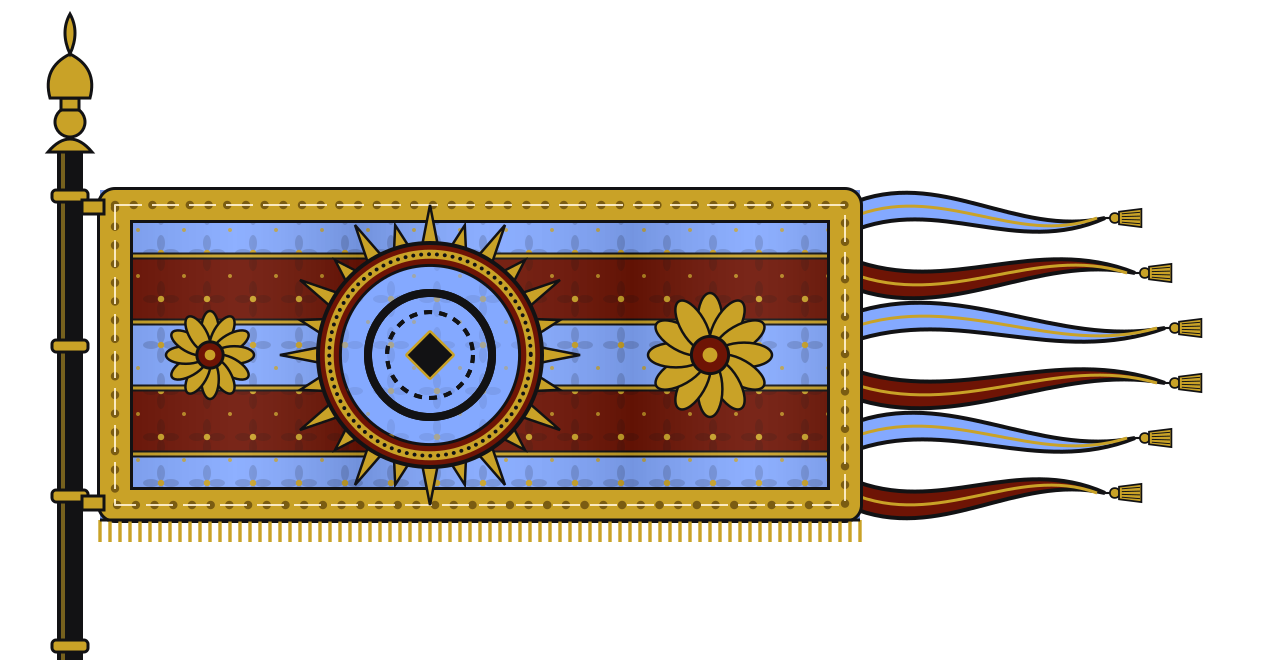
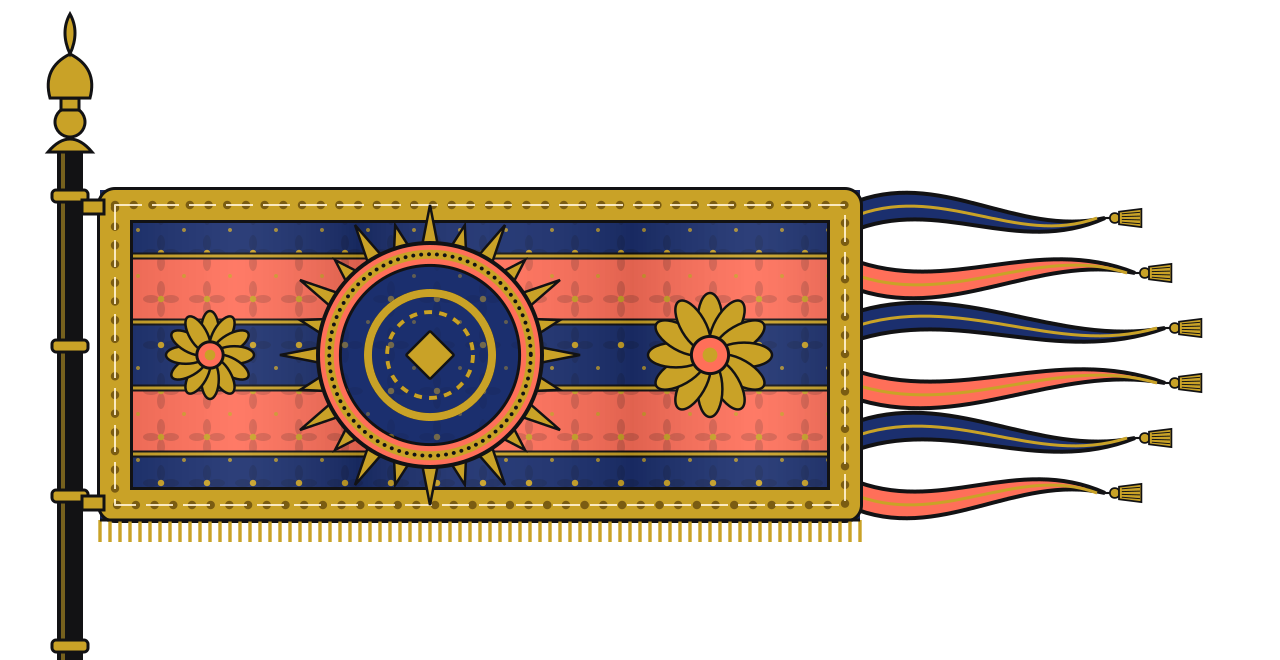
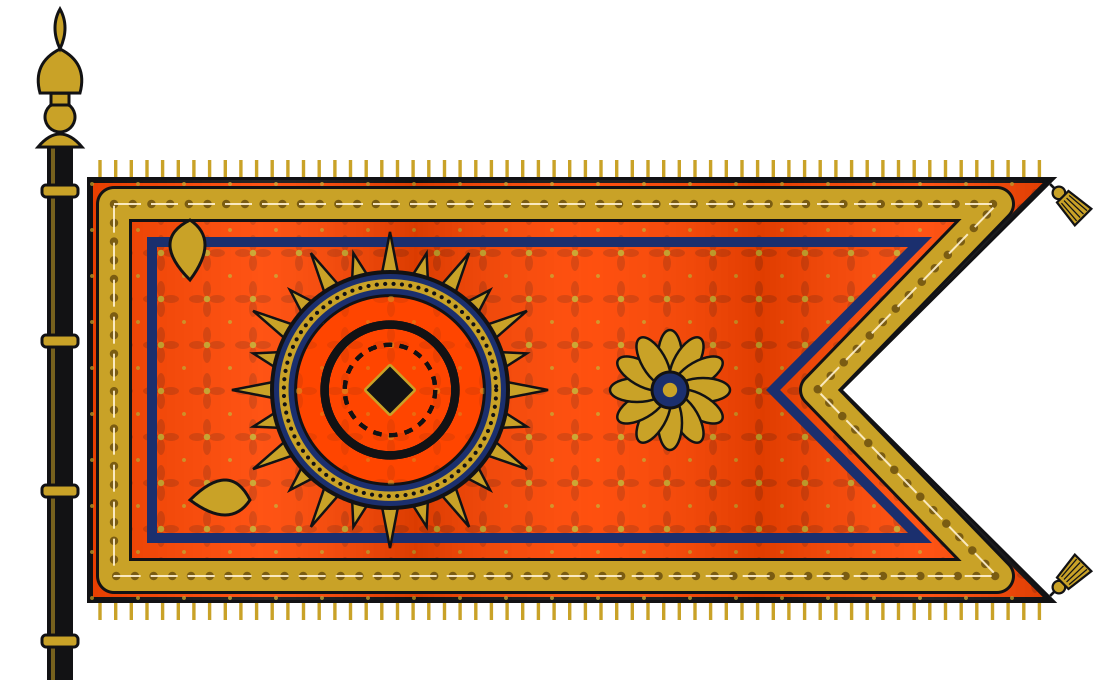
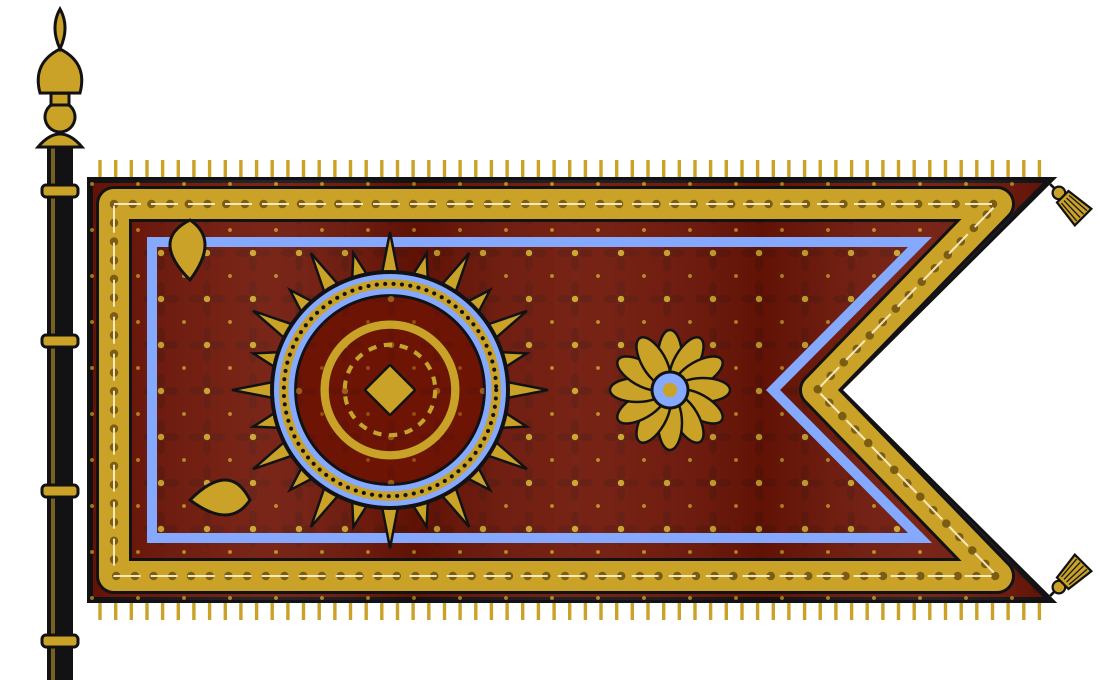
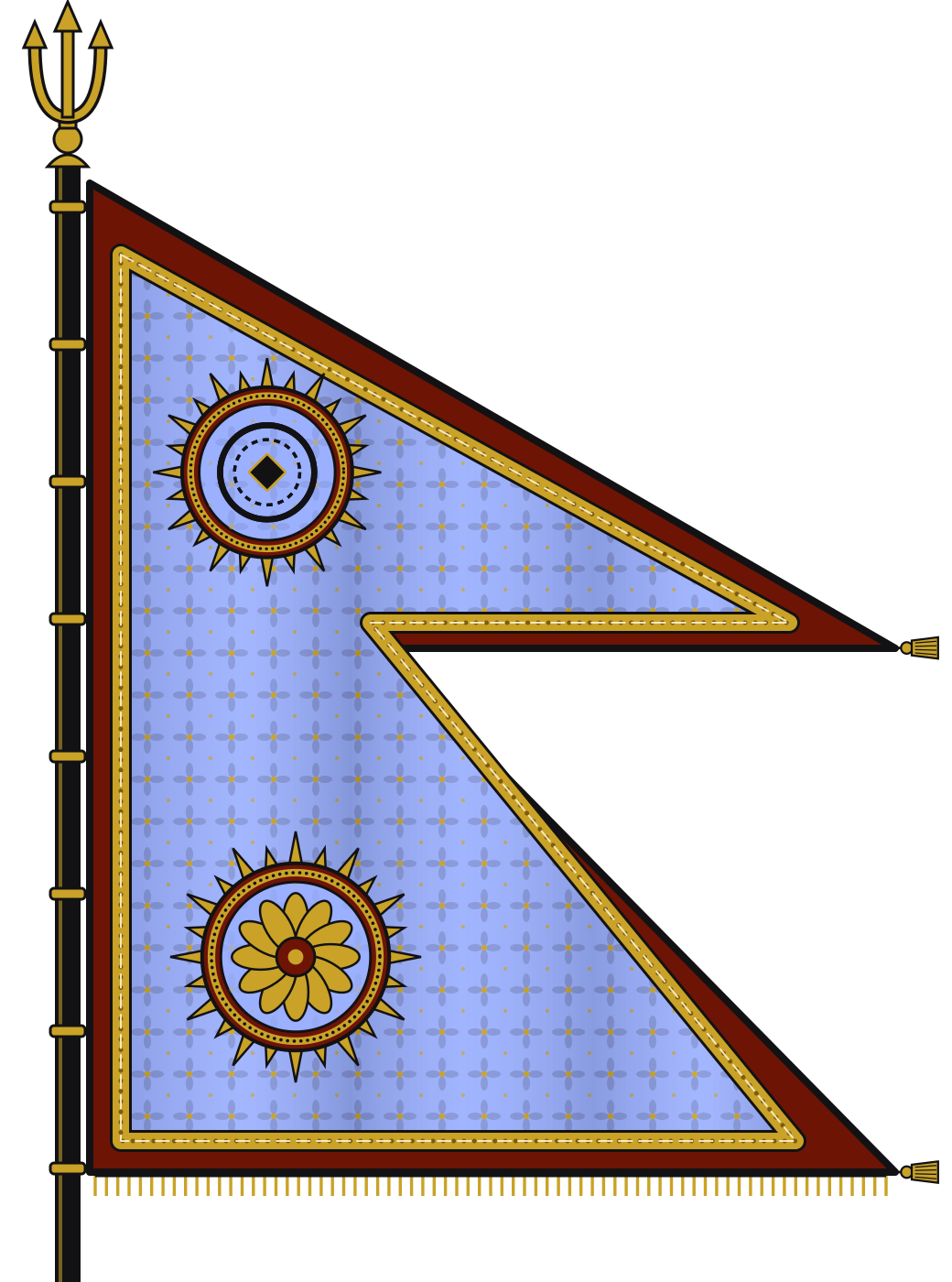
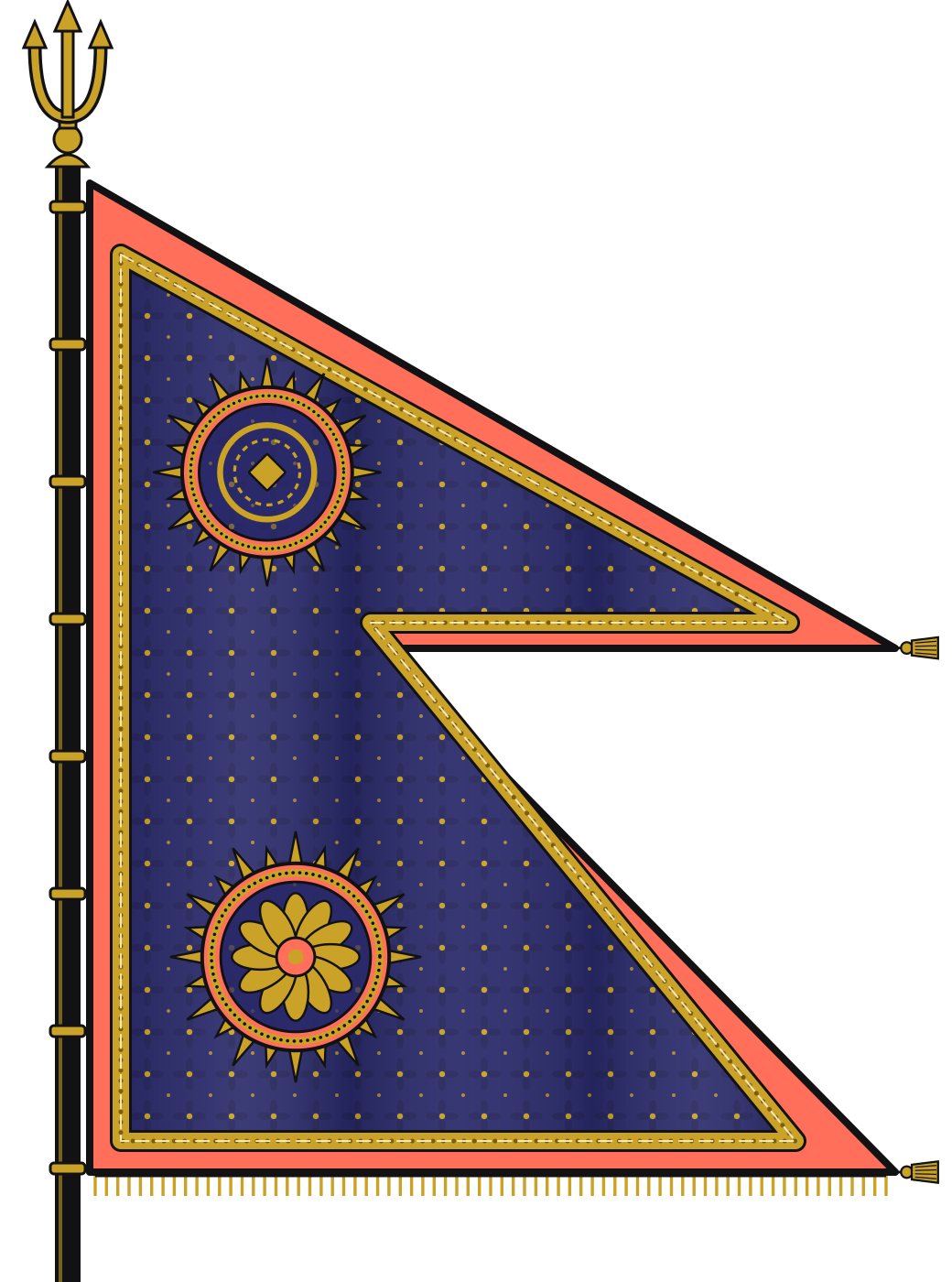

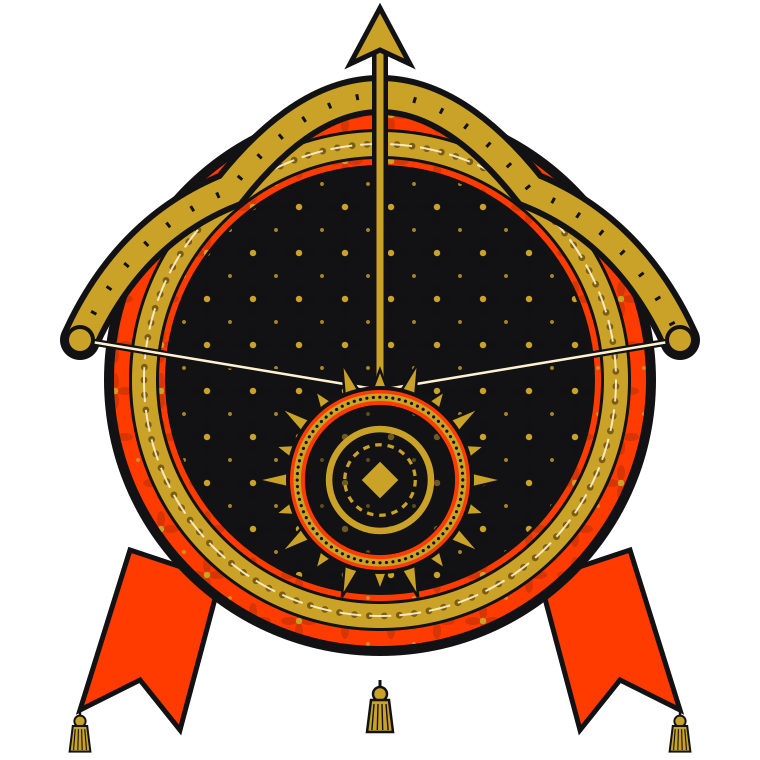
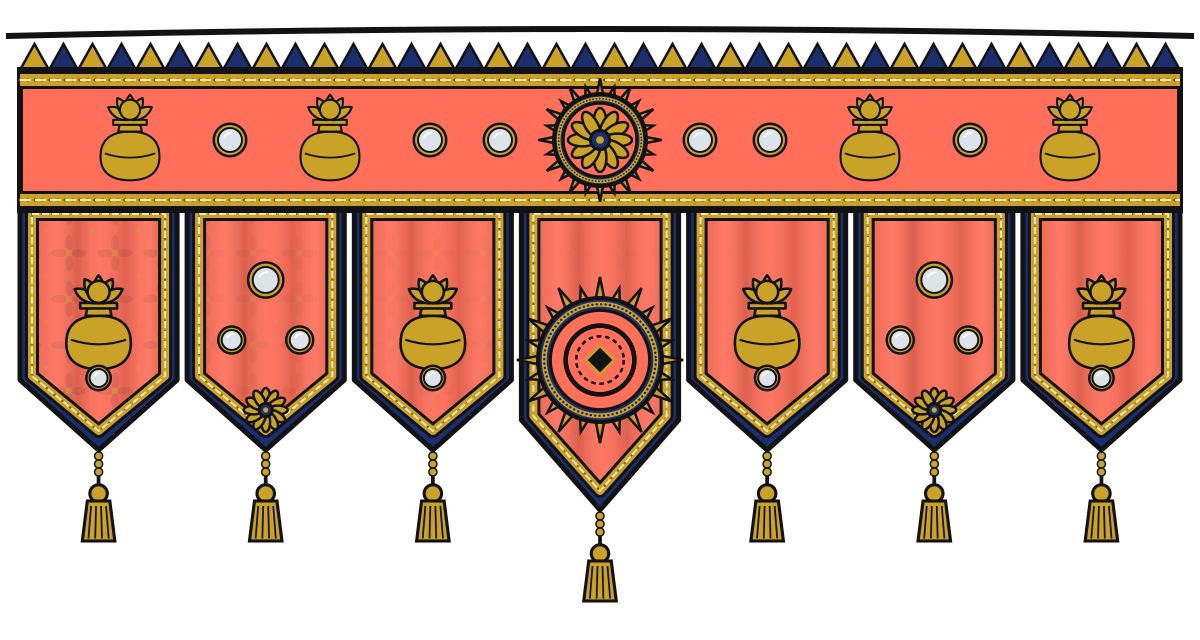
Historic banner
None known
New flag types
| Accessory | For this clan | Basis |
|---|---|---|
| A9 Pota-dhvaja · ship and trade flag For ships, caravans and markets | Not yet designed for this clan | Design |
| A10 Utsava-patāka · festival flag Light, bright flag for fairs and festivals | Not yet designed for this clan | Design |
| A11 Shoka-dhvaja · mourning flag White cloth with the emblem outline in the clan's metal | Not yet designed for this clan | Design |
7. Regalia
| Accessory | For this clan | Basis |
|---|---|---|
| E1 Chhatra · house parasol The ceremonial umbrella | Not yet designed for this clan | Design |
| E2 Chamara · fly-whisks The pair of whisks beside the head of the house | Not yet designed for this clan | Design |
| E3 Danda · staff of office Staff or scepter | Not yet designed for this clan | Design |
| E4 Simhasana · seat The seat of the house, covered in clan cloth | Not yet designed for this clan | Design |
| E5 Khetaka · shield A round shield; the Changi and Dhanush are its flag forms | Not yet designed for this clan | Regional tradition |
| E6 Kula-ayudha · clan weapon The weapon the clan honours | Not yet found for this clan | Under research |
8. Worn
| Accessory | For this clan | Basis |
|---|---|---|
| F1 Kula-vastra · clan cloth The clan's woven pattern in its kit colours | Not yet designed for this clan | Design |
| F2 Kirti-vastra · honour cloth A cloth earned for a deed, not inherited | Not yet designed for this clan | Design |
| F3 Kula-mala · garland flower The flower or leaf the clan wears as a garland | Not yet found for this clan | Under research |
| F4 Chinha · house pin A metal badge with the pin emblem | Not yet designed for this clan | Design |
9. Records
| Accessory | For this clan | Basis |
|---|---|---|
| H1 Clan words A traditional line in the native script | · “Under research” No clan line is recorded in the extracts. Leads: Elwin, The Agaria (1942), as reported in the 1943 review[4] | Documented |
| H2 Biruda · titles The house's title or titles | Not yet found for this clan | Under research |
| H3 Prashasti · praise genealogy The lineage as written at the head of a grant | Not yet found for this clan | Under research |
| H4 Vahi · clan register The book of the clan's births, marriages and deaths | Not yet found for this clan | Under research |
| H5 Rana-ghosha · war cry The clan's cry in battle or celebration | Not yet found for this clan | Under research |
10. VishwaVit · knower of the world
Game values are design choices for this project, not historical claims.
References
- Jay DiMaggio, Agaria, Encyclopedia of World Cultures (Gale, 2008), read 2026-11-08, https://www.everyculture.com/South-Asia/Agaria.html
- Jay DiMaggio, Agaria, Encyclopedia of World Cultures via Encyclopedia.com (same text as Everyculture), read 2026-11-08, https://www.encyclopedia.com/humanities/encyclopedias-almanacs-transcripts-and-maps/agaria
- R. V. Russell and Hira Lal, The Tribes and Castes of the Central Provinces of India, vol. 2 (London, 1916), Project Gutenberg eBook #22010, https://www.gutenberg.org/ebooks/22010
- Review of Verrier Elwin, The Agaria (Oxford University Press, Indian Branch), Triveni Journal, March 1943 section, read 2026-11-08, https://www.wisdomlib.org/history/compilation/triveni-journal/d/doc68165.html
- Wikipedia, Tribals in Madhya Pradesh (2011 census table), read 2026-10-19, https://en.wikipedia.org/wiki/Tribals_in_Madhya_Pradesh
- Wikipedia, List of Scheduled Tribes in Uttar Pradesh (Census 2011 populations), read 2026-10-22, https://en.wikipedia.org/wiki/List_of_Scheduled_Tribes_in_Uttar_Pradesh
- Amarendra Kishore, "Tribal Identity and Callous Bureaucracy", Mainstream Weekly, Vol. LII No. 33, 9 August 2014, read 2026-11-08, https://mainstreamweekly.net/article5119.html
- DTE Staff, "A dying craft", Down To Earth, 30 June 1997, read 2026-10-26, https://www.downtoearth.org.in/environment/a-dying-craft-23952
- Vandna Tete, "असुरों की चमत्कारी धातु लोहा" (Sahapedia, 2019 fellowship interviews; credits K. K. Leuba, The Asur (1963) and P. C. Oraon, Bihar ke Asur (1994)), CC-BY-NC-SA 4.0, read 2026-10-20, https://www.sahapedia.org/asauraon-kai-camatakaarai-dhaatau-laohaa